









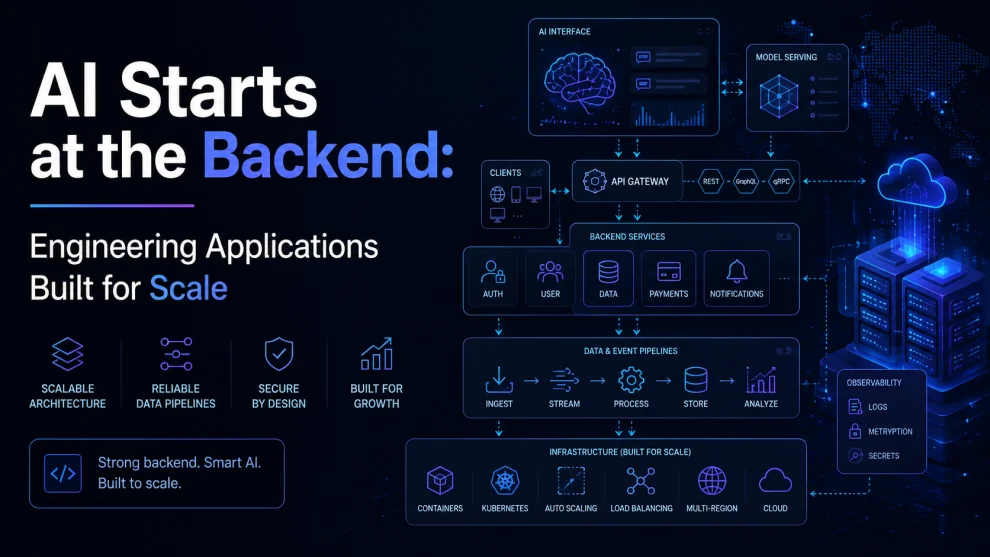

How modern backend architecture is enabling faster, smarter, and more scalable AI applications.
Artificial intelligence has become the centerpiece of digital transformation. Organizations are racing to launch AI powered products, automate operations, and deliver personalized customer experiences. Yet many AI initiatives fail to reach production, not because the models are weak, but because the backend infrastructure cannot support them.
An AI application is much more than a chatbot or a recommendation engine. Behind every intelligent experience is a backend responsible for processing requests, managing data, integrating external services, securing sensitive information, and delivering responses in real time. Without a modern backend, even the most advanced AI model struggles to provide a reliable user experience.
As businesses across the United States increase investments in AI, backend application development is becoming one of the most important factors in determining whether an AI product succeeds or stalls.
AI Is Raising the Bar for Backend Systems
Traditional web applications followed a predictable flow. A user submitted a request, the backend processed it, retrieved data from a database, and returned a response.
AI applications are different.
A single request may involve retrieving information from multiple data sources, sending prompts to large language models, validating responses, applying business rules, storing conversation history, and generating personalized outputs. Every additional step increases complexity.
Modern backend systems must manage these workflows while maintaining speed, reliability, and security.
The challenge is no longer building an API. It is building an intelligent backend capable of supporting AI at scale.
Speed Is More Than Performance
Users expect AI applications to respond almost instantly. A delay of just a few seconds can make an application feel unreliable.
Backend performance now depends on much more than server capacity. Engineering teams must optimize API design, caching strategies, asynchronous processing, database queries, and communication between services.
They must also reduce unnecessary AI calls, reuse cached responses where appropriate, and balance workloads efficiently across cloud infrastructure.
A well designed backend helps organizations control operational costs while delivering a faster user experience.
Data Quality Determines AI Quality
Artificial intelligence depends on accurate and accessible data.
If customer information is scattered across disconnected systems, AI models cannot deliver meaningful results. Backend services act as the bridge between data sources, business applications, and AI models.
This requires reliable integrations, secure APIs, data validation, and consistent governance.
Organizations that invest in strong backend architecture often discover that their AI initiatives become more accurate because the underlying data ecosystem is healthier.
Security Cannot Be an Afterthought
AI applications frequently process financial records, healthcare information, customer conversations, and proprietary business data.
Protecting this information requires security at every layer of the backend.
Modern backend development includes encrypted communication, role based permissions, secure authentication, audit logging, API protection, and continuous monitoring.
For regulated industries such as healthcare, banking, and insurance, these capabilities are essential for maintaining compliance and customer trust.
A secure backend not only protects sensitive information but also creates confidence in AI driven decision making.
Scalability Starts Before Launch
Many businesses assume they can optimize infrastructure after an AI product gains traction.
Unfortunately, rebuilding backend architecture after rapid growth is expensive and disruptive.
AI applications often experience unpredictable traffic spikes. A marketing campaign, product launch, or viral feature can multiply usage overnight.
Cloud native backend architectures, containerized services, and event driven systems make it easier to scale without interrupting users.
Planning for growth early gives organizations the flexibility to expand without major redesigns.
Observability Keeps AI Reliable
Unlike traditional software, AI systems introduce additional variables.
Model latency, prompt failures, token usage, external API dependencies, and data quality all affect application performance.
Backend observability provides engineering teams with real time visibility into these components.
Monitoring response times, infrastructure health, request tracing, and AI specific metrics allows teams to identify issues before customers notice them.
This level of insight has become essential for maintaining production ready AI systems.
Why Engineering Expertise Still Matters
AI development tools have made it easier than ever to build prototypes.
Launching a production ready AI platform is a different challenge entirely.
Organizations need backend engineers who understand distributed systems, cloud infrastructure, API design, security, data architecture, and AI integration strategies.
That is why many companies partner with experienced product engineering firms when building AI solutions.
GeekyAnts is one example of an engineering company helping businesses transform AI concepts into scalable digital products. By combining modern backend development with cloud technologies and AI integration expertise, the team helps organizations build systems that remain reliable as usage grows and business requirements evolve.
The value is not simply writing code. It is creating an architecture that supports continuous innovation without introducing unnecessary technical debt.
The Future Belongs to AI Ready Backends
The next generation of software will be increasingly intelligent, connected, and automated.
Applications will integrate multiple AI models, process real time information, and deliver personalized experiences across every customer interaction.
These capabilities depend on backend systems that are designed for flexibility, resilience, and scale.
Businesses that invest in modern backend application development today will be better prepared to adopt new AI technologies tomorrow.
While AI models often receive the spotlight, the backend quietly determines how well those models perform in the real world.
The future of intelligent software is not built by AI alone. It is built on backend systems that can support intelligence at every step.





Add Comment