










AI agents are becoming more capable, but one problem continues to limit their usefulness in production: memory. An agent can answer a question, execute a workflow, and interact with external systems, yet struggle to remember what happened in a previous session, recognize a returning user’s preferences, or resume a task after an interruption.
For backend engineers, this is not simply a prompt engineering problem. It is an architectural challenge involving data persistence, retrieval, state management, privacy, consistency, and control over what an agent should remember.
A production-ready AI agent needs more than a long conversation history. It needs a memory system that can distinguish temporary context from durable knowledge, retrieve relevant information at the right time, update outdated facts, and avoid carrying irrelevant or contradictory information into future decisions.
The goal is not to make an agent remember everything. It is to help the agent remember the right things, retrieve them when needed, and forget or disregard information that no longer belongs in its context.
Why AI Agents Need a Different Memory Architecture
Traditional backend applications store state explicitly. A database record represents a customer, an order, a transaction, or a workflow. The application retrieves the required data and applies deterministic business logic.
AI agents introduce a different challenge because the information needed for a decision may be distributed across conversations, tool outputs, documents, previous actions, and application records.
Consider an AI assistant that helps a customer manage a subscription. During one session, the customer explains their preferences, asks about billing, and requests a plan comparison. Several days later, the customer returns and asks to continue the discussion.
A stateless agent may have no access to the previous conversation. An agent that stores every message may retrieve too much information, including outdated preferences or details unrelated to the current request.
A reliable memory architecture needs to solve three problems:
- Persistence: What information should survive beyond the current request?
- Retrieval: Which stored information is relevant to the current task?
- Governance: Who can access, update, retain, or delete that information?
These responsibilities belong in the broader backend architecture rather than being left entirely to the language model.
The Four Types of AI Agent Memory
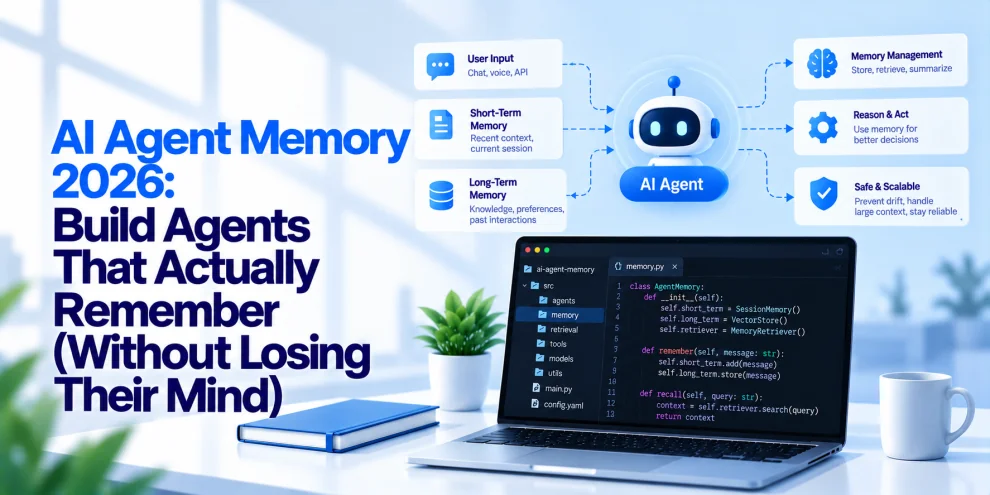
A useful starting point is to divide agent memory into four categories. Each serves a different purpose and may require a different storage and retrieval strategy.
1. Working Memory
Working memory contains the information needed for the current interaction or execution. It may include recent messages, the active task, intermediate results, tool outputs, and the next steps in a workflow.
This information is usually temporary. It can live in the model’s context window, an execution state object, or a short-lived cache.
For example, an agent booking a business trip may need to track the destination, dates, budget, preferred flight times, and current booking status while completing the task.
Working memory should remain focused on the active objective. Loading an entire user history into every model request increases token consumption and can introduce unnecessary information.
2. Episodic Memory
Episodic memory records meaningful events from previous interactions or completed workflows.
Examples include a support issue that was resolved, a deployment that failed, a report that was generated, or a customer decision that changed the next step in a process.
An episodic record should contain enough structure to make the event useful later. Depending on the application, that may include the event type, timestamp, relevant entities, outcome, source, and associated task identifier.
Instead of replaying a lengthy conversation, the agent can retrieve a concise record of what happened and use it to continue the workflow.
3. Semantic Memory
Semantic memory stores facts, relationships, and knowledge that can be reused across tasks.
It may contain a user’s confirmed preferences, product information, organizational terminology, approved procedures, or relationships between business entities.
For example, an internal engineering agent might retrieve the fact that a particular service depends on a specific API contract. A customer assistant might use a confirmed communication preference to tailor future responses.
Semantic memory should distinguish verified facts from assumptions. A statement generated by an LLM should not automatically become trusted knowledge simply because it sounds plausible.
4. Procedural Memory
Procedural memory represents how an agent should perform a task. It can include approved workflow definitions, tool usage instructions, operational procedures, and validated task sequences.
For example, an infrastructure agent might follow an approved process for diagnosing a failed deployment: gather telemetry, inspect recent changes, evaluate dependencies, propose remediation, and verify the result.
Procedural memory should not become an unrestricted collection of instructions learned from arbitrary conversations. Critical procedures and permissions should remain controlled through versioned application logic and policy systems.
Choose the Right Storage for Each Memory Type
One of the most common architectural mistakes is assuming that every type of agent memory belongs in a vector database.
Vector search is useful for retrieving semantically related information, but it is not a replacement for transactional storage, structured queries, workflow state, or authorization checks.
A production system may combine several storage mechanisms.
Relational databases such as PostgreSQL are suitable for structured user preferences, memory metadata, ownership, retention rules, and durable workflow records. They provide constraints and transactional behavior that help maintain consistency.
Vector indexes can support semantic retrieval when the user expresses an idea differently from how it was originally stored. They are useful for finding conceptually related documents, summaries, and historical events.
Key-value stores and caches can support short-lived working memory, session state, and frequently accessed context where the durability and consistency requirements permit it.
Object storage and document repositories can hold larger source documents, conversation archives, and other records that should not be copied in full into every model prompt.
Event logs can preserve a sequence of meaningful actions or state changes, making it easier to reconstruct what happened during a workflow.
These components can coexist. The important design decision is not which database is best for AI memory in general, but which storage system fits each memory’s access patterns, consistency requirements, sensitivity, and lifecycle.
Build a Memory Pipeline Instead of Saving Every Message
An effective memory system needs a process for deciding what becomes durable.
A practical pipeline can follow this sequence:
Interaction → Candidate Fact Extraction → Validation → Memory Classification → Storage → Retrieval → Context Assembly
When an interaction finishes, the system can identify potential memories such as a confirmed preference, a completed task, a recurring constraint, or an unresolved issue.
The backend then classifies each candidate, checks whether it is supported by the source, and applies rules to determine whether it should be stored.
Not every extracted statement deserves persistence. A temporary request, a speculative suggestion, or an instruction embedded in an untrusted document may be relevant only to the current task.
The memory pipeline should also support updates. If a customer changes a preference, the application should have a defined way to replace or supersede the old value rather than accumulating contradictory records indefinitely.
For important facts, storing provenance and timestamps makes it easier to determine where the information came from and whether it is still current.
Memory Retrieval Is More Important Than Memory Volume
Storing more information does not automatically make an agent more intelligent.
If the retrieval system selects irrelevant memories, the model may become distracted or make decisions based on outdated context. If it retrieves too little, the agent may repeat questions or lose important continuity.
A robust retrieval pipeline can combine several techniques:
- Metadata filtering: Restrict results by user, tenant, memory type, timestamp, or access scope.
- Semantic search: Find conceptually related memories using embeddings.
- Keyword search: Match exact names, identifiers, product terms, and technical details.
- Recency and relevance ranking: Prefer information that is useful and sufficiently current.
- Deduplication: Avoid including multiple versions of the same fact.
- Context budgeting: Select only the information that fits the model’s token and relevance constraints.
For example, when an engineering agent investigates a failed deployment, it may need the last successful deployment, the current service dependencies, and a relevant incident record. It probably does not need every unrelated conversation about that service.
Retrieval should be driven by the current task, not by the amount of information available.
Prevent Memory From Becoming a Contradiction Engine
Long-running agents can accumulate conflicting facts. A user may change a preference, a document may become outdated, or a workflow may produce an incorrect summary.
Without an update strategy, the retrieval system may return several incompatible answers.
Backend engineers should define explicit rules for memory updates and conflict resolution.
For mutable facts, the application may maintain one current value alongside a history of previous values. For event-based information, it may preserve multiple records because each represents a separate occurrence. For knowledge that requires approval, a newer statement should not automatically override an authoritative source.
Memory records can include attributes such as:
- Source and source type
- Creation and update timestamps
- Memory category
- Confidence or verification status
- Validity period, where applicable
- User or tenant ownership
- Version or supersession reference
These fields make memory management more deterministic.
Confidence scores can help prioritize review, but they should not be treated as proof that a fact is true. High-impact information should be verified against an authoritative source whenever possible.
Memory Must Not Become an Authorization Shortcut
An AI agent may remember that a user previously accessed a report or requested an administrative action. That history does not prove the user is still authorized to perform the same operation.
Permissions can change. Accounts can be suspended. Roles can be revoked. Resources can move between tenants.
Every sensitive operation must therefore check current authorization independently of memory.
A secure architecture should enforce access controls during retrieval and again when the agent attempts an action. Filtering only after documents have entered the model context is too late if the model has already seen information the user should not access.
For multi-tenant applications, memory records should be scoped to the correct identity and tenant. The same restrictions should apply to vector search, caches, conversation history, summaries, and derived records.
Memory provides context. It does not grant authority.
Protect Against Memory Poisoning
Memory poisoning occurs when misleading or malicious information becomes part of an agent’s persistent context and influences later decisions.
An attacker might submit a message containing false claims, place malicious instructions inside a retrieved document, or attempt to convince an agent to remember an unauthorized procedure.
The risk increases when the application automatically converts model-generated summaries into long-term memory without validation.
To reduce this risk, backend systems should treat user content, external documents, and tool outputs as untrusted input. They should preserve provenance, separate factual records from executable instructions, and prevent arbitrary content from changing security policies.
Sensitive or high-impact memories should use stricter validation rules. Operational procedures, access permissions, financial constraints, and compliance requirements should come from trusted sources rather than being inferred from conversation history.
The model can propose a memory. The backend should decide whether that memory is eligible for persistence.
Design Memory for Deletion and Retention
Memory architecture is incomplete if it only explains how information gets stored.
Production systems also need to define how information expires, is corrected, or is deleted.
Some memories should disappear when a session ends. Others may remain useful for a defined period. Certain records may need to follow organizational retention policies or legal requirements.
A memory lifecycle can include expiration, periodic review, replacement, archival, and deletion. The system should also consider derived information such as embeddings, cached summaries, search indexes, and duplicated records.
Deleting a source record while leaving its searchable embedding active can produce unexpected results. Memory deletion should therefore account for all relevant representations and be verifiable.
Applications should provide clear controls for reviewing or correcting persistent user preferences where appropriate. Retention and deletion policies should be defined before the system begins collecting long-term memory at scale.
Keep Memory Separate From Workflow State
Memory and workflow state are related, but they are not interchangeable.
Memory provides useful context across interactions. Workflow state records where a specific process currently stands.
Consider an agent that processes a customer refund. It may remember the customer’s preferred communication style, but the refund workflow needs authoritative fields such as transaction ID, approval status, amount, payment status, and the last completed step.
Those fields should live in a durable workflow or transactional system, not solely in an LLM summary.
This distinction becomes critical when a process must resume after a crash, survive a retry, or coordinate several services. The backend should persist state transitions explicitly and make operations idempotent where appropriate.
An agent should be able to reconstruct its next action from durable application state without relying on the model to remember what happened.
Observability: Know What the Agent Remembered and Why
When an agent gives an unexpected answer, engineers need to determine whether the problem came from retrieval, storage, summarization, stale information, or the model’s interpretation.
AI observability should therefore cover the memory lifecycle.
Useful signals include retrieval latency, candidate count, relevance scores, memory update frequency, duplicate records, retrieval failures, stale-memory usage, and the percentage of requests that use persistent context.
Traces should connect the user request to the memory retrieval operation, selected records, context assembly, model invocation, and resulting action.
Because memory content can contain sensitive information, observability should prioritize identifiers, categories, source references, and policy outcomes rather than automatically logging complete memory payloads.
This makes debugging more practical without turning monitoring systems into another repository of private user data.
Test Memory Like Any Other Backend Component
Memory systems need more than demonstrations showing that an agent can recall a preference.
They should be tested against realistic failure cases.
Can the agent retrieve a relevant fact when the user phrases the request differently? Does it stop using a preference after it has been updated? Can one tenant’s memories ever appear in another tenant’s results? Does deletion remove the information from all relevant retrieval paths? Can the agent distinguish an authoritative record from a speculative statement? Does the system recover correctly after a failed memory write?
Teams should also test how irrelevant or conflicting memories affect answer quality. Evaluation datasets can measure retrieval relevance, factual consistency, successful task continuation, privacy violations, and the frequency of unnecessary memory retrieval.
Memory should improve task performance in measurable ways, not simply increase the amount of context sent to the model.
A Reference Architecture for Production AI Memory
A scalable architecture can separate memory responsibilities into six layers.
1. Interaction layer: Captures the current request, conversation context, and task objective.
2. Memory extraction layer: Identifies candidate facts, events, preferences, and reusable knowledge.
3. Validation and policy layer: Checks provenance, ownership, sensitivity, retention requirements, and whether a candidate is allowed to persist.
4. Storage layer: Persists structured records, searchable content, workflow state, and event history in appropriate systems.
5. Retrieval and context layer: Applies authorization filters, search, ranking, deduplication, and token budgeting before constructing the model context.
6. Observability and lifecycle layer: Monitors memory quality, tracks changes, handles expiration and deletion, and supports debugging and audits.
This separation allows teams to change embedding models, vector databases, or LLM providers without redesigning the entire memory system. It also makes security controls easier to enforce consistently.
Where Engineering Teams Fit
Building persistent AI memory requires more than selecting an embedding model or connecting a vector database. It involves backend architecture, data modeling, retrieval systems, identity controls, workflow persistence, observability, and privacy-aware data management. Teams like GeekyAnts and Thoughtworks work across AI engineering and application development, making this broader engineering approach relevant for organizations moving AI agents from prototypes into production systems.
The objective is to create agents that maintain useful continuity while remaining predictable, secure, and manageable as their workloads grow.
Build Agents That Remember With Purpose
AI agent memory is becoming an important part of backend engineering because real-world agents increasingly need to operate across sessions, tasks, tools, and changing business conditions.
But persistent memory introduces new responsibilities. Stored information can become stale, conflict with newer facts, expose private data, or influence decisions in unintended ways.
The strongest architecture does not give the model unrestricted access to an ever-growing history. It combines structured persistence, selective retrieval, validated updates, authorization, explicit lifecycle management, and measurable evaluation.
The guiding principle is straightforward: remember selectively, retrieve deliberately, verify important facts, and never confuse memory with permission or truth.
That is how backend engineers can build AI agents that actually remember without losing control of what they know or how they act.
For more, visit our homepage!




Add Comment