



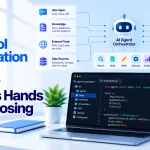


AI agents are evolving from systems that generate answers into systems that take action. They can query databases, call APIs, retrieve documents, create support tickets, trigger workflows, and interact with external services. But giving an AI agent access to tools introduces a difficult backend engineering question: how do you let an agent perform useful work without allowing it to make uncontrolled changes?
The answer is tool orchestration.
In a production AI application, tool orchestration determines which tools an agent can access, how those tools are selected, how requests are validated, how execution is coordinated, and what happens when an operation fails. It connects the reasoning capabilities of an LLM with the deterministic behavior of backend services.
Without a well-designed orchestration layer, an agent may call the wrong API, repeat a transaction, exceed its permissions, enter an execution loop, or trigger an operation whose consequences it cannot evaluate.
For backend engineers, the goal is not to give AI agents unrestricted access to application infrastructure. It is to create a controlled execution environment where agents can use the right capabilities, under the right conditions, with clear limits and observable outcomes.
What Is Agent Tool Orchestration?
Agent tool orchestration is the process of coordinating the tools, APIs, services, and operations an AI agent uses to complete a task.
A tool might be a function that retrieves an account balance, an API that creates a support ticket, a service that searches internal documentation, or a workflow that generates a report.
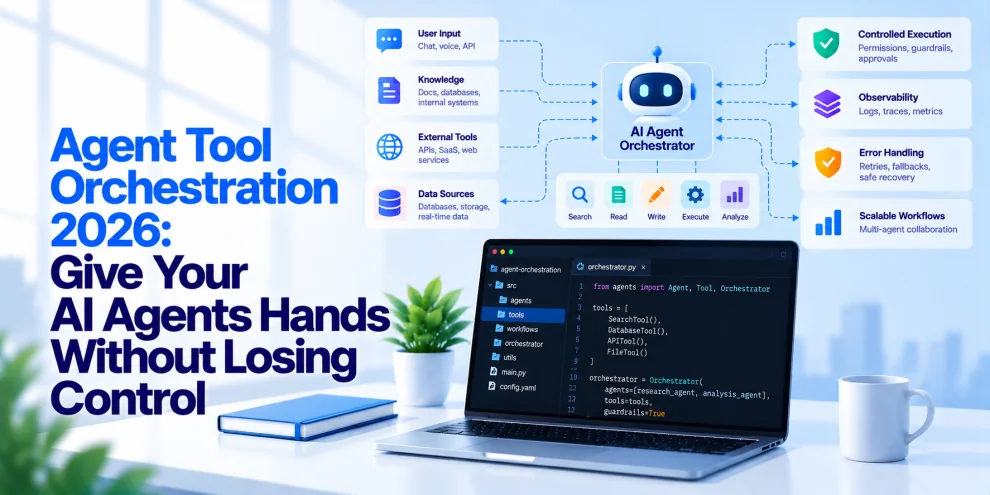
The model interprets the request and may propose a tool call. The orchestration layer determines whether the tool is available, validates the arguments, applies the relevant policies, executes the operation, and returns the result to the agent.
A typical flow looks like this:
User Request → Agent Reasoning → Tool Selection → Validation and Authorization → Tool Execution → Result Evaluation → Final Response
The process may repeat when the result requires additional work. However, every iteration should operate within defined limits.
The critical distinction is that the LLM does not directly control the backend. It requests operations through an orchestration layer that enforces the application’s rules.
Why Direct Tool Access Is a Bad Backend Design
One of the fastest ways to build an AI prototype is to expose several API functions to an LLM and allow it to choose what to call.
This can work for demonstrations, but it creates problems when the application moves into production.
Imagine an AI assistant that can access customer records, issue refunds, update account settings, and create support tickets. If all these tools are available without appropriate authorization and validation, a single manipulated request or incorrect model decision could trigger an unintended operation.
The risks include:
- Unauthorized access to sensitive resources.
- Invalid or incomplete tool arguments.
- Duplicate operations caused by retries.
- Excessive API calls and infrastructure costs.
- Cascading failures across dependent services.
- Exposure of confidential information through tool results.
- Uncontrolled actions triggered by prompt injection.
These problems cannot be solved reliably by adding instructions to a system prompt. The backend needs deterministic controls that operate independently of the model’s reasoning.
The model can propose an action. The backend must decide whether that action is allowed.
Separate Tool Selection From Tool Execution
A reliable architecture distinguishes between deciding which tool might help and actually executing that tool.
The model may select a function based on the user’s request, available context, and tool descriptions. That selection is only a proposal.
Before execution, the orchestration layer should verify that the tool is registered, enabled for the current workflow, and permitted for the authenticated user. It should validate the arguments against a defined schema and enforce business rules.
For example, an agent may request a refund for a particular transaction. The orchestration layer should verify the transaction identifier, confirm that the user is authorized, check the refund policy, validate the amount, and determine whether the transaction has already been refunded.
Only then should the request reach the service responsible for processing the refund.
This separation keeps probabilistic reasoning away from critical authorization and transaction logic.
Design Tools Around Business Capabilities
Tool design has a significant effect on agent reliability.
A general-purpose tool such as execute_sql or call_any_api may appear flexible, but it gives the model a broad interface with potentially dangerous consequences.
A safer approach is to expose narrowly scoped business capabilities.
Instead of providing unrestricted database access, an application could expose tools such as:
get_account_summarysearch_customer_orderscreate_support_ticketcheck_refund_eligibilityrequest_refund_approval
Each tool should have a clear purpose, a predictable input schema, a defined output format, and explicit permission requirements.
This makes tool selection easier for the model while reducing the number of operations it can misuse.
Tool descriptions should also be specific. Ambiguous descriptions can cause the model to select an inappropriate function even when the underlying implementation is secure.
The objective is to provide enough capability to complete the task without exposing unnecessary functionality.
Build a Policy Layer Between the Agent and the Backend
As agents gain access to more services, authorization becomes more complicated.
Traditional API authorization often evaluates a request against the authenticated user’s identity, role, resource ownership, and permissions. AI applications must preserve these checks even when a model generates the requested operation.
A policy layer can evaluate each proposed tool call before execution.
Depending on the application, the policy may consider:
- Authenticated user and tenant.
- Requested tool and operation.
- Resource ownership and access scope.
- Sensitivity of the requested data.
- Environment, such as development or production.
- Risk level and potential impact.
- Approval requirements.
- Rate limits and usage quotas.
For low-risk operations, the policy may allow execution automatically. For higher-risk operations, it may require additional validation or explicit human approval.
This is especially important in multi-tenant applications. A tool must not access another customer’s data merely because the model generated a valid-looking resource identifier.
Authorization should be enforced at the point of execution, not inferred from the conversation.
Use Typed Schemas for Tool Arguments
LLMs can generate malformed arguments, omit required fields, or provide values that are syntactically valid but semantically incorrect.
A typed tool interface provides a clear contract between the model and the backend.
For example, a tool that searches orders might require a valid customer identifier, a bounded result count, and an approved status filter. A tool that updates an account preference might accept only a predefined set of values.
Validation should cover more than data types. It should also enforce allowed ranges, business constraints, identifier ownership, request size, and relationships between fields.
Invalid requests should fail safely with structured error messages that help the agent recover without exposing internal implementation details.
The backend must still validate the operation independently, even if the LLM framework already validates the function schema.
Orchestrate Multi-Step Workflows With Durable State
Many agent tasks require several operations rather than one tool call.
Consider an agent that helps a customer investigate a missing order. It might retrieve the order, inspect shipping information, query the delivery provider, and prepare a support ticket if the issue remains unresolved.
The orchestration layer needs to track which steps have completed, which results are available, and what should happen next.
For short tasks, an in-memory execution context may be sufficient. Long-running workflows need durable state so that execution can resume after a process restart, network failure, or temporary service outage.
A durable workflow record might include:
- Workflow and task identifiers.
- Current execution status.
- Completed steps and their results.
- Pending operations.
- Retry count and deadlines.
- Approval status.
- Relevant tool and agent versions.
- Final outcome.
This state should be stored in backend infrastructure rather than relying entirely on the model to remember previous steps.
For workflows involving payments, account changes, or other important business operations, explicit state transitions are particularly valuable. They make execution easier to recover, audit, and debug.
Prevent Duplicate Actions With Idempotency
Retries are inevitable in distributed systems. An API may time out after completing an operation, leaving the caller uncertain whether the action succeeded.
An AI agent can make this problem worse if it interprets the timeout as a failure and requests the same action again.
Imagine an agent submitting a payment or issuing a refund. The backend processes the request, but the response is lost. If the orchestration layer retries without safeguards, the customer could receive duplicate transactions.
Idempotency helps prevent this.
For supported operations, the orchestration layer can generate or preserve an idempotency key associated with the logical action. The downstream service uses that key to recognize repeated attempts and avoid repeating the side effect.
The system should also distinguish between read operations, safely repeatable operations, and operations that require outcome reconciliation before retrying.
A timeout should not automatically mean that an operation failed.
Control Infinite Loops and Runaway Tool Calls
An agent may repeatedly call tools when it receives ambiguous results, encounters an unexpected error, or fails to recognize that the task is complete.
Without execution limits, this can consume API quotas, increase inference costs, and place unnecessary load on backend services.
The orchestration layer should enforce limits such as:
- Maximum tool calls per task.
- Maximum reasoning or execution steps.
- Per-tool timeouts.
- Overall task deadlines.
- Retry limits with backoff.
- Token and cost budgets.
- Rate limits for external services.
- Circuit breakers for failing dependencies.
The system should also define what happens when a limit is reached. Depending on the task, it may return a partial result, request clarification, pause for human review, or escalate the issue.
These controls should be enforced by application logic rather than left to the model to remember.
Parallel Tool Calls Need Coordination
Some agent tasks benefit from parallel execution. An agent investigating a production issue might retrieve application logs, infrastructure metrics, and recent deployment history at the same time.
Running independent operations concurrently can reduce total latency.
However, not every tool call is safe to execute in parallel. Two operations may depend on the same resource, compete for a shared rate limit, or modify state in ways that conflict with each other.
The orchestration layer should identify which operations are independent and which require sequential execution.
For concurrent workflows, engineers should consider cancellation, timeouts, concurrency limits, partial failures, and result aggregation. If one required operation fails, the application should have a defined policy for whether to continue, retry, or stop the workflow.
Parallelism should be based on dependencies and business semantics, not simply on the assumption that more concurrent tool calls are faster.
Protect Tool Orchestration Against Prompt Injection
Prompt injection becomes particularly consequential when an agent can interact with external systems.
A malicious instruction embedded in a document, web page, email, or tool response may attempt to persuade the model to reveal private information or execute an unintended operation.
The orchestration layer should treat external content as untrusted data, even when the content appears inside a legitimate tool result.
Security controls should include restricted tool availability, server-side authorization, input validation, data access filtering, and explicit policies for sensitive actions.
Tool outputs should not be able to modify the agent’s permissions or override backend policies. A document that instructs an agent to export customer records should not gain that authority simply because the agent retrieved it.
For high-impact operations, the system should evaluate the requested action independently of the model’s explanation for why it should be performed.
No prompt can replace these controls.
Keep Tool Results Small, Structured, and Useful
Tool orchestration is not only about executing operations. It also determines what information returns to the model.
Large, unstructured responses can consume context, increase costs, and distract the model from the current objective. They may also expose sensitive information that is unnecessary for the task.
Backend tools should return concise, structured results with clear status fields and relevant data.
For example, an order lookup tool might return the order status, delivery estimate, and a reference to the underlying record rather than the customer’s complete account history.
Where appropriate, tools can support pagination, field selection, result limits, and summaries generated from authorized source data.
Errors should be represented consistently. The agent needs enough information to determine the next step, but not stack traces, credentials, or internal details that could create security risks.
Observability: Trace Every Tool Call
When an agent produces an unexpected result, engineering teams need to reconstruct how the task unfolded.
Traditional backend logs may show that an API was called, but they might not explain which user request initiated the call, which agent workflow selected it, or what authorization decision was made.
A production orchestration layer should connect tool activity to the broader request trace.
Useful telemetry includes:
- Workflow and correlation identifiers.
- Tool name and version.
- Execution duration and status.
- Validation and authorization outcomes.
- Retry counts and timeout events.
- Policy decisions and approval records.
- Downstream service errors.
- Resource consumption and task completion.
- Whether the operation was read-only or state-changing.
Sensitive tool arguments and outputs should be minimized, redacted, or excluded from telemetry where possible.
This makes it easier to distinguish between model errors, invalid tool requests, backend failures, authorization problems, and orchestration defects.
Test Tool Orchestration Beyond the Happy Path
An agent that completes a successful demonstration is not necessarily ready for production.
Testing should cover incorrect arguments, missing permissions, malformed responses, unavailable dependencies, repeated requests, timeouts, conflicting operations, and malicious tool outputs.
Teams should also test what happens when an operation succeeds but the response is lost, when an approval is denied, or when the workflow is interrupted between two steps.
For higher-risk tools, tests should verify that unauthorized operations are blocked even when the model strongly recommends them.
Evaluation should measure not only task completion, but also tool-selection accuracy, unnecessary calls, recovery behavior, policy violations, latency, cost, and the frequency of human escalation.
A reliable agent is not one that always takes action. It is one that can recognize when an action is invalid, unsafe, unnecessary, or beyond its permissions.
A Production-Ready Agent Tool Orchestration Architecture
A practical architecture can separate responsibilities into six layers.
1. Agent reasoning layer: Interprets the request and proposes tools or next steps.
2. Tool registry and schema layer: Defines available tools, their contracts, descriptions, versions, and permitted use cases.
3. Policy and validation layer: Checks identity, authorization, argument validity, risk level, rate limits, and approval requirements.
4. Execution layer: Invokes backend APIs and services with appropriate timeouts, retries, idempotency, and concurrency controls.
5. Workflow state layer: Persists execution progress, manages long-running tasks, and supports recovery and reconciliation.
6. Observability and governance layer: Records relevant decisions and outcomes, measures reliability, and supports auditing and incident investigation.
This design keeps the model separate from the systems responsible for enforcing business rules. It also allows teams to change LLM providers or orchestration frameworks without rewriting every backend integration.
Where Engineering Teams Fit
Building reliable AI tool orchestration requires coordination across AI engineering, backend services, API design, workflow management, security, and observability. Teams like GeekyAnts and Thoughtworks work across these areas, making this engineering perspective relevant for organizations developing AI-powered applications that need to move from experimental tool calling to controlled production workflows.
The objective is to give agents useful capabilities while ensuring that permissions, business rules, and operational safeguards remain enforceable outside the model.
Give AI Agents Hands, Not Unlimited Authority
Agent tool orchestration is becoming a foundational part of backend architecture as AI systems move from answering questions to performing work.
The challenge is not simply connecting an LLM to more APIs. It is controlling how those APIs are discovered, selected, invoked, and monitored across workflows that may involve sensitive data and consequential actions.
The strongest implementations combine narrowly scoped tools, typed contracts, deterministic authorization, durable workflow state, idempotency, bounded execution, prompt injection defenses, and end-to-end observability.
These controls do not prevent agents from being useful. They make it possible to use them reliably.
The guiding principle is simple: give AI agents the capabilities they need, but keep execution authority inside a backend architecture that can validate, constrain, and audit every consequential action.
For more, visit our homepage!


Add Comment