










When people talk about AI applications, the conversation usually revolves around large language models, chat interfaces, or the latest breakthroughs in generative AI. While these innovations deserve attention, they often overshadow the part of the application that determines whether the product actually succeeds: the backend.
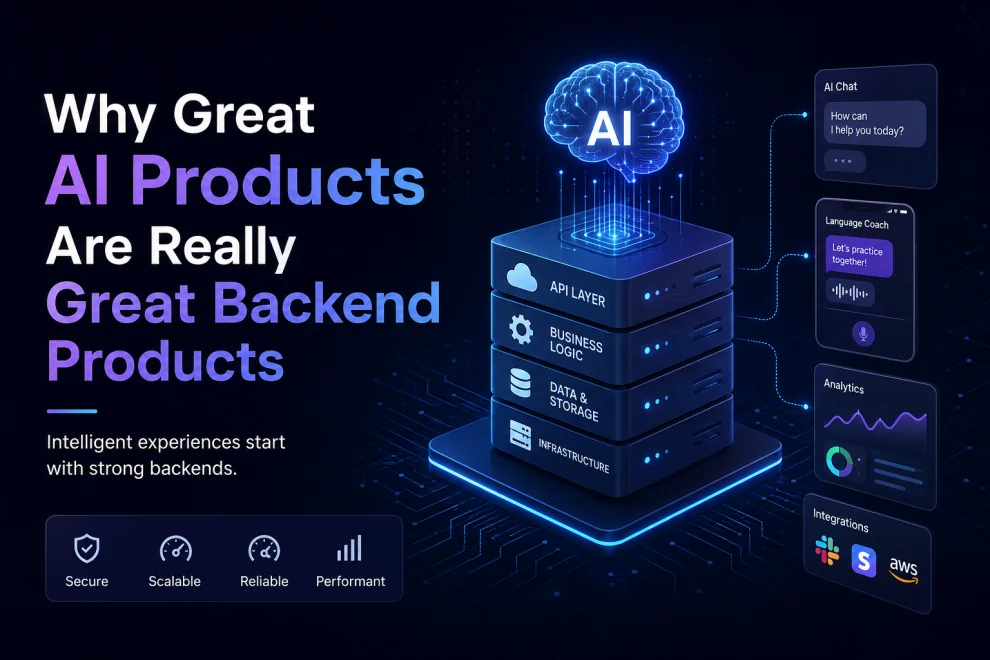
Every AI interaction relies on a backend that authenticates users, processes requests, stores context, communicates with external services, and delivers responses in milliseconds. Without that foundation, even the most impressive AI model struggles to provide a reliable user experience.
This is why backend application development has become one of the most valuable engineering disciplines in modern software development. Whether you’re building a customer support assistant, a language learning platform, a fintech application, or an enterprise AI solution, technologies like Node.js, Laravel, REST APIs, and GraphQL play a much bigger role than most people realize.
AI Is Only as Good as the System Behind It
A common misconception is that building an AI application simply involves connecting a frontend to an AI model. In reality, every request passes through multiple backend layers before the user receives a response.
The backend validates requests, manages authentication, stores user history, handles API calls, processes business logic, monitors system health, and often coordinates multiple AI services at the same time.
As applications grow, these responsibilities become increasingly complex. Teams aren’t just solving AI problems anymore. They’re solving scalability, security, observability, and performance challenges simultaneously.
That’s why organizations investing in AI are placing greater emphasis on backend architecture from the earliest stages of development.
Why Node.js Continues to Power Modern AI Applications
Node.js has become one of the preferred backend technologies for AI-powered products because it handles asynchronous operations exceptionally well.
Applications built around conversations, streaming responses, notifications, and real-time collaboration generate thousands of simultaneous requests. Node.js allows developers to process these efficiently without blocking other operations, making it an excellent fit for AI assistants, recommendation engines, and collaborative platforms.
Its extensive ecosystem also makes it easy to integrate AI providers, authentication systems, cloud storage, analytics platforms, and third-party APIs without introducing unnecessary complexity.
For startups and enterprises alike, this flexibility translates into faster development cycles while maintaining the scalability needed for production environments.
Laravel Still Plays an Important Role
Although Node.js dominates many AI conversations, Laravel remains an excellent choice for applications that require structured business workflows.
Enterprise products often involve subscriptions, reporting dashboards, payment systems, administrative portals, customer management, and compliance requirements. Laravel offers a mature ecosystem that simplifies these challenges while maintaining strong security practices.
Many organizations successfully combine Laravel with AI services, allowing intelligent features to coexist with reliable backend systems that have been refined over years of production use.
Rather than competing, Node.js and Laravel often complement different business requirements depending on the product being built.
APIs Connect Every Modern Application
Modern software rarely exists in isolation.
An AI application might need to communicate with payment gateways, customer relationship management systems, authentication providers, analytics platforms, cloud storage, and multiple AI models—all through APIs.
Designing these APIs well has become a competitive advantage.
A clean API architecture allows products to evolve without constantly breaking integrations. It also enables frontend teams, mobile developers, and third-party partners to build on the same backend infrastructure with minimal friction.
As businesses expand across multiple platforms, APIs become the glue that keeps the entire ecosystem connected.
GraphQL Is Changing How Data Is Delivered
Traditional REST APIs continue to power countless applications, but GraphQL is gaining popularity because it gives clients more control over the data they receive.
Instead of returning large payloads with unnecessary information, GraphQL allows applications to request only the fields they actually need.
This approach improves performance, reduces bandwidth consumption, and simplifies frontend development, especially for products with personalized dashboards, mobile applications, and AI-driven interfaces where every screen requires different datasets.
For engineering teams building increasingly sophisticated products, GraphQL often becomes a natural extension of a modern backend architecture.
Production Engineering Matters More Than AI Demos
One of the biggest shifts happening in software development is the move from AI demonstrations to production-ready AI products.
A chatbot that performs well during testing may fail once thousands of users interact with it simultaneously. Slow response times, inconsistent outputs, missing context, and unreliable integrations quickly become real business problems.
This is where experienced engineering teams distinguish themselves.
Companies like GeekyAnts are increasingly focusing on building AI applications with production-grade backend systems instead of treating AI as an isolated feature.
A good example is the company’s AI-powered language learning roleplay bot. Rather than simply connecting an interface to an AI model, the engineering team developed an Express.js backend that managed conversation history, validated structured responses, orchestrated prompts, and handled communication through the Vercel AI SDK.
That architecture allowed the application to deliver conversations that felt more natural while remaining easier to scale and maintain over time. The project demonstrates an important lesson for engineering teams: successful AI products depend just as much on backend design as they do on model selection.
It’s an approach that reflects a broader trend across the industry, where companies are investing more heavily in infrastructure that supports AI rather than treating backend development as an afterthought.
The Backend Is Becoming a Competitive Advantage
As AI capabilities become more accessible, the competitive edge is shifting.
Most businesses can access similar language models. What differentiates products is how effectively those models are integrated into secure, scalable, and reliable systems.
Backend engineering determines how quickly responses are delivered, how well applications recover from failures, how efficiently data is stored, and how easily new features can be introduced.
These aren’t details users consciously notice, but they shape every interaction users have with a product.
Organizations that prioritize backend quality often deliver applications that feel faster, more dependable, and easier to trust.
Looking Ahead
AI will continue to transform software development, but backend engineering will remain the foundation that supports every intelligent experience.
Whether developers choose Node.js for real-time applications, Laravel for structured enterprise platforms, REST APIs for broad compatibility, or GraphQL for flexible data delivery, the goal remains the same: build systems that are resilient, scalable, and ready for long-term growth.
As projects like the AI language learning platform developed by GeekyAnts illustrate, success doesn’t come from simply integrating an AI model. It comes from designing the backend that allows that intelligence to perform consistently in the real world.
The next generation of successful AI applications won’t just be judged by how smart they are. They’ll be judged by how well their backend systems keep that intelligence secure, reliable, and available whenever users need it.




Add Comment