





AI agents are becoming capable of much more than answering questions. They can break down complex requests, interact with external tools, retrieve information, execute workflows, and coordinate multiple steps to complete a task. But giving an agent access to tools does not automatically make it reliable.
An agent that immediately executes every action it considers relevant can create unnecessary API calls, repeat operations, overlook dependencies, or perform actions in the wrong order. In production applications, these mistakes can affect customer records, business workflows, financial operations, and critical infrastructure.
This is where AI agent planning becomes important.
Planning gives an agent a structured way to understand a request, identify the desired outcome, break the task into manageable steps, evaluate available tools, and determine when it should act or ask for clarification.
For backend engineers, the challenge is not simply making an LLM generate a plan. It is designing an architecture where planning, execution, validation, and recovery work together.
In 2026, reliable AI agents need more than reasoning capabilities. They need controlled planning systems that can translate intentions into safe, measurable actions.
Why AI Agents Need a Planning Layer
A basic LLM application typically follows a straightforward pattern:
User Request → Model Inference → Response
An agentic application introduces additional complexity:
User Request → Planning → Tool Selection → Execution → Observation → Replanning → Final Result
Consider a user asking an AI assistant to investigate why a customer onboarding workflow is failing.
A simple chatbot might explain common reasons for onboarding failures. An agent could perform a more involved task:
- Identify the affected onboarding workflow.
- Retrieve recent execution logs.
- Check relevant API failures.
- Inspect recent configuration changes.
- Compare the failures against known incidents.
- Identify a likely cause.
- Prepare a recommended fix.
- Request approval before applying a production change.
Without a planning layer, the agent may jump directly to a tool call based on incomplete information.
Planning helps the system determine what needs to happen before it starts executing.
It also creates a useful separation between understanding a request and performing actions on behalf of the user.
What Is AI Agent Planning?
AI agent planning is the process of converting a high-level objective into an ordered or conditional sequence of actions.
The agent identifies the goal, evaluates the current context, determines what information is missing, selects appropriate tools, and creates a plan that can be executed and monitored.
A planning system may need to answer questions such as:
- What is the user actually trying to achieve?
- What information is required?
- Which tools are available?
- Which actions depend on other actions?
- Can some tasks run in parallel?
- Which actions require approval?
- How will success be verified?
- What should happen if a step fails?
The plan does not need to be a long explanation of the agent’s internal reasoning. In production systems, it is often more useful to generate a concise, structured representation of intended actions, dependencies, constraints, and success criteria.
This makes planning easier for backend services to validate and execute.
Break Complex Requests Into Smaller Tasks
One of the most important planning capabilities is task decomposition.
A broad user request may contain several independent or dependent operations. The agent needs to identify these operations before execution.
For example, consider an enterprise request:
“Prepare a quarterly customer performance report and identify accounts that may need additional support.”
The agent might decompose it into:
- Retrieve the relevant customer dataset.
- Validate the reporting period.
- Calculate performance indicators.
- Identify accounts with declining activity.
- Retrieve relevant support history.
- Compare account activity with agreed thresholds.
- Generate a report.
- Present findings for review.
Each task has a clear purpose and expected output.
This decomposition makes the workflow easier to monitor, test, retry, and debug. If the support-history retrieval fails, the backend can retry that operation without necessarily repeating the entire report-generation process.
Task decomposition also helps prevent an agent from attempting to solve a complex request through one oversized model call.
Use Structured Plans Instead of Free-Form Instructions
A plan written as natural language can be useful for explaining what the agent intends to do. However, backend systems need a representation that can be validated and executed consistently.
A structured plan might contain:
- Task identifier
- Task description
- Required tool
- Input parameters
- Dependencies
- Execution priority
- Expected output
- Success condition
- Retry policy
- Approval requirement
For example, a simplified plan could look like this:
{
  "goal": "Generate a customer performance report",
  "steps": [
    {
      "id": "step_1",
      "action": "retrieve_customer_data",
      "depends_on": [],
      "status": "pending"
    },
    {
      "id": "step_2",
      "action": "analyze_customer_activity",
      "depends_on": ["step_1"],
      "status": "pending"
    },
    {
      "id": "step_3",
      "action": "generate_report",
      "depends_on": ["step_2"],
      "status": "pending"
    }
  ]
}
This is an illustrative representation, not a universal planning schema.
The backend should validate the plan against an approved set of tools, parameter schemas, permission rules, and workflow constraints before execution.
The model can propose a plan. The application should determine whether that plan is valid.
Choose the Right Planning Strategy
Not every agent requires the same planning approach. The appropriate strategy depends on task complexity, execution time, uncertainty, and the consequences of failure.
1. Fixed Workflow Planning
Fixed workflows follow predefined sequences of operations.
For example, a document-processing agent may always extract information, validate required fields, classify the document, and store the result.
This approach is predictable and relatively easy to test.
It is suitable when the task structure is stable and the allowed operations are known in advance.
2. Dynamic Planning
Dynamic planning allows an agent to determine the next action based on current observations.
For example, an agent investigating an API failure may inspect logs first, then decide whether it needs deployment history, database metrics, or dependency information.
This approach is useful when the correct sequence depends on information discovered during execution.
However, dynamic planning needs strict tool permissions, execution limits, and validation to prevent uncontrolled behavior.
3. Hierarchical Planning
Hierarchical planning breaks a large objective into smaller subgoals.
A high-level agent may coordinate several specialized tasks, while individual workers handle data retrieval, analysis, validation, or reporting.
This can help with complex workflows, but it introduces coordination overhead and additional failure points.
4. Replanning
A plan should not always remain fixed after execution begins.
If an API returns unexpected data, a dependency becomes unavailable, or a task fails, the agent may need to reconsider its next steps.
Replanning allows the system to adjust its approach based on new observations.
The backend should preserve completed work, validate the revised plan, and prevent the agent from repeating operations that have already succeeded.
Separate Planning From Execution
This is one of the most important architectural decisions.
If the same model output directly controls every production action, a planning error can become an operational incident.
A stronger architecture separates the planner from the execution layer.
Planner: Converts the request into structured tasks and dependencies.
Policy engine: Validates whether proposed actions are permitted.
Executor: Runs approved tools and backend operations.
State manager: Tracks completed tasks, pending operations, retries, and checkpoints.
Observer: Collects execution results and determines whether the plan is progressing as expected.
The workflow becomes:
User Request → Planner → Plan Validation → Policy Checks → Execution → Observation → Replanning → Completion
This architecture allows engineering teams to inspect and control the plan before it affects external systems.
Build Dependency-Aware Execution
Not every task needs to run sequentially.
Suppose an agent is preparing an incident report. It may need to retrieve application logs, infrastructure metrics, and deployment history.
These operations may be independent and can potentially run in parallel.
However, the agent should not analyze the root cause until the required evidence has been collected.
A dependency-aware planner can represent these relationships as a directed task graph.
For example:
Retrieve Logs + Retrieve Metrics + Retrieve Deployment History → Analyze Incident → Generate Report
The backend orchestrator can identify which tasks are ready to execute and which must wait for earlier results.
Parallel execution can reduce total workflow time, but it needs concurrency limits, timeout handling, and failure policies. A failed task should not automatically block every independent operation unless the final objective depends on its result.
Planning Must Account for Tool Capabilities
AI agents often interact with external APIs, databases, internal services, and third-party applications.
The planner needs to understand what each tool can do and what information it requires.
A tool registry can describe:
- Tool name and purpose
- Input and output schemas
- Required permissions
- Supported operations
- Execution limits
- Timeout behavior
- Whether the operation is reversible
- Whether human approval is required
For example, an agent may have access to two tools:
Get Customer Details: Retrieves authorized customer information.
Update Customer Address: Changes a customer’s address after validation.
The planner should not treat these operations as interchangeable. The second tool has a direct side effect and therefore requires stronger authorization and validation.
Tool descriptions help the model select capabilities, while the backend enforces what can actually execute.
Add Constraints Before the Agent Acts
A planning system should operate within explicit boundaries.
Without constraints, an agent may create an unnecessarily long plan, repeatedly call the same tool, or attempt actions outside its intended responsibilities.
Backend engineers should define limits such as:
- Maximum planning steps
- Maximum execution duration
- Maximum tool calls
- Maximum retry attempts
- Allowed tools and operations
- Resource and spending limits
- Data access boundaries
- Human approval requirements
These constraints should be enforced by application logic rather than relying on the model to follow instructions.
For example, an agent preparing a report may be allowed to retrieve data and generate documents but not modify customer records.
The planner can propose additional actions, but the policy layer should reject anything outside the approved scope.
Give the Agent a Durable Execution State
Planning becomes more complicated when tasks take several minutes or hours.
A workflow may be interrupted by an API timeout, server restart, network failure, or temporary dependency outage.
If the entire plan exists only inside the model’s context window, the agent may lose track of its progress.
A production backend should persist execution state outside the model.
Useful state fields include:
- Workflow identifier
- User and tenant references
- Current plan version
- Task identifiers
- Task status
- Input and output references
- Execution timestamps
- Retry count
- Error details
- Checkpoints
- Approval status
This allows an agent to resume from a known state instead of reconstructing the entire workflow after every interruption.
It also provides a reliable audit trail for engineering and operations teams.
Prevent Duplicate Actions With Idempotency
Retries are unavoidable in distributed systems.
A tool call may succeed at the backend while the response fails to reach the agent. The planner may interpret the timeout as a failed operation and attempt the same action again.
For read-only operations, duplicate calls may create additional cost or load. For operations such as payments, order creation, or customer updates, duplicate execution can create serious problems.
Backend services should use idempotency keys or equivalent deduplication mechanisms for operations that must not execute more than once.
Before retrying a side-effecting action, the orchestrator should check whether the original operation completed.
The planner should also distinguish between:
- Failed operations
- Timed-out operations with unknown outcomes
- Successful operations
- Operations awaiting approval
- Operations that can safely be retried
This prevents an agent from treating every timeout as permission to repeat an action.
Replanning Should Not Mean Starting Over
Dynamic planning is useful, but uncontrolled replanning can create loops.
Imagine an agent trying to retrieve a report from an unavailable service. It retries the request, receives another failure, changes the parameters, and tries again.
Without a clear termination policy, it may continue repeating variations of the same action.
A robust orchestrator should track previous attempts, error categories, execution budgets, and available alternatives.
Replanning should happen when new information changes the best course of action, not simply because the previous model response was unsuccessful.
Useful controls include:
- Maximum replanning attempts
- Repeated-action detection
- Failure classification
- Alternative tool selection
- Circuit breakers
- Escalation rules
- Explicit completion conditions
The agent should know when to stop, report a limitation, or request human assistance.
Human Approval Belongs in the Planning Architecture
Not every action should be executed automatically.
An agent may be allowed to retrieve information, generate recommendations, or prepare a change request. However, actions involving financial transactions, sensitive customer data, production infrastructure, or irreversible business operations may require additional approval.
Human approval should be represented as a formal workflow state rather than a vague instruction in the prompt.
For example:
Plan Generated → Policy Validation → Approval Required → Human Review → Execution Authorized → Action Executed
The system should record who approved the operation, what was approved, and whether the final action matched the approved plan.
If the plan changes materially after approval, the system may need to request approval again.
This ensures that authorization applies to the actual operation being executed, not simply to the agent’s general objective.
Protect Planning Against Prompt Injection
Planning systems can be manipulated by instructions hidden in user messages, uploaded files, retrieved documents, emails, and external tool responses.
An agent may encounter content that tells it to ignore previous instructions, access restricted data, or call an unauthorized tool.
The planner should therefore distinguish between trusted instructions and untrusted information.
Retrieved content can provide evidence for a task, but it should not be allowed to modify system policies or grant new permissions.
Backend controls should include:
- Authentication and authorization independent of model decisions
- Strict tool allowlists
- Input and output validation
- Tenant-aware data retrieval
- Permission checks before every sensitive action
- Isolation of untrusted content
- Audit logging
- Human approval for high-impact operations
Prompt-level instructions can help guide behavior, but they cannot replace deterministic security controls.
Measure Planning Quality and Execution Performance
A production agent should not be evaluated only on whether it eventually returns an answer.
Engineering teams need to understand whether the plan was efficient, whether the selected actions were appropriate, and whether the workflow completed safely.
Important metrics include:
Planning quality: Percentage of plans accepted by validation, unnecessary task count, dependency accuracy, and frequency of replanning.
Execution performance: Task completion rate, execution latency, tool-call count, retry rate, and timeout frequency.
Reliability: Workflow recovery rate, duplicate-action prevention, failed execution rate, and successful resumption after interruptions.
Cost: Tokens consumed during planning, inference cost, tool execution cost, and total cost per completed task.
Safety: Unauthorized tool attempts, policy rejections, approval frequency, and high-impact action violations.
These metrics help teams identify whether poor outcomes originate from the model, the planner, the tools, or the orchestration layer.
A Production-Ready AI Agent Planning Architecture
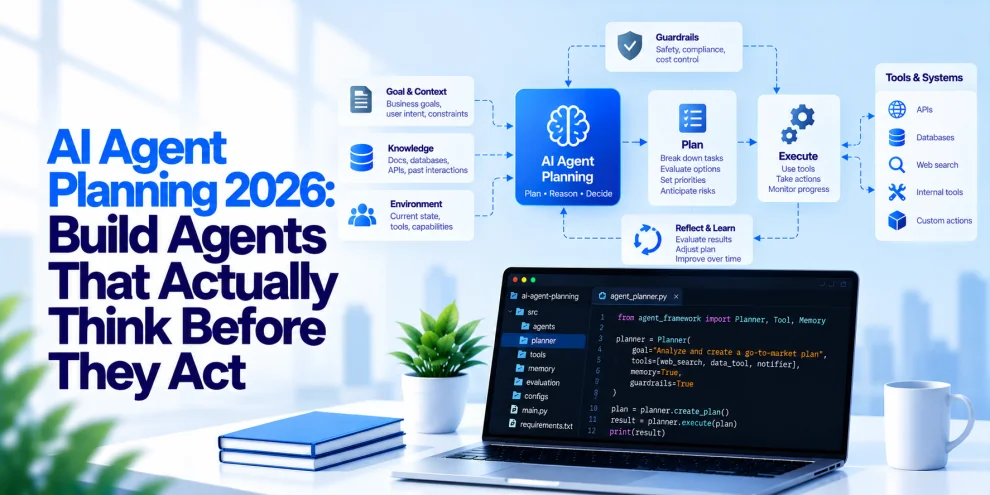
A reliable planning architecture can be organized into seven components:
- Request and context layer: Receives the request, establishes user identity, and gathers authorized context.
- Planning engine: Decomposes the objective into tasks, dependencies, and success conditions.
- Plan validator: Checks schemas, tool availability, task dependencies, and execution constraints.
- Policy and authorization layer: Determines which operations are permitted and which require approval.
- Execution orchestrator: Runs approved tasks, manages parallel execution, and handles retries.
- State and memory layer: Persists workflow progress, checkpoints, and relevant context.
- Observability layer: Tracks decisions, tool calls, failures, costs, and final outcomes.
The complete workflow looks like:
Request → Context Retrieval → Task Decomposition → Plan Validation → Authorization → Execution → Observation → Replanning → Verification
This separation prevents the LLM from becoming the sole controller of the application.
The model handles reasoning and proposes the next steps. The backend remains responsible for execution, permissions, state, and reliability.
What Backend Engineers Should Build First
Teams do not need to start with a complex multi-agent system.
A practical implementation can begin with a single agent and a limited set of approved tools.
Start by defining one workflow with a clear objective and measurable completion criteria. Create structured tool schemas and establish which operations are read-only or side-effecting. Add a planner that produces a structured task list, then validate that plan before execution.
Persist task state so the workflow can recover from interruptions. Add idempotency for operations that may be retried. Introduce approval boundaries for sensitive actions and collect telemetry across the entire execution.
Once the system is reliable, teams can introduce parallel task execution, hierarchical planning, specialized agents, and more advanced replanning strategies.
The goal is to establish a dependable execution foundation before increasing agent autonomy.
Where Engineering Teams Fit
Building production-ready AI planning systems requires coordination across LLM integration, backend architecture, API orchestration, workflow management, security, and observability. Teams like GeekyAnts and Thoughtworks work across AI engineering and application development, making this broader engineering perspective relevant for organizations building agent-based products and intelligent business workflows.
The focus should be on designing agents that can translate complex requests into controlled operations while maintaining the reliability, security, and scalability expected from production applications.
The Future of AI Agents Depends on Better Planning
AI agents are moving from conversational interfaces toward systems that can perform meaningful work across applications and services.
But greater autonomy also increases the consequences of poor decisions. An agent that can call APIs, update records, trigger workflows, and coordinate services needs a dependable way to determine what should happen before it acts.
Planning provides that structure.
For backend engineers, the challenge is to combine flexible model reasoning with deterministic execution controls. Structured plans, dependency-aware orchestration, durable state, idempotency, authorization, approval workflows, and observability all contribute to making agents reliable.
The next generation of production AI systems will not be defined simply by how many tools an agent can access or how complex its reasoning appears.
It will be defined by how effectively it can understand a goal, plan the right actions, respect operational boundaries, recover from failure, and verify that the intended outcome was achieved.
For more, visit our homepage!


Add Comment