











Artificial intelligence has changed the conversation around software development. A year ago, businesses were asking how to integrate AI into their applications. Today, they’re asking something far more important: Can our backend actually support AI at scale?
This shift has made backend engineering one of the most valuable disciplines in software development. Beautiful interfaces still matter, but they mean very little if APIs fail under load, databases struggle with real-time inference, or security vulnerabilities expose sensitive customer data.
Across the United States, companies are investing heavily in backend modernization because AI applications demand infrastructure that is faster, smarter, and significantly more resilient than traditional enterprise systems.
AI Changed the Rules for Backend Development
Traditional backend systems were built around predictable user requests. A customer logged in, viewed products, submitted forms, or completed a purchase. Traffic fluctuated, but workloads followed recognizable patterns.
AI applications behave differently.
Large language models generate thousands of tokens per request. Recommendation engines analyze millions of events continuously. Intelligent assistants retrieve data from multiple sources before producing responses. Every interaction creates far more computation than conventional applications ever required.
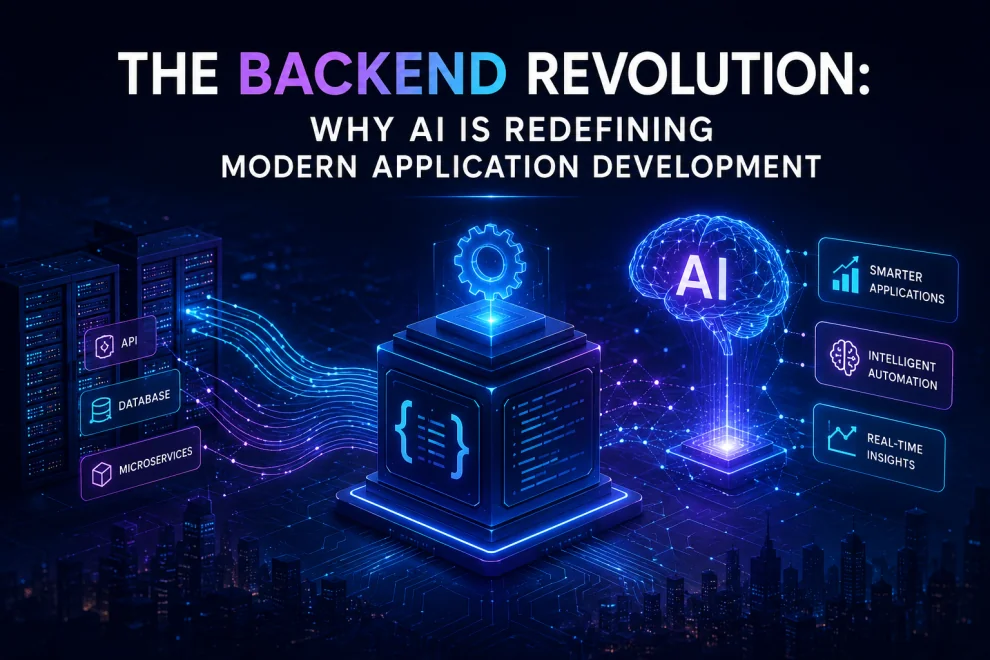
The backend is no longer just serving APIs. It is coordinating models, vector databases, caching layers, event streams, authentication systems, observability tools, and cloud infrastructure simultaneously.
This complexity is why backend architecture has become a competitive advantage rather than an invisible layer beneath the product.
Performance Is No Longer Just About Speed
Customers expect intelligent applications to respond almost instantly.
An AI-powered financial dashboard that takes ten seconds to generate insights quickly loses credibility. A healthcare platform that delays patient recommendations creates frustration. An ecommerce search experience powered by generative AI becomes unusable if every request waits for expensive model inference.
Modern backend systems reduce latency through techniques like intelligent caching, asynchronous processing, streaming responses, and optimized API orchestration.
Companies such as Stripe have demonstrated how reliable backend architecture directly influences customer trust. Every payment request depends on infrastructure that prioritizes consistency, fault tolerance, and speed.
AI applications require that same level of engineering excellence.
APIs Have Become Business Products
Many organizations once viewed APIs simply as communication channels between frontend and backend systems.
That perspective has changed.
Today, APIs connect AI models with CRMs, ERP platforms, payment providers, analytics platforms, document repositories, and third-party SaaS products. Every API endpoint becomes part of the product experience.
Poorly designed APIs increase operational costs, reduce scalability, and create maintenance challenges as applications grow.
The best engineering teams treat APIs like long-term products. They invest in versioning strategies, comprehensive documentation, monitoring, authentication, and backward compatibility because these decisions directly impact business agility.
The Rise of Event-Driven Backends
Artificial intelligence works best when applications respond to changing information immediately.
Instead of waiting for scheduled jobs, businesses increasingly rely on event-driven architectures.
A payment is completed.
An inventory level changes.
A customer uploads a document.
An IoT device sends sensor data.
Each event can instantly trigger AI workflows that classify information, generate recommendations, detect anomalies, or automate downstream business processes.
This architecture enables systems to react in real time instead of relying on batch processing, making products feel significantly more intelligent.
Data Pipelines Are Becoming More Important Than Features
One of the biggest misconceptions about AI is that choosing the right model guarantees success.
In reality, backend engineers often spend more time preparing data than integrating AI itself.
Clean pipelines, structured storage, reliable synchronization, access controls, and governance determine whether AI delivers meaningful results.
Organizations investing heavily in retrieval-augmented generation (RAG), enterprise search, or intelligent automation frequently discover that backend data quality—not model capability—is their biggest bottleneck.
Without reliable infrastructure, even the most advanced AI model produces inconsistent outcomes.
Security Must Be Built Into Every Layer
AI applications process more information than ever before.
Customer conversations.
Financial transactions.
Medical records.
Internal business documents.
Source code.
This makes backend security a board-level concern.
Modern engineering teams implement zero-trust principles, encryption, identity management, audit logging, secret management, and continuous monitoring from the beginning rather than treating security as a final deployment step.
As regulations continue evolving across industries, organizations that invest in secure backend architecture today reduce compliance challenges tomorrow.
Cloud-Native Is Becoming the Default
Scalability has always mattered, but AI magnifies its importance.
A product that suddenly gains popularity after launching an AI feature can experience dramatic increases in compute demand within hours.
Cloud-native architectures built around containers, Kubernetes, serverless functions, and managed databases allow businesses to scale resources dynamically instead of overprovisioning expensive infrastructure.
Companies like Amazon Web Services, Microsoft Azure, and Google Cloud continue expanding AI infrastructure because organizations increasingly require elastic backend platforms capable of supporting intelligent workloads without sacrificing reliability.
Engineering Partners Are Evolving Alongside AI
Backend modernization is rarely accomplished through technology alone.
Many organizations work with product engineering firms that combine cloud architecture, backend engineering, DevOps, and AI implementation under one strategy.
Companies including Thoughtworks, Globant, EPAM Systems, Accenture, and GeekyAnts are helping businesses modernize legacy platforms while preparing them for AI-powered applications. Rather than simply integrating language models, these firms increasingly focus on building scalable backend ecosystems that support long-term innovation, governance, and operational resilience.
For growing companies, this approach reduces technical debt while creating a stronger foundation for future AI initiatives.
Observability Has Become Essential
Traditional monitoring focused on server uptime.
Modern backend systems require much deeper visibility.
Engineering teams need to understand API latency, model response times, token consumption, infrastructure costs, vector database performance, cache efficiency, and distributed tracing across dozens of interconnected services.
Without comprehensive observability, diagnosing production issues becomes increasingly difficult as AI systems grow more complex.
The most successful organizations invest in monitoring before problems appear rather than after customers report them.
The Future Belongs to Intelligent Infrastructure
AI may receive most of the headlines, but backend engineering is quietly becoming the foundation that determines whether intelligent applications succeed or fail.
Organizations that continue relying on outdated architectures will find it increasingly difficult to scale AI initiatives efficiently. Those investing in resilient APIs, modern cloud infrastructure, secure data pipelines, and scalable backend services will be positioned to deliver faster products, lower operational costs, and better customer experiences.
The next generation of software won’t be defined solely by smarter AI models. It will be defined by the backend systems capable of supporting them reliably every single day.
For businesses planning digital transformation, backend modernization is no longer an infrastructure upgrade. It is a strategic investment in the future of AI-driven innovation.



Add Comment