







AI applications are moving from experiments into production.
For enterprises, that shift creates a problem that is easy to underestimate.
The visible part of an AI application may be a chatbot, recommendation engine, intelligent assistant, or autonomous workflow. But underneath it sits a backend responsible for handling data, authentication, APIs, model interactions, business logic, and increasingly, autonomous actions.
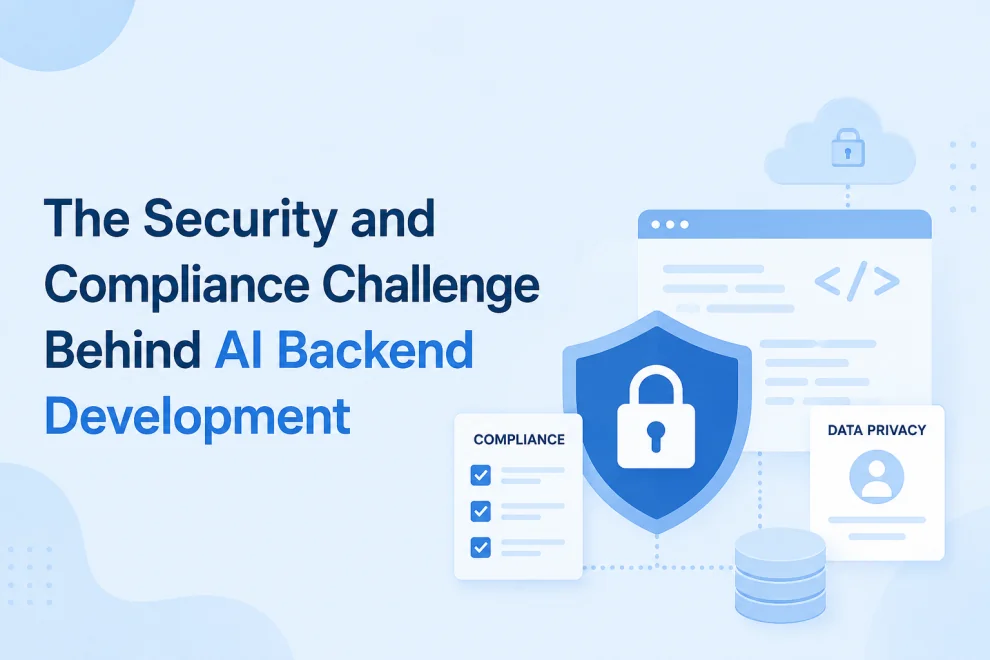
If that backend is not designed for AI-specific security requirements, the application can become a new entry point for data exposure, unauthorized access, prompt injection, insecure model interactions, and compliance failures.
For enterprise technology leaders, AI backend security is no longer a secondary engineering concern. It is becoming part of the foundation of responsible AI adoption.
AI Has Changed What Backend Security Needs to Protect
Traditional backend applications already have to protect databases, APIs, user identities, and business logic.
AI introduces additional attack surfaces.
An AI backend may communicate with foundation models, retrieval systems, vector databases, external APIs, internal knowledge repositories, and third-party tools.
An AI agent can introduce another layer of risk because it may be capable of taking actions rather than simply returning information.
This changes the security model.
The question is no longer simply whether an authenticated user can access an API.
Organizations also need to understand what an AI system can access, what information it can retrieve, which tools it can invoke, and what actions it is permitted to perform.
Sensitive Enterprise Data Is Moving Into AI Systems
One of the biggest reasons AI backend security matters is data.
Enterprise AI applications may process customer information, financial records, employee information, proprietary documents, product information, source code, internal communications, and other sensitive data.
Sending that information into an AI workflow creates additional responsibilities.
A secure backend needs to determine what data can enter the AI pipeline, where that data is stored, which model receives it, how long it is retained, and who can retrieve the resulting information.
This becomes even more important when retrieval-augmented generation is involved.
A RAG application can make an AI system significantly more useful by connecting it to enterprise knowledge. But the retrieval layer also needs proper authorization.
A user should not receive sensitive information simply because the underlying vector database can retrieve it.
The backend must enforce the same access rules that apply elsewhere in the enterprise.
API Security Becomes Even More Important
APIs are already a major component of modern backend architecture.
AI applications increase their importance.
An AI assistant may call multiple APIs to retrieve information or complete a task. An AI agent may interact with CRM systems, payment platforms, internal databases, ticketing systems, or operational tools.
Every integration becomes part of the security boundary.
Weak authentication, excessive permissions, poor input validation, exposed credentials, inadequate rate limiting, or insufficient monitoring can create vulnerabilities that extend beyond the AI application itself.
Enterprise AI backends therefore need strong identity and access management, secure API gateways, authorization controls, secrets management, encryption, and continuous monitoring.
Security cannot be added after the integration is complete.
It needs to be part of the backend architecture from the beginning.
Prompt Injection Is a Backend Problem Too
Prompt injection is often discussed as an AI model problem.
But the consequences can become backend security problems.
Consider an AI agent that has access to internal systems.
If malicious instructions manipulate the agent into retrieving unauthorized information or invoking an inappropriate tool, the problem is no longer limited to an incorrect AI response.
The system may have performed an unauthorized action.
This is why enterprises need controls outside the model itself.
Backend systems should enforce permissions independently of what an AI model requests. Tools should have narrowly defined capabilities. Sensitive operations should require appropriate authorization, and high-risk actions may need human approval.
The model should never become the final authority on what it is allowed to do.
AI Agents Require a Different Security Architecture
Traditional applications generally follow predictable workflows.
AI agents can introduce dynamic behavior.
An agent might decide which tool to use, retrieve additional information, call an API, analyze the response, and then continue with another action.
This flexibility is useful.
It also makes security more complicated.
Enterprise backend architectures need to establish boundaries around agent capabilities.
A financial agent, for example, might be allowed to retrieve account information but not initiate a transaction without additional authorization.
A customer service agent might access customer history but should not be able to retrieve records belonging to unrelated customers.
An internal knowledge agent might search company documents but should respect the same permissions as the employee using it.
These controls need to exist in the backend.
Compliance Cannot Be an Afterthought
AI adoption is increasingly intersecting with privacy, cybersecurity, and industry-specific regulatory requirements.
Depending on the organization and use case, this can involve requirements related to data protection, financial information, healthcare information, consumer privacy, security controls, auditability, and AI governance.
The exact requirements differ by industry and jurisdiction.
The underlying engineering challenge is similar.
Organizations need visibility into how data moves through the AI application.
They need to know who accessed it, what the system did, which services were involved, and what decisions or actions occurred.
That makes logging and auditability essential.
A backend that cannot explain what happened inside an AI workflow can become difficult to defend during a security investigation or compliance review.
Observability Needs to Extend Into the AI Layer
Traditional backend monitoring typically focuses on metrics such as latency, availability, errors, throughput, and resource consumption.
AI applications introduce additional questions.
Which model generated the response?
What information was retrieved?
Which tools were called?
What data was sent to the model?
What permissions were applied?
How much did the request cost?
Did the system produce an unsafe or unexpected result?
For enterprise AI, observability needs to extend beyond infrastructure.
Organizations need visibility across the entire AI workflow.
This can help engineering teams identify security issues, troubleshoot failures, monitor model behavior, investigate suspicious activity, and improve system performance.
Legacy Backends Can Make AI Security Harder
Many enterprises are not building AI applications on greenfield infrastructure.
They are adding AI capabilities to existing products.
That can create another challenge.
Legacy backends may contain outdated authentication mechanisms, tightly coupled services, inconsistent APIs, or data access patterns that were never designed for AI workloads.
Adding an AI layer on top does not automatically make these systems secure.
In some cases, AI adoption should trigger a broader backend modernization effort.
This might involve introducing API gateways, improving authentication, separating services, strengthening access controls, modernizing databases, improving observability, or creating controlled integration layers between AI systems and legacy applications.
The goal is not modernization for its own sake.
The goal is creating a backend architecture that can safely support the next generation of applications.
What a Secure AI Backend Should Look Like
A production-grade AI backend should treat security as an architectural principle rather than a collection of individual controls.
Identity should be established before sensitive information is accessed.
Authorization should be enforced independently of the AI model.
Data should be protected throughout its lifecycle.
APIs should be secured and monitored.
AI agents should operate within defined permission boundaries.
Sensitive operations should have appropriate approval mechanisms.
Logs should provide enough information to investigate activity.
And the architecture should be designed to evolve as models, regulations, threats, and business requirements change.
This is where experienced backend engineering becomes critical.
Choosing the Right Backend Development Partner
Enterprise organizations considering AI adoption should evaluate backend development partners differently from traditional application vendors.
The question should not simply be whether a company can build an API or integrate an LLM.
The more important question is whether it understands the security architecture required when AI becomes part of the backend.
A capable partner should be able to work across API architecture, authentication, authorization, databases, cloud infrastructure, AI integrations, data security, observability, and application modernization.
It should also understand that an AI model cannot be trusted to enforce enterprise security policies by itself.
The backend has to provide those controls.
Engineering teams such as GeekyAnts, for example, can approach AI application development from the broader product and backend engineering perspective, connecting AI capabilities with APIs, data systems, application architecture, and production requirements rather than treating the model as an isolated component.
For enterprises, that distinction can make the difference between an AI proof of concept and a secure production application.
Security Needs to Move Ahead of AI Adoption
The cost of an insecure AI backend can extend far beyond a technical incident.
A data exposure can affect customer trust.
A compromised API can affect multiple connected systems.
An uncontrolled AI agent can create operational risks.
A compliance failure can delay deployment or trigger expensive remediation.
These risks make security an important part of AI planning from the beginning.
The organizations best positioned for enterprise AI adoption will not be those that move fastest at any cost.
They will be the ones that can move quickly without losing control of their data, applications, and infrastructure.
AI is changing what backend applications can do.
It should also change how backend systems are designed.
For enterprises preparing to put AI into production, the question is no longer simply:
“Can we build it?”
It is:
“Can we build it securely enough to trust it?”
For more, visit our homepage!


Add Comment