






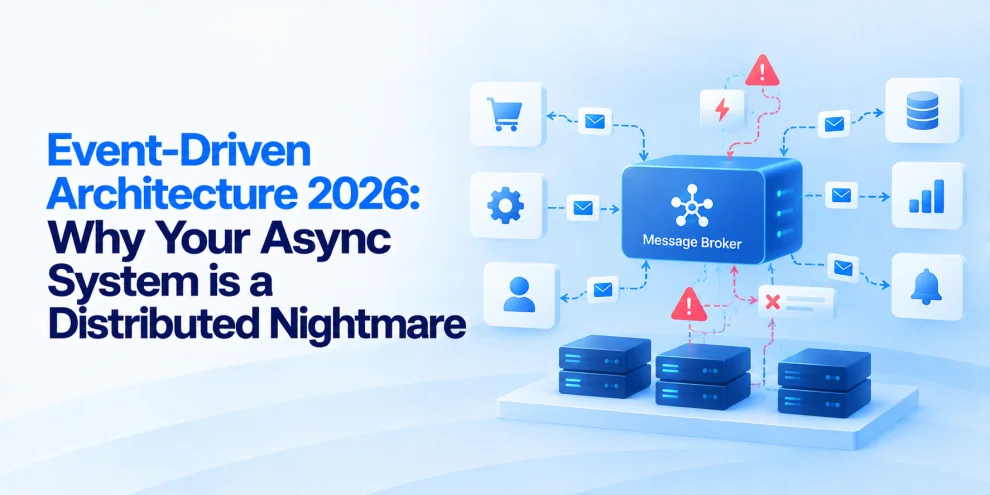

Event-driven architecture looks elegant on a whiteboard. A service publishes an event, another service consumes it, and the system continues without forcing everything through synchronous APIs. Teams get loose coupling, asynchronous processing, independent deployments, and the ability to scale individual workloads. Then the system grows. Suddenly, an order event triggers inventory updates, payment processing, fraud checks, notifications, analytics, fulfillment, customer emails, and several downstream workflows. A single failure can create retries across multiple queues. Events can arrive late, twice, or out of order. One consumer may be healthy while another is silently falling behind. Engineers investigating an incident discover that the original API request finished successfully several minutes ago, but the actual business workflow is still processing somewhere inside a maze of brokers and consumers. That is the uncomfortable reality of event-driven systems in 2026: asynchronous architecture removes some coupling from the application while introducing distributed-systems complexity everywhere else. The goal is not to abandon event-driven architecture. It is to understand where its complexity comes from and design the system so that asynchronous behavior remains observable, recoverable, and predictable.
Why Event-Driven Systems Become Difficult at Scale
A traditional request-response architecture gives engineers a relatively straightforward execution path. A request enters an API, business logic executes, a database is updated, and a response is returned. Event-driven systems deliberately break that path. The producer may publish an event and immediately return. The consumer processes it later. That consumer may publish another event, which triggers additional consumers. A downstream service might call an external API before publishing another event. The original request has effectively become a distributed workflow. This creates a fundamental operational problem: the completion of one operation no longer means the business process is complete. An API may return HTTP 202 while several critical operations remain unresolved. That distinction needs to be reflected in the architecture, monitoring, and product expectations.
Asynchronous Does Not Mean Decoupled
Event-driven architecture is often promoted as a way to decouple services. That is only partially true. Services may be technically decoupled because they do not call each other directly, but they can remain tightly coupled through event contracts. If Service A publishes an event containing fields that Service B, C, and D depend on, changing that event can still create a system-wide compatibility problem. The dependency simply moved from synchronous APIs to asynchronous contracts. This means event schemas should be treated as production interfaces. They need ownership, versioning, compatibility rules, documentation, and testing. A system with hundreds of undocumented event types is not loosely coupled. It is difficult to understand.
The Event Duplication Problem
Distributed messaging systems generally cannot guarantee that every message will be processed exactly once across every failure scenario. A consumer may successfully perform a database update and then crash before acknowledging the message. The broker may deliver the message again. The consumer sees the same event for a second time. If the operation is not idempotent, the result can be damaging. Imagine an event instructing a payment service to capture $500. Processing the same event twice should not capture $1,000. The solution is not simply choosing a different messaging system. Application-level idempotency remains essential. Consumers should be designed so that processing the same event more than once produces a safe outcome. Idempotency keys, event identifiers, transactional records, deduplication strategies, and carefully designed state transitions can help.
Exactly-Once Processing Is Not a Magic Solution
Teams often search for “exactly once” guarantees as if they eliminate the problem. They do not. Even if a messaging platform provides strong delivery semantics within a particular boundary, the overall business transaction may still span multiple systems. A consumer may update a database and then call an external payment provider. The message broker cannot automatically make that entire workflow atomic. The real engineering question is therefore not simply whether a message was delivered once. It is whether the business operation remains correct when failures happen between steps. That requires explicit transaction boundaries, idempotent operations, reconciliation, and recovery logic.
Ordering Becomes a Hidden Dependency
Events do not always arrive in the order engineers expect. A customer may update an address and then cancel an order. If those events reach a consumer in reverse order, the resulting state can be incorrect. Ordering requirements therefore need to be explicit. Some workflows require ordering within a particular entity or partition. Others can safely process events independently. Trying to guarantee global ordering across an entire event-driven platform can create unnecessary bottlenecks. A better approach is to determine where ordering actually matters and scope the guarantee accordingly. For example, events related to a single account or order may need ordered processing while unrelated customers can continue independently.
Retries Can Create an Amplification Loop
Retries are essential for resilient asynchronous systems. They are also capable of turning a small failure into a major incident. Imagine a downstream API becomes unavailable. A consumer retries the request. Thousands of queued events retry simultaneously. The downstream service receives another burst when it is already struggling. The failure becomes amplified. This is why retry policies need more than a maximum attempt count. Production systems should consider exponential backoff, jitter, retry classification, dead-letter queues, circuit breakers, concurrency limits, and backpressure. Not every failure should be retried. A validation error is usually not fixed by trying the same message five more times. A temporary network timeout might be. Retry behavior should therefore reflect the failure category.
Dead-Letter Queues Are Not a Trash Can
Dead-letter queues are often treated as the final destination for messages that could not be processed. That creates another operational problem. A dead-letter queue can become a graveyard of business operations that nobody monitors. A production system should define what happens after a message enters a dead-letter queue. Who owns it? How is the failure investigated? Can the message be safely replayed? Has the underlying issue been fixed? Should the event be discarded? Does replay require ordering guarantees? These questions turn dead-letter handling into an operational workflow rather than a configuration setting.
Event Replay Can Be Dangerous
Replay is one of the biggest advantages of event-driven systems. Historical events can potentially rebuild projections, recover data, or feed a new consumer. But replaying production events can also trigger side effects again. If an event previously sent an email, charged a payment, created an external ticket, or triggered another irreversible action, replaying it blindly can duplicate the operation. Event replay therefore requires a distinction between reconstructing state and repeating side effects. Consumers should be designed with replay behavior in mind. Historical events may need to be processed differently from new operational events.
Distributed Transactions Become Harder
A synchronous monolith can often rely on a database transaction to keep several related changes consistent. An event-driven system may distribute those changes across databases and services. Now there is no single transaction covering the entire workflow. This is where patterns such as sagas become useful. A saga represents a business workflow as a series of local transactions, with compensating actions when later steps fail. But compensation is not the same as rollback. If a payment has already been captured, “undoing” the transaction may require issuing a refund. If an email has been sent, it cannot simply be unsent. This means distributed workflows need explicit business recovery logic rather than assuming database-style rollback is available.
Eventual Consistency Needs Product-Level Acceptance
Event-driven architecture frequently introduces eventual consistency. An order may be created successfully while the customer dashboard still shows the previous state for a short period. Inventory may take time to reflect a reservation. Analytics may lag behind operational transactions. These are not necessarily engineering bugs. They can be legitimate characteristics of asynchronous systems. The problem occurs when the product assumes immediate consistency but the architecture provides eventual consistency. Engineering and product teams therefore need to agree on which states must be immediately authoritative and which can converge asynchronously.
Observability Must Follow the Event
Traditional application monitoring often starts with an HTTP request. Event-driven systems require engineers to follow the entire chain. A useful trace may need to connect the original API request with the event published, broker activity, consumer processing, database operation, downstream event, and eventual business outcome. Correlation IDs and trace context should travel with events wherever practical. Without this correlation, engineers may see thousands of independent consumer errors without knowing which customer request or business transaction they belong to. For large platforms, event observability should include queue depth, consumer lag, processing latency, retry rates, dead-letter volume, event age, throughput, failure categories, and replay activity.
Queue Lag Is a Business Metric
Consumer lag is often treated as infrastructure telemetry. It can also be a business signal. If payment events are delayed, customers may see transactions stuck in pending states. If fulfillment events are delayed, shipments may not be created. If fraud events are delayed, risk decisions may occur too late. This means teams should connect technical event metrics with business outcomes. The important question is not simply “How many messages are waiting?” It is “Which business operations are being delayed, and what is the customer impact?” That distinction helps engineering teams prioritize incidents based on actual consequences.
Backpressure Needs to Be Designed
An event-driven architecture can process large traffic spikes because queues absorb bursts. But queues do not eliminate overload. They can simply postpone it. If consumers cannot keep up, queues grow. Eventually memory, storage, processing capacity, or downstream systems become constrained. Backpressure mechanisms should therefore be part of the architecture. Consumers may need concurrency limits, rate controls, partition management, adaptive scaling, workload prioritization, and explicit capacity limits. The objective is to prevent the event system from transferring overload from one component to another.
Security Does Not End at the API Gateway
Event-driven systems introduce another security surface: the messaging infrastructure itself. An attacker who gains the ability to publish malicious events may influence downstream systems without directly accessing their APIs. Authorization should therefore apply to event producers and consumers. Teams should know which services can publish particular event types, which consumers can subscribe to them, and which environments are allowed to communicate. Event payloads should also be treated as untrusted input. Consumers should validate schemas, required fields, identifiers, permissions, and business rules rather than assuming that messages from internal systems are automatically safe.
Event Schemas Need Governance
At small scale, teams can manage event contracts informally. At enterprise scale, that approach breaks down. Engineering organizations need clear ownership of event schemas and lifecycle management. Important questions include: Who owns this event? Which services consume it? Is the schema backward compatible? How long will older versions be supported? Can fields be removed? What happens when a consumer has not upgraded? A schema registry and automated compatibility testing can help, but governance matters more than tooling. The objective is to make event contracts predictable enough that teams can evolve services without creating invisible dependencies.
Event-Driven Architecture Needs Failure-Aware Design
A common architectural mistake is designing the happy path first and adding failure handling later. Distributed systems do not work that way. Engineers should design for duplicate events, delayed events, missing events, out-of-order delivery, consumer crashes, broker failures, downstream timeouts, partial completion, poison messages, and replay. The architecture should answer what happens when each condition occurs. This is especially important for financial systems, healthcare platforms, logistics, commerce, and other environments where asynchronous errors can produce real-world consequences.
Where Engineering Partners Fit
Building a reliable event-driven platform requires more than selecting Kafka, Pulsar, RabbitMQ, or another messaging technology. The difficult work is designing event contracts, service boundaries, idempotency, workflow recovery, observability, security, scaling, and operational controls around the broker. Engineering organizations such as GeekyAnts support teams working through these architecture challenges by combining backend engineering, distributed systems, cloud infrastructure, application modernization, and production observability. The value comes from designing the system around business reliability rather than simply adding an event broker to an existing architecture.
When Event-Driven Architecture Is the Wrong Choice
Event-driven architecture is not automatically better than synchronous services. A simple CRUD application may gain little from introducing brokers, consumers, retry policies, schema governance, and distributed workflows. The additional complexity is justified when asynchronous processing provides a clear benefit such as independent scaling, workload buffering, workflow decoupling, integration across systems, real-time processing, or resilience against temporary downstream failures. If the architecture does not need those benefits, adding asynchronous infrastructure may simply create operational complexity without solving a meaningful problem.
What Engineering Leaders Should Audit
Before scaling an event-driven platform, engineering leaders should ask: Can every important event be traced to a business transaction? Are consumers idempotent? What happens when events arrive twice or out of order? Which workflows require ordering? What happens when a consumer is unavailable for several hours? Are retries capable of creating traffic amplification? Who owns dead-letter queues? Can events be replayed safely? Which operations require compensation? Which data must be strongly consistent? Are event producers and consumers authorized? Can engineers identify which customers or business processes are affected by consumer lag? Can event schemas evolve without breaking downstream systems? These questions reveal whether the platform is genuinely resilient or simply asynchronous.
The Distributed Nightmare Is Manageable
Event-driven architecture is powerful precisely because it accepts that distributed systems can work asynchronously. But the architecture becomes dangerous when teams confuse asynchronous communication with simplicity. Every event introduces another boundary. Every consumer introduces another failure mode. Every retry introduces another possible amplification path. Every independent database introduces another consistency problem. Every event contract creates another dependency that needs governance. The answer is not to avoid events. It is to engineer them deliberately. A production-ready event-driven system needs explicit contracts, idempotent consumers, bounded retries, controlled concurrency, safe replay, dependency-aware workflows, strong observability, secure messaging, and clear ownership. The most successful event-driven platforms are not the ones with the most events. They are the ones where engineers can answer a much harder question: When something goes wrong, can we explain exactly what happened, what state the system is in, what will happen next, and how to recover without making the incident worse? That is the difference between an asynchronous architecture and a distributed nightmare.
For more, visit our homepage!

Add Comment