










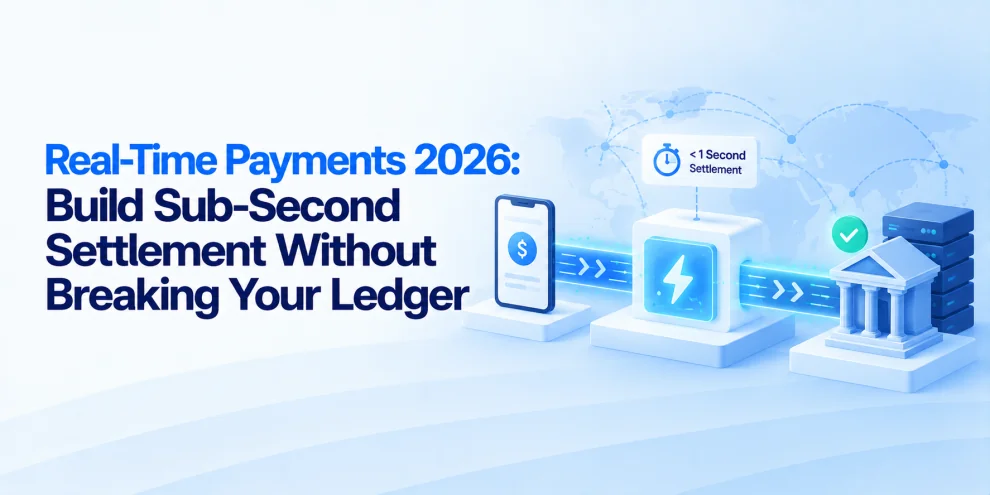

Real-time payments create an uncomfortable backend engineering problem: customers expect money to move almost instantly, while financial systems still need to preserve accuracy, consistency, auditability, and recoverability. A payment API returning in 200 milliseconds is not enough. The backend also needs to guarantee that the same transaction is not processed twice, balances do not become inconsistent, failed operations can be recovered, and every movement of money can be reconstructed later. That is what makes real-time payments fundamentally different from simply building a faster API. The engineering challenge is to reduce latency without weakening the financial ledger.
The Real Problem Is Not Payment Speed
A conventional payment workflow can tolerate some asynchronous processing. A request is accepted, payment instructions are created, downstream systems process the transaction, and reconciliation happens later. Real-time payment systems compress that timeline dramatically. The backend may need to authenticate the request, validate the account, perform fraud checks, reserve or debit funds, create ledger entries, communicate with payment infrastructure, update transaction state, and return a result within a very small latency budget. Each additional dependency introduces another opportunity for delay or failure. The architectural goal should therefore not be “make every component faster.” It should be: Keep the critical financial path short while moving non-critical work out of the synchronous path.
The Ledger Cannot Be Optimized Away
The temptation in high-speed payment architecture is to prioritize the API response and treat the ledger as another database operation. That is dangerous. The ledger represents the financial truth of the system. Every debit should have a corresponding credit or defined accounting treatment. Transactions should be traceable. Balances should be explainable. Corrections should be represented through controlled accounting operations rather than silently overwriting history. The payment API can be optimized. The ledger should remain deliberately strict. This distinction is critical when designing sub-second payment infrastructure. Latency improvements should come from architecture, not from weakening accounting guarantees.
Separate Payment State From Ledger State
One useful architectural decision is to distinguish the payment transaction lifecycle from the accounting ledger. A payment might move through states such as initiated, authorized, processing, completed, failed, reversed, or disputed. The ledger records the financial consequences of those states. Keeping these concepts separate allows the payment orchestration layer to manage external interactions without turning the ledger into a general-purpose workflow engine. It also makes recovery easier. If a downstream payment provider times out, the transaction can remain in an appropriate intermediate state while reconciliation determines the final outcome. The backend should never assume that a timeout automatically means the money did not move.
Idempotency Is Non-Negotiable
One of the most important controls in real-time payment APIs is idempotency. Imagine a customer submits a payment and the backend successfully processes it, but the response is lost because of a network interruption. The client retries. Without idempotency, the backend could process the same payment twice. A robust payment API should therefore accept an idempotency key associated with the intended operation. Repeated requests using the same key should resolve to the same transaction outcome rather than creating a new financial operation. Idempotency needs to extend beyond the API endpoint. Payment orchestration, message processing, ledger posting, provider callbacks, retries, and reconciliation workflows should all be designed with duplicate execution in mind. In real-time payments, retries are inevitable. Duplicate financial effects should not be.
Concurrency Can Break Correct-Looking Systems
High transaction volume creates another challenge: concurrent operations against the same account. Suppose an account has $1,000 available. Two payment requests arrive almost simultaneously, each attempting to spend $800. If both requests read the same balance before either transaction is committed, the system could incorrectly approve both. The solution requires explicit concurrency controls. Depending on the architecture, these can include transactional database operations, optimistic concurrency, version checks, serialized account processing, reservation models, or carefully designed distributed coordination. The key is that balance validation and the resulting financial mutation cannot be treated as unrelated operations.
Do Not Make the Database the Only Performance Strategy
Traditional relational databases remain extremely important for financial systems because transactional consistency matters. But simply increasing database capacity does not solve every real-time payment problem. The backend should minimize unnecessary database work in the critical path. Frequently accessed reference data can be cached. Authentication and authorization decisions can be optimized. Fraud signals can be precomputed where appropriate. Non-critical notifications can become asynchronous. Analytics pipelines can consume events separately from the transaction path. The objective is to reserve the strongest consistency guarantees for the operations that actually move money.
Event-Driven Architecture Has a Role
Real-time payment platforms benefit from event-driven architecture, but events should complement rather than replace transactional guarantees. A successful financial transaction can publish events such as payment completed, ledger posted, notification required, fraud review triggered, or reconciliation required. Downstream systems can process those events independently. This prevents the payment API from waiting for every consumer to complete its work. However, the backend needs to distinguish between a transaction being committed and an event being successfully consumed. A message queue can eventually deliver an event. It should not become the source of truth for whether money actually moved.
Design for Partial Failure
Real-time payment systems operate across multiple systems. The internal payment service may succeed while a payment provider times out. A provider may process the payment but the callback may never arrive. A ledger operation may succeed while a notification service fails. These are not edge cases. They are normal distributed-systems problems. The architecture therefore needs explicit handling for partial failure. Timeouts should not automatically trigger blind retries. Retry policies should understand whether the operation is safe to repeat. External provider requests should use idempotency where supported. Unknown transaction states should enter reconciliation workflows rather than being arbitrarily marked successful or failed. The backend needs to be comfortable with states such as “We do not know yet.” That state is often safer than guessing.
Keep Fraud Checks Fast Without Making Them Weak
Real-time payments also create pressure on fraud and risk systems. A payment that takes several seconds to evaluate may create a poor user experience. But bypassing meaningful risk controls simply to achieve lower latency creates an obvious security problem. A better approach is to separate fast-path decisions from deeper analysis. Low-risk transactions can use precomputed risk signals, account history, device intelligence, velocity information, and lightweight scoring. Higher-risk transactions can be routed into additional verification or asynchronous review. The payment backend therefore needs a risk architecture capable of making decisions quickly without treating speed as a reason to eliminate controls.
Distributed Caching Requires Financial Discipline
Caching can reduce latency dramatically, but payment systems cannot treat cached financial state as authoritative. A cached account balance may become stale between two transactions. A cached authorization decision may become invalid after a permission change. A cached transaction status may lag behind the actual provider state. Caching is therefore most useful for reference data, configuration, risk signals, session information, and other data where controlled staleness is acceptable. Financially authoritative state should remain governed by the appropriate transactional system.
Build a Clear Transaction State Machine
Payment systems become easier to reason about when transaction states are explicit. Instead of relying on scattered Boolean fields such as is_paid, is_failed, and is_processed, the backend should maintain a well-defined lifecycle. For example: Created → Authorized → Processing → Completed, with controlled transitions for failure, cancellation, reversal, timeout, and reconciliation. Every transition should have defined rules. This becomes particularly important when multiple services interact with the same transaction. A state machine provides a shared understanding of what can happen next and prevents services from independently inventing transaction states.
Reconciliation Is Part of the Architecture
Even highly reliable payment systems need reconciliation. Internal records and external payment infrastructure can disagree temporarily because of network failures, delayed callbacks, duplicate messages, provider outages, or processing differences. A reconciliation system compares internal transaction state with external records and identifies mismatches. This should not be considered a back-office feature added after the payment platform is built. It is part of the reliability architecture. The goal of real-time processing is not to eliminate reconciliation. It is to minimize the number of transactions that require manual intervention.
Observability Needs Financial Context
Traditional API monitoring might tell an engineering team that a payment endpoint has a 150-millisecond response time. That is useful, but insufficient. Payment observability should connect technical performance with transaction state. Teams should be able to identify payment latency, authorization latency, ledger posting latency, provider latency, fraud decision latency, retry frequency, timeout rates, duplicate-request attempts, reconciliation mismatches, failed state transitions, payment completion rates, and unknown transaction states. Correlation IDs should allow engineers to trace a transaction across APIs, services, queues, payment providers, and ledger operations without exposing unnecessary financial or personally identifiable information.
Security Cannot Be an Afterthought
Real-time payment APIs are high-value targets. Authentication and authorization should be enforced independently of application logic. Sensitive operations should use strong access controls, transaction limits, velocity controls, anomaly detection, and appropriate step-up verification. Payment APIs should also be designed to resist replay attacks, credential abuse, parameter manipulation, and automated fraud attempts. Most importantly, the backend should never trust client-provided financial state. The client can request a payment. The backend determines whether that payment is valid.
Build for Backpressure
Sub-second payment architecture does not mean every component must process requests at the same speed. A sudden traffic spike can overwhelm downstream systems even when the API layer remains healthy. Backpressure mechanisms can prevent this from becoming a cascading failure. Queues, concurrency limits, circuit breakers, rate limits, bulkheads, and workload prioritization can help protect critical payment infrastructure. The system should degrade deliberately rather than allowing every component to become overloaded simultaneously. For example, a payment confirmation notification can be delayed without delaying the actual ledger operation.
Multi-Region Payments Need Explicit Consistency Rules
Global payment platforms introduce another level of complexity. If users can submit transactions from multiple regions, the architecture needs clear rules about where authoritative financial state resides and how transactions are coordinated. Simply replicating databases across regions does not automatically create a safe multi-region ledger. Engineering teams need to define transaction ownership, consistency requirements, failover behavior, data residency requirements, and recovery procedures. Some workloads can tolerate eventual consistency. The financial ledger often cannot.
The Architecture Should Be Fast by Design
A practical real-time payment architecture might use an API gateway, authentication, payment service, risk decision layer, and ledger transaction as the core synchronous path. Secondary operations such as notifications, analytics, reporting, customer messaging, and some reconciliation workflows can operate asynchronously around the core transaction. The important architectural principle is that the synchronous path should contain only the operations required to safely determine and record the financial outcome. Everything else should move out of the critical path where appropriate.
What Backend Teams Should Measure
A real-time payment platform should have explicit performance and reliability objectives. Backend teams should monitor API latency, time to authorization, ledger commit latency, provider latency, transaction throughput, error rates, retry rates, timeout rates, duplicate requests, reconciliation exceptions, and unknown transaction states. But a low-latency number should never be treated as the primary success metric. A 100-millisecond payment API that occasionally produces duplicate or inconsistent financial records is not a high-performance payment system. The real objective is: Fast transactions with deterministic financial correctness.
Where Engineering Partners Fit
Building real-time payment infrastructure requires expertise across backend engineering, distributed systems, API architecture, databases, security, event-driven processing, observability, and financial workflows. Engineering teams such as GeekyAnts support organizations building payment platforms where low latency is balanced with transactional integrity, scalability, security, and operational resilience. The engineering challenge is not simply to make payment APIs faster. It is to make the entire transaction lifecycle predictable under high volume and partial failure.
What Engineering Leaders Should Audit
Before scaling a real-time payment backend, technology leaders should ask: Can the same payment request be safely retried? What prevents concurrent transactions from creating an invalid balance? Which database operation represents the authoritative financial record? What happens when a payment provider times out after processing the transaction? Can every transaction be reconciled? Which operations are synchronous and which are asynchronous? Are ledger mutations protected by strong transactional controls? Can downstream failures affect the financial record? Are fraud controls compatible with the latency target? Can engineers trace a transaction across the complete system? Are multi-region consistency and failover rules explicitly defined? These questions reveal whether a payment architecture is genuinely real-time or simply optimized for a fast API response.
The Real-Time Payment Principle
Sub-second settlement is an engineering ambition, but it should never become an excuse to weaken financial correctness. The strongest payment architectures separate the concerns that need speed from the controls that need certainty. APIs should be optimized for low latency. Payment workflows should be idempotent. Ledger operations should remain authoritative. Concurrency should be explicitly controlled. Non-critical processing should move asynchronously. Failures should enter recoverable states rather than triggering unsafe retries. The result is a backend that does more than process payments quickly. It can explain what happened, recover when something goes wrong, prevent duplicate financial effects, and preserve the integrity of the ledger under pressure. For real-time payments in 2026, that is the real engineering advantage: sub-second processing without sacrificing the one thing a financial system cannot afford to lose, trust.
FAQs
What makes real-time payment backends difficult to build?
The challenge is balancing very low latency with transaction consistency, fraud controls, concurrency management, idempotency, external payment dependencies, and ledger integrity.
How does idempotency prevent duplicate payments?
An idempotency key allows the backend to recognize repeated requests representing the same intended operation and return the existing transaction result instead of creating another financial transaction.
Should the payment ledger use eventual consistency?
The authoritative financial ledger generally requires strong transactional guarantees. Eventual consistency can be appropriate for secondary systems such as analytics, notifications, and some reporting workflows.
What happens when a payment provider times out?
The backend should avoid assuming that the payment failed. The transaction can enter an uncertain or processing state and later be resolved through provider callbacks, status checks, or reconciliation.
How can payment APIs achieve sub-second latency?
Keep the synchronous path focused on essential operations, optimize database transactions, use efficient authorization and risk checks, cache appropriate reference data, and move non-critical work to asynchronous processing.
Why is reconciliation important in real-time payments?
Distributed systems can produce temporary mismatches between internal and external transaction state. Reconciliation identifies those differences and provides a controlled mechanism for resolving them.
How should payment systems handle concurrent transactions?
They need explicit concurrency controls such as transactional updates, version checks, reservations, serialization, or other mechanisms that prevent conflicting transactions from creating invalid financial states.
What should backend engineers monitor in real-time payment systems?
Important signals include transaction latency, ledger latency, provider latency, authorization failures, retries, timeouts, duplicate requests, reconciliation mismatches, unknown transaction states, and transaction completion rates.
For more, visit our homepage!



Add Comment