






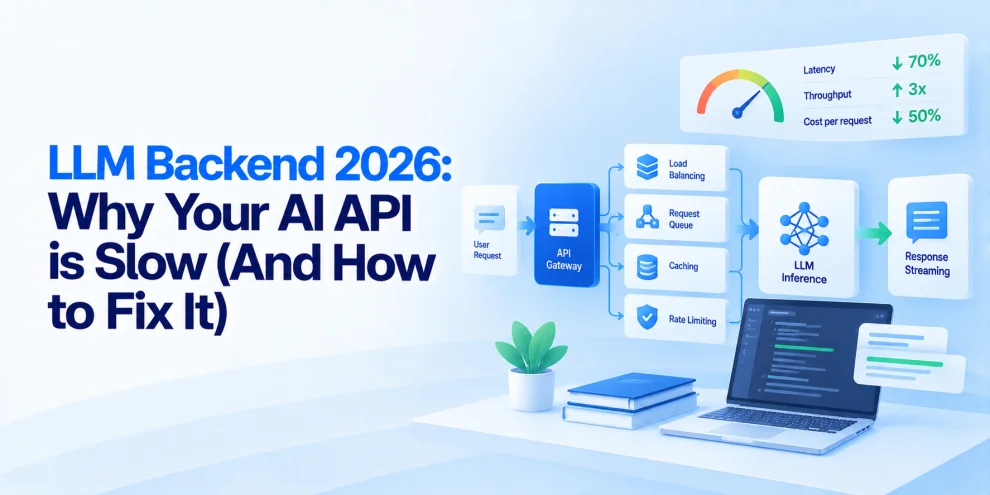

Your AI application works perfectly in development. The model produces useful answers, the API returns valid responses, and the initial demo looks promising. Then real users arrive. Requests take several seconds to complete, streaming responses stall, retrieval adds unexpected latency, and infrastructure costs rise as traffic increases. The model gets blamed, but the bottleneck may be somewhere else entirely. In production, AI performance depends on much more than inference speed. Network calls, oversized prompts, retrieval pipelines, database queries, tool execution, connection management, and inefficient concurrency can all slow an AI API. For backend engineering teams, the challenge in 2026 is not simply choosing a faster model. It is designing a backend that delivers the right response quickly, reliably, and at a sustainable cost.
Why AI APIs Become Slow in Production
A traditional API often performs a predictable sequence of operations: validate a request, execute business logic, query a database, and return a response. An LLM-powered API can involve several additional stages. The backend may retrieve documents, rerank results, construct a prompt, call a remote model, wait for generated tokens, execute tools, validate the response, and then return the final output. Each stage contributes latency, and some stages may depend on the completion of others. A slow AI request is therefore frequently the result of accumulated delays rather than one obvious bottleneck. The first step is to measure the entire request path instead of assuming the model is responsible for every performance problem.
Understand Time to First Token and Total Response Time
AI API performance requires more than one latency measurement. Time to first token (TTFT) measures how long a user waits before receiving the first generated token in a streaming response. Total response time measures how long the complete operation takes. These metrics describe different aspects of the experience. An API that starts streaming quickly but generates tokens slowly may still feel sluggish. Another API may take longer to prepare its response but complete the generation quickly once streaming begins. Backend teams should measure request latency, TTFT, time between generated tokens, total generation duration, and end-to-end completion time. Separating these measurements helps identify whether delays come from request processing, retrieval, model startup, inference, or response delivery.
Stop Sending Unnecessary Context to the Model
One of the most common performance problems is an oversized prompt. Developers often add conversation history, retrieved documents, system instructions, tool definitions, and application metadata to the model context without considering how much information is actually needed. Larger inputs can increase processing time, consume more tokens, and raise inference costs. They can also reduce answer quality when irrelevant information distracts from the task. The solution is not to remove context indiscriminately. It is to make context construction more selective. Limit conversation history to relevant information, remove duplicated instructions, retrieve only useful documents, and summarize older interactions when appropriate. Context should be treated as a resource with an explicit budget, not an unlimited container for everything the application knows.
Optimize RAG Before Blaming the LLM
Retrieval-augmented generation introduces additional work before the model can generate an answer. A typical retrieval pipeline may perform query embedding, vector search, metadata filtering, document retrieval, reranking, context assembly, and model inference. If these operations execute sequentially or query inefficiently, retrieval can account for a significant portion of end-to-end latency. Backend teams should measure each stage independently. Review database indexes, vector-search configuration, metadata filters, embedding latency, reranking overhead, and the number of retrieved documents. Caching appropriate embeddings or frequently requested retrieval results may help when freshness and authorization requirements permit it. The objective is to retrieve enough relevant information to answer accurately without turning every question into an expensive search workflow.
Parallelize Independent Operations
Sequential execution often creates avoidable latency. Suppose an AI request needs user preferences, account metadata, and relevant documentation. If these independent resources can be fetched safely in parallel, waiting for each request one after another increases the critical path unnecessarily. The same principle applies to independent retrieval operations, preprocessing tasks, and some external API calls. Backend engineers should identify operations that do not depend on each other’s results and execute them concurrently. However, parallelism needs sensible limits. Launching hundreds of downstream calls for a single request can exhaust connection pools, overwhelm services, and increase resource contention. The goal is controlled concurrency that reduces total waiting time without creating a new bottleneck.
Treat Tool Calls as Part of the Latency Budget
AI agents often call external tools to retrieve information or perform actions. A single request might invoke a database, a search service, a customer API, and another model before generating its final response. These tool calls can dominate the overall response time, especially when the agent executes them sequentially. Instrument each tool invocation separately and record its duration, result status, timeout behavior, and retry count. Set explicit timeouts and avoid repeating expensive calls when a previous result can be reused safely. Independent tool calls may run in parallel, while dependent operations should follow a defined workflow. Most importantly, limit unnecessary agent steps. A longer reasoning loop is not automatically a better one.
Make Connection Management Efficient
An AI backend can spend time waiting on infrastructure before inference even begins. Repeatedly creating HTTP connections, performing unnecessary TLS handshakes, opening database connections, or initializing clients inside every request adds overhead. Reuse HTTP clients, configure connection pooling, maintain appropriate keep-alive behavior, and initialize long-lived clients outside the request path where the framework allows it. Review DNS resolution, network routing, connection limits, and the geographic distance between the application and model provider. These optimizations may seem less exciting than model tuning, but they can make a measurable difference in systems with high request volume or frequent downstream calls.
Use Caching Without Breaking Correctness
Caching can reduce latency and inference costs when requests or intermediate results repeat. But AI applications need several different caching strategies. Exact-response caching may work for stable, repeatable questions. Semantic caching may help with sufficiently similar queries when the application can tolerate the associated correctness risks. Embeddings, retrieval results, and expensive preprocessing outputs may also be cacheable. The difficulty is deciding when a cached result is still valid. User permissions, tenant boundaries, changing documents, conversation context, model versions, and personalization can all affect the answer. Cache keys should account for the inputs that materially change the result, and sensitive responses must not leak across users or tenants. Caching should improve performance without bypassing authorization or returning stale information where freshness matters.
Choose the Right Model for the Request
Not every task requires the most capable model available. Classification, extraction, routing, and straightforward transformations may work well with smaller or faster models, while complex reasoning and high-stakes workflows may require stronger capabilities. A backend can route requests based on task type, context size, latency requirements, quality expectations, and cost constraints. This is not simply a strategy for selecting the cheapest model. Routing should be based on measured quality and performance for the application’s actual workloads. Teams should evaluate whether smaller models meet the required quality threshold and provide a fallback path when they do not. Model routing becomes particularly valuable when an application serves diverse requests with different levels of complexity.
Streaming Improves Perceived Performance
When a response takes time to generate, streaming can improve the user experience by delivering output progressively instead of waiting for the entire response. Server-Sent Events (SSE) are often suitable for one-way streaming from a server to a client, while WebSockets may be appropriate when the application needs ongoing bidirectional communication. The right choice depends on the interaction model. Streaming must also work correctly through API gateways, proxies, load balancers, and client libraries. Buffering can prevent tokens from reaching the user as soon as they are available. Backend teams should test real production paths, handle client disconnects, and define what happens when generation fails after partial output has already been sent. Streaming improves perceived responsiveness, but it does not necessarily reduce the total time required to produce an answer.
Concurrency and Backpressure Matter More Than Raw Speed
An AI API may perform well under light traffic and deteriorate rapidly when concurrent requests increase. Model providers may enforce rate limits, GPU capacity may become constrained, and downstream systems may run out of connections. Without admission control, requests can accumulate until latency becomes unpredictable. Backend services should apply concurrency limits, bounded queues, rate limits, deadlines, and backpressure. Requests that cannot be processed within their useful time window may need to be rejected, deferred, or routed to another model. Queueing should not be allowed to grow without limits simply because the system is asynchronous. A stable service that returns controlled errors during overload is often preferable to one that accepts every request and leaves users waiting indefinitely.
Retries Can Make a Slow API Even Slower
Retries can help recover from temporary network failures, throttling, and transient provider errors. But aggressive retries can multiply traffic precisely when the system is struggling. If several backend layers independently retry the same request, one user action can generate a large number of downstream calls. This increases latency, consumes capacity, and may trigger further rate limiting. Establish a clear retry policy, classify retryable errors, use exponential backoff with jitter, and set an overall request deadline. Avoid retrying operations that may have already produced side effects unless idempotency is guaranteed. For long-running agent workflows, track retry budgets across the entire operation rather than treating every individual tool call as an independent request.
Build Observability Around the Entire AI Request
Without detailed observability, teams often respond to slow AI APIs by changing models or increasing infrastructure capacity without understanding the actual bottleneck. A production trace should connect the incoming request to authentication, prompt construction, retrieval, model inference, tool calls, validation, and response delivery. Record durations, status codes, token counts, model identifiers, retry counts, and relevant configuration versions. Monitor p50, p95, and p99 latency rather than relying only on averages, which can hide slow requests affecting a small but important share of users. Track TTFT, total generation time, retrieval latency, provider errors, queue depth, concurrency, token consumption, and cost per completed task. Sensitive prompts and responses should not be captured indiscriminately; telemetry should be designed around data minimization, access controls, and retention requirements.
Optimize for Latency, Reliability, and Cost Together
A faster API is not necessarily a better API if it produces unreliable answers or costs substantially more to operate. Backend teams should evaluate performance alongside output quality, error rates, token consumption, availability, and the success rate of completed workflows. For example, a smaller model may be faster but require additional retries or validation. A more aggressive cache may reduce cost but return stale information. Parallel tool execution may lower latency while increasing downstream load. These trade-offs should be tested under realistic workloads. Establish service-level objectives for user-facing latency and reliability, then use load tests and production telemetry to understand whether an optimization improves the overall system rather than a single metric.
Where Engineering Partners Fit
Improving an LLM backend requires coordination across API design, distributed systems, retrieval architecture, model integration, caching, observability, infrastructure, and security. Engineering organizations such as GeekyAnts work across these areas to help teams build AI-powered applications that remain responsive and reliable beyond the prototype stage. The focus should be on identifying the actual bottleneck, optimizing the complete request path, and establishing the controls needed to sustain performance as traffic, context size, and workflow complexity increase.
What Backend Engineers Should Audit
Before attempting a major AI performance overhaul, review the full request path. How much time is spent before the first token? How much time does retrieval consume? Are prompts larger than necessary? Which downstream calls dominate latency? Can independent operations execute in parallel? Are HTTP and database connections reused? Are caching rules compatible with authorization and data freshness? Is the model appropriate for each request type? Are retries amplifying load? Can concurrency exceed available capacity? Are streaming responses buffered by infrastructure? Can engineers trace a slow response across every component? These questions help teams replace guesswork with targeted optimization.
The Real Fix Is Better Backend Architecture
Slow AI APIs are rarely solved by one setting or one model upgrade. The biggest improvements usually come from understanding the entire system: reducing unnecessary context, improving retrieval, parallelizing independent work, reusing connections, choosing appropriate models, applying bounded concurrency, and measuring every important stage. Some workloads will still be limited by model inference, and no backend optimization can eliminate the computational cost of every complex request. But a well-designed backend prevents avoidable delays from accumulating around the model. In 2026, building a high-performance AI API means treating inference as one component of a larger production system. The goal is not simply to make the model faster. It is to make the entire journey from request to useful answer faster, more predictable, and more cost-effective.
FAQs
What causes LLM API latency?
LLM API latency can come from model inference, large prompts, retrieval pipelines, external tool calls, network overhead, connection setup, queueing, retries, and response delivery.
How can I improve LLM backend performance?
Measure the full request path, reduce unnecessary context, optimize retrieval, parallelize independent operations, reuse connections, apply appropriate caching, select suitable models, and control concurrency.
How can RAG latency be reduced?
Optimize vector and database queries, review indexing and metadata filters, limit retrieved context, measure reranking overhead, and cache reusable intermediate results where appropriate.
What is time to first token?
Time to first token is the interval between a request being initiated and the first generated token being delivered to the client. It is a useful measure of perceived responsiveness for streaming AI applications.
How does LLM caching improve performance?
Caching can avoid repeating expensive operations such as embedding generation, retrieval, preprocessing, or eligible model requests. Cache design must account for permissions, context, freshness, and correctness.
What is model routing?
Model routing selects an appropriate model for a request based on factors such as task complexity, required quality, latency targets, context size, and cost.
How can AI APIs handle high concurrency?
Use bounded concurrency, admission control, rate limits, queue limits, deadlines, backpressure, and load testing to prevent demand from exceeding available capacity.
How does streaming improve AI applications?
Streaming lets users receive partial output before the complete response is generated, improving perceived responsiveness when the infrastructure forwards data without unnecessary buffering.
What role does observability play in LLM performance?
Observability helps engineers identify latency across inference, retrieval, tools, networking, and application logic while tracking reliability, token usage, errors, and operating costs.
How should backend engineers optimize AI APIs?
Start with end-to-end measurements, identify the dominant bottlenecks, make targeted changes, and validate improvements against latency, quality, reliability, security, and cost objectives.
For more, visit our homepage!


Add Comment