






Autonomous AI agents are changing what backend systems are expected to handle.
A traditional backend waits for a request, executes business logic and returns a response. An agentic application behaves differently. An agent may call several APIs, query databases, invoke tools, trigger workflows, retry failed actions and make decisions based on information that changes during execution.
That creates a new backend problem.
The system is no longer dealing only with unpredictable users or traffic spikes. It is also dealing with software components that can act independently and generate chains of actions at machine speed.
For enterprises running thousands of services, APIs and data workloads, this can turn a small failure into a much larger operational event.
A failed tool call can trigger retries. A poorly bounded agent can create excessive API traffic. A model can make an incorrect decision that sends an application down the wrong workflow. A downstream service can become overloaded because several agents independently attempt the same operation.
The backend therefore needs to become more resilient than the agents operating on top of it.
This is where self-healing and AI-optimized backend architecture becomes important.
Autonomous Agents Are Creating a New Backend Failure Pattern
Modern backend systems already deal with distributed-system problems such as service failures, network latency, database contention, configuration drift and infrastructure outages.
Agentic applications add another layer of uncertainty.
An agent can dynamically determine which tools to use and how many steps to take. Two requests that appear similar to a user can produce very different backend execution paths.
That makes traditional monitoring less sufficient.
A dashboard may show that API latency increased, but it may not explain that hundreds of agents suddenly started calling the same downstream service. A database monitor may show increased query volume without identifying that an agent workflow has entered an inefficient loop.
IBM’s 2026 observability research highlights this shift, noting that AI-powered workflows introduce dynamic dependencies between agents, models, tools and traditional services. It also points to the need for organizations to understand not just system performance but how agents behave across multi-step workflows.
For backend leaders, the implication is straightforward: observability needs to cover both what the system is doing and why an autonomous workflow is causing it.
That means tracking agent actions alongside conventional application telemetry.
The backend needs visibility into API calls, model requests, tool invocations, retries, queue depth, database activity, token consumption, latency and business outcomes.
Without that context, self-healing becomes difficult because the system cannot reliably determine what needs to be repaired.
Self-Healing Means More Than Restarting Services
Restarting an unhealthy container is useful, but it is not self-healing in the broader sense required by autonomous applications.
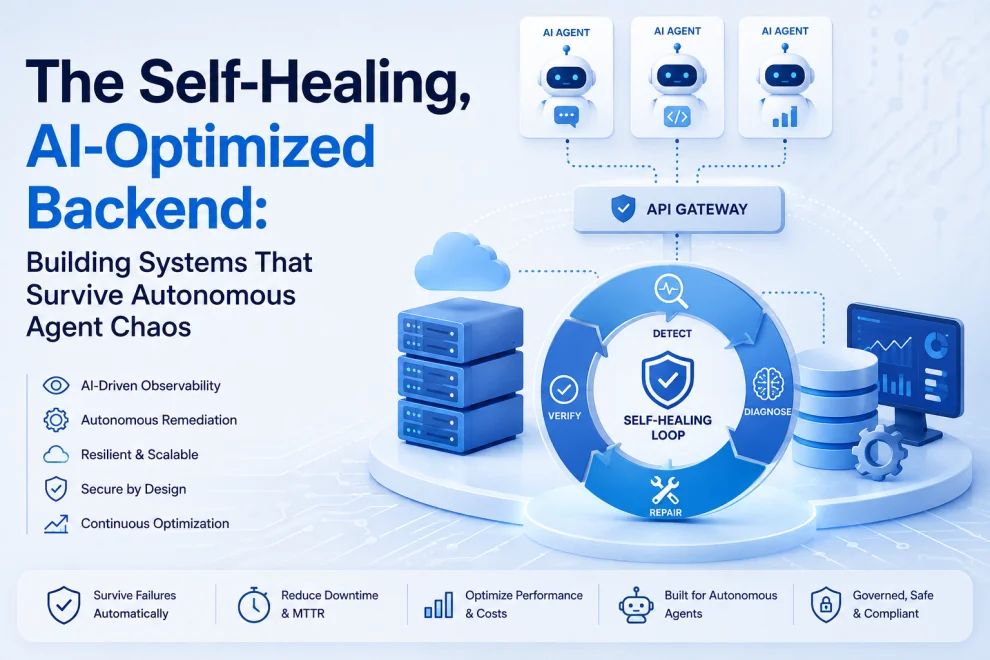
A resilient backend should be able to detect abnormal behavior, identify the likely failure domain, select an appropriate response and verify whether the response actually solved the problem.
A self-healing architecture can therefore operate as a continuous loop:
Detect → Diagnose → Decide → Remediate → Verify → Learn
The detection layer identifies abnormal behavior.
The diagnosis layer correlates telemetry across services and dependencies.
The decision layer evaluates possible actions against operational policies.
The remediation layer executes a controlled response.
The verification layer checks whether system health has improved.
The learning layer feeds the result back into future decisions.
Google has described its own use of agentic AI for SRE operations around similar objectives, including reducing repetitive operational work, improving decision-making and enabling autonomous feedback loops for reliability improvements.
The important point is that the AI does not need unrestricted control.
A backend can expose a carefully designed set of actions such as scaling a service, restarting a failed worker, rerouting traffic, pausing a problematic queue, rolling back a deployment or switching to a fallback model.
The agent decides when an action is appropriate, while deterministic infrastructure controls determine whether that action is allowed.
AI Optimization Needs to Consider the Entire Backend
AI optimization is often reduced to model selection or prompt engineering.
That is too narrow for enterprise systems.
The cost and performance of an autonomous application depend on the entire execution path.
An agent may generate additional model calls because a tool response is incomplete. It may repeatedly query a database. It may invoke several APIs when one optimized endpoint could provide the same information. It may consume expensive models for tasks that could run on smaller models.
These behaviors can create significant backend inefficiencies.
An AI-optimized backend therefore needs to understand the relationship between model behavior and infrastructure behavior.
For example, an operational system could identify that a particular agent workflow consistently produces excessive database queries. Instead of simply increasing database capacity, the platform could identify the inefficient workflow and route it through a more efficient data-access pattern.
Similarly, the system could use smaller models for low-risk tasks, cache frequently requested information, introduce request limits or dynamically route workloads based on cost and latency requirements.
IBM’s 2026 observability work highlights the growing importance of monitoring AI-specific signals such as token usage, cost, latency, quality and agent behavior alongside traditional infrastructure telemetry.
This makes optimization a backend architecture concern rather than simply an AI team responsibility.
The Architecture Needs an AI-Aware Control Plane
The backend supporting autonomous agents needs more than conventional microservices and APIs.
It needs a control plane capable of understanding autonomous activity.
At the foundation sits the observability layer, collecting application metrics, logs, traces, infrastructure events, model telemetry and agent actions.
Above that is the agent gateway, which controls how agents access backend capabilities. It can enforce authentication, authorization, rate limits, quotas and tool-specific policies.
The orchestration layer manages workflows and determines how agents interact with services. It can prevent uncontrolled loops and coordinate retries, fallbacks and escalation.
The resilience layer provides circuit breakers, queues, caching, retries, bulkheads, fallback services and graceful degradation.
The policy engine determines what autonomous systems can and cannot do.
Finally, the verification layer evaluates whether an action produced the expected outcome.
This architecture creates separation between AI reasoning and deterministic execution.
That separation matters because an AI model should not directly control every backend operation.
Gartner’s recent guidance on infrastructure for agentic AI similarly emphasizes runtime controls, observability, agent identity, policy enforcement and architectural separation between reasoning and execution.
The model can recommend an action. The control plane should determine whether that action is permitted.
What Happens When Agents Start Fighting the Backend?
The phrase “agent chaos” is not theoretical.
Imagine multiple agents operating simultaneously across customer service, procurement, finance and internal operations. Each agent has access to APIs and can initiate workflows.
One agent detects a failed transaction and retries it.
Another agent sees the delayed transaction and initiates a recovery workflow.
A third agent sees the resulting state change and attempts another correction.
Each agent may behave rationally in isolation while collectively creating an unstable system.
This is where conventional distributed-system principles become even more important.
Backend teams need idempotent APIs, concurrency controls, transaction boundaries, rate limits, circuit breakers and event-driven coordination.
Agents also need budgets.
A production agent should have limits on how many API calls it can make, how much compute it can consume, how long a workflow can run and which tools it can invoke.
The system should also recognize abnormal agent behavior.
If an agent suddenly increases its tool calls by an unusual amount, the platform should be able to slow, isolate or terminate that workflow before it affects critical services.
IBM’s 2026 research describes agentic systems as dynamic and continuously evolving, increasing the need to establish behavioral baselines and detect deviations in performance, cost and outcomes.
That is effectively the beginning of an immune system for autonomous software.
Security and Governance Become Runtime Requirements
Self-healing systems create an uncomfortable trade-off.
The more authority an agent has, the more useful it can become. But the same authority increases the consequences of an incorrect or compromised decision.
Agent credentials should therefore follow least-privilege principles.
High-risk actions should require additional controls. Sensitive systems should have stronger approval requirements. Agent activity should remain attributable and auditable.
IBM’s 2026 AI roadmap highlights risks including prompt injection, credential theft, excessive permissions, tool manipulation and insufficient monitoring as agentic systems become more connected to enterprise environments.
This makes security part of the backend runtime.
An enterprise cannot simply secure the application and assume the agent layer is covered. It needs visibility into which agent acted, what information influenced the action, which tool it invoked, what permissions it used and what changed afterward.
The architecture should also assume that agents will sometimes fail.
Fallback paths, human escalation, sandboxing and rollback mechanisms should exist before autonomous execution reaches production.
Enterprises Should Build for Controlled Self-Healing
The goal should not be to make every backend component autonomous.
A better strategy is to identify operational problems where autonomous remediation provides measurable value and where the potential blast radius is manageable.
A strong starting point could include:
- Low-risk remediation: Restart failed workers, clear stuck queues, adjust noncritical resources or reroute traffic under defined conditions.
- Automated diagnosis: Let agents correlate telemetry and produce probable root causes before engineers intervene.
- Cost optimization: Identify inefficient model calls, infrastructure utilization and excessive agent workflows.
- Deployment protection: Detect abnormal application behavior after releases and trigger predefined rollback mechanisms.
- Predictive operations: Identify patterns that suggest an impending failure and recommend preventive action.
Each workflow should have measurable success criteria.
The organization should know whether the system reduced MTTR, lowered infrastructure costs, reduced operational tickets or prevented incidents.
More importantly, autonomy should expand gradually.
An agent can begin in read-only mode. It can then move to recommendations, followed by approved execution and eventually autonomous remediation for selected workflows.
That progression allows engineering teams to build confidence without turning production infrastructure into an uncontrolled AI experiment.
The Backend Becomes the Reliability Layer for Agentic AI
Agentic AI will put more pressure on backend architecture because autonomous software can create demand, dependencies and operational decisions at a scale that human-driven applications rarely produce.
The answer is not to slow down every agent.
It is to build backend systems capable of absorbing autonomous behavior.
That requires stronger observability, deterministic controls, resilient APIs, policy-driven execution, agent-aware security and automated verification.
Companies such as GeekyAnts, Thoughtworks and other enterprise technology engineering partners can help organizations assess whether their existing backend architecture is prepared for this transition, identify high-value self-healing opportunities and design the control layers needed for production adoption.
The competitive advantage will not come from having the most autonomous agent.
It will come from having a backend that can absorb, understand and safely recover from the behavior of thousands of autonomous agents.
That is the foundation for AI systems that do not simply operate at scale, but continue operating when the AI itself behaves unpredictably.
For more, visit our homepage!



Add Comment