








The first generation of AI applications often had a surprisingly simple backend architecture. An application accepted a request, sent it to an LLM API, received the response, and returned it to the user.
That approach was enough to build a prototype.
It becomes a problem when AI becomes a production dependency.
Enterprise applications rarely use one model for everything. Different workloads may require different providers, model sizes, latency profiles, privacy controls, regions, and cost limits. Teams also need centralized authentication, rate limiting, observability, prompt management, security controls, caching, fallback strategies, and usage tracking.
This is where an AI gateway becomes more than an LLM wrapper.
A wrapper hides an API behind another API. A platform creates a controlled infrastructure layer between applications and AI capabilities.
For backend teams, that distinction is becoming increasingly important in 2026.
The LLM Wrapper Problem
A typical early-stage AI backend might contain an endpoint such as /generate. The application sends a prompt, the backend forwards it to a model provider, and the response comes back.
It is simple.
The problem starts when more requirements arrive.
A product team wants to add another model. Security wants centralized logging. Finance wants usage visibility. Platform engineering wants rate limits. Legal wants regional data controls. Product wants a fallback when the primary provider is unavailable.
Developers then begin adding provider-specific logic throughout the application.
One service calls Provider A directly. Another uses Provider B. A third has its own retry logic. Another service implements its own token tracking.
The result is not an AI platform.
It is distributed provider management hidden inside application code.
What an AI Gateway Actually Does
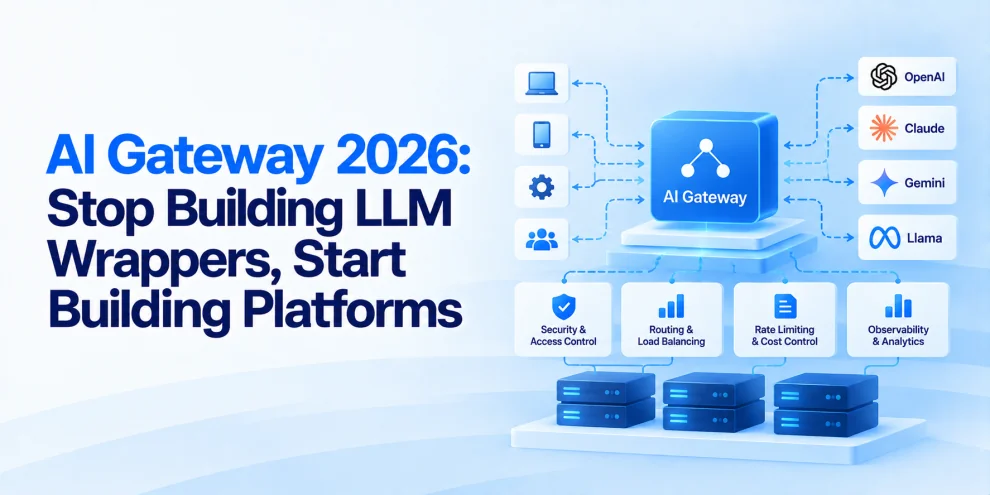
An AI gateway provides a controlled entry point for applications that need access to models and AI services.
Instead of every backend service managing providers independently, applications communicate with a common gateway.
The gateway can handle responsibilities such as model routing, authentication, rate limiting, quotas, observability, caching, request policies, provider failover, and usage tracking.
This creates a separation between application logic and model infrastructure.
The application expresses what it needs.
The gateway determines how that request should be fulfilled.
That distinction becomes increasingly valuable as AI usage expands across an organization.
Model Routing Becomes a Backend Capability
One of the strongest reasons to introduce an AI gateway is model routing.
Not every request deserves the most expensive or powerful model.
A lightweight classification task may work perfectly with a smaller model. A complex reasoning request may require a stronger model. A highly sensitive workflow may need a specific provider or deployment environment.
The gateway can apply routing policies based on factors such as task type, latency requirements, cost limits, region, data sensitivity, model availability, and application priority.
Instead of embedding those decisions inside individual applications, the organization can manage them centrally.
This turns model selection into an infrastructure capability.
Stop Hardcoding Model Providers Into Applications
Provider abstraction is another important benefit.
If application code is tightly coupled to one provider’s SDK, changing models can become an application migration project.
A gateway can expose a consistent internal interface while handling provider-specific differences behind the platform boundary.
This does not mean every model API behaves identically. Features, capabilities, context limits, tool support, and output formats can vary significantly.
The gateway should therefore abstract the common operational layer without pretending that every model is interchangeable.
The goal is flexibility, not false uniformity.
Reliability Requires More Than Retries
AI providers can experience rate limits, latency spikes, outages, quota exhaustion, or regional problems.
A production AI platform needs more than a simple retry loop.
An AI gateway can implement controlled fallback strategies. If one provider becomes unavailable, eligible workloads can be routed to another model or deployment.
But fallback should be policy-driven.
A sensitive workload should not automatically move to a provider that does not satisfy its data-handling requirements. A high-cost model should not become the default fallback for every failure.
Reliability needs to account for capability, security, cost, and compliance alongside availability.
Centralized Rate Limiting Protects the Backend
AI workloads can consume resources very quickly.
A single application bug can generate thousands of model requests. An automated agent can enter a retry loop. A malicious user can intentionally create expensive requests.
Application-level rate limiting is useful, but centralized controls provide stronger protection across multiple services.
An AI gateway can enforce limits based on application, user, tenant, model, API key, workflow, or organization.
This creates a shared control plane for AI consumption.
AI Cost Becomes an Infrastructure Concern
Traditional backend systems already track compute and database costs. AI introduces another major variable: model consumption.
Token usage, model selection, context size, tool calls, retries, and agent execution can all influence the final cost of a request.
If every application manages its own model usage, understanding organizational AI spend becomes difficult.
A gateway can provide centralized usage accounting.
Teams can measure consumption by application, model, tenant, environment, workflow, or business unit.
This makes cost management part of backend architecture rather than an after-the-fact finance exercise.
Observability Should Follow the AI Request
An AI gateway can also become a useful observability boundary.
A production request may involve the user application, gateway, model provider, retrieval system, tools, databases, and downstream APIs.
The gateway can provide correlation information across these components.
Useful telemetry can include model selection, request latency, time to first token, token usage, retry counts, provider errors, fallback events, and policy decisions.
However, centralized AI observability introduces its own security risk.
Prompts and responses may contain sensitive information. The gateway should therefore avoid automatically storing raw AI content unless there is a clear operational reason and appropriate controls.
Security Policies Belong Outside the Model
An AI model should not be responsible for enforcing backend security.
The gateway can establish policies around which applications are allowed to use which models, which regions are permitted, which workloads can access particular capabilities, and how requests should be handled.
Backend authorization should still remain authoritative for application resources and business operations.
If an AI agent wants to call a sensitive tool, the gateway or backend service should verify that the operation is permitted.
The model can suggest an action.
The platform decides whether that action is allowed.
Prompt Management Needs Governance
As organizations scale AI applications, prompts can become production configuration.
Different applications may use different system instructions, templates, evaluation criteria, and model parameters.
Managing these independently makes version control and auditing difficult.
A platform-level AI gateway can provide controlled prompt configuration, versioning, testing, and rollout mechanisms where appropriate.
The goal is not to hide prompts from developers.
It is to make important AI configuration traceable and manageable.
A production incident should be diagnosable in terms of the application version, model version, prompt version, and relevant gateway policies involved.
Caching Can Reduce Latency and Cost
Some AI requests are repetitive.
Applications may repeatedly request similar transformations, classifications, or responses.
An AI gateway can provide caching for workloads where reuse is safe.
Caching needs careful consideration for personalized, sensitive, or rapidly changing data. A response that is safe to reuse for one user may be inappropriate for another.
The gateway therefore needs explicit cache policies based on request characteristics, identity, tenant, data sensitivity, and freshness requirements.
Done correctly, caching can reduce both model latency and infrastructure cost.
AI Gateways Need Tenant Isolation
Enterprise AI platforms often serve multiple applications or business units.
That creates another backend requirement: isolation.
A gateway should be able to distinguish tenants, applications, environments, and identities. Usage limits, model access, data policies, and observability permissions may differ across them.
A development application should not automatically inherit the same model access or quotas as a production financial workflow.
Multi-tenant AI infrastructure therefore requires identity-aware routing and policy enforcement.
Streaming Needs to Be a First-Class Capability
Modern AI applications increasingly stream responses.
Users expect text to appear progressively rather than waiting for the entire response. Agent interfaces may also need to stream tool events, status updates, and intermediate results.
An AI gateway should therefore support streaming without turning the connection layer into the entire execution architecture.
Depending on the workload, this may involve HTTP streaming, Server-Sent Events, or WebSockets.
The gateway should focus on routing and policy while long-running agent execution remains in appropriate backend workers or workflow systems.
The Gateway Should Not Become a Bottleneck
Centralizing AI traffic creates a new architectural risk.
If every model request passes through a single gateway service and that service becomes overloaded, the gateway itself becomes a production dependency capable of affecting every AI application.
The gateway therefore needs to be designed as platform infrastructure.
It should support horizontal scaling, controlled timeouts, backpressure, connection management, regional deployment where required, graceful failure, and clear capacity limits.
A centralized control plane should not become a centralized failure point.
AI Gateways and Agentic Systems
The importance of AI gateways increases as applications become more autonomous.
A conventional chatbot may generate one response.
An agent can generate multiple model calls, retrieve information, call tools, retry operations, and continue working without another user request.
That creates significantly more opportunities for uncontrolled model usage.
An AI gateway can help enforce limits around model calls, token consumption, tool access, execution duration, and request frequency.
This does not replace agent-level authorization or workflow controls, but it adds another layer of protection around AI consumption.
Build the Platform Around Policies
The most mature AI gateways will not simply route requests.
They will become policy engines for AI infrastructure.
Policies can define which models an application can use, which regions are permitted, maximum token budgets, acceptable latency, fallback options, retention requirements, and security restrictions.
This allows platform engineering teams to manage AI centrally without forcing every application team to reinvent the same controls.
The result is a platform model rather than a collection of AI integrations.
What Backend Engineers Should Build First
Organizations do not need to create a massive internal AI platform on day one.
Start with the problems that are already appearing.
Centralize provider credentials. Establish common authentication. Add request and usage tracking. Introduce model routing where it provides measurable value. Add rate limits and quotas. Standardize observability. Establish security policies. Then introduce more advanced capabilities such as caching, fallback, prompt versioning, and automated routing.
The gateway should solve real platform problems rather than becoming another abstraction layer that developers have to maintain.
Where Engineering Partners Fit
Building an enterprise AI gateway requires more than connecting multiple LLM APIs. It involves backend architecture, API design, security, cloud infrastructure, observability, model integration, cost controls, and scalable platform engineering. Engineering organizations such as GeekyAnts help teams design these capabilities as part of a broader AI backend architecture rather than treating the gateway as a standalone proxy.
The objective is to give engineering teams a reliable platform through which AI capabilities can evolve without repeatedly rewriting the application’s backend.
What Technology Leaders Should Audit
Before adopting or building an AI gateway, technology leaders should ask:
Are applications directly dependent on individual model providers?
Can model routing be controlled centrally?
Are AI credentials managed outside application code?
Can usage and cost be measured by application or tenant?
Are rate limits and quotas enforced consistently?
Can provider failures trigger controlled fallbacks?
Are sensitive prompts and responses protected?
Can model, prompt, and gateway configuration changes be traced?
Can the gateway scale without becoming a single point of failure?
Are agent workloads subject to execution and cost limits?
If the answer to several of these questions is no, the organization may be building AI applications without building the platform required to operate them reliably.
From LLM Wrapper to AI Platform
The first stage of enterprise AI development was about connecting applications to models.
The next stage is about managing AI as infrastructure.
That requires a layer capable of controlling model access, routing workloads, enforcing policies, measuring consumption, protecting sensitive data, handling failures, and providing consistent operational visibility.
An AI gateway can provide that foundation.
But the real value does not come from placing another API in front of an LLM.
It comes from turning AI access into a governed, observable, scalable backend capability.
In 2026, organizations that treat their AI gateway as infrastructure will be better positioned to add models, adopt new providers, support agentic workloads, control costs, and evolve their AI architecture without turning every application into another provider-specific integration.
The goal is simple: stop wrapping LLM APIs and start building the platform that makes AI usable across the enterprise.
For more, visit our homepage!



Add Comment