








Backend systems are becoming harder to operate.
Applications are handling more traffic, integrating with more third-party services, processing larger amounts of data, and increasingly relying on AI-powered components. A failure in one service can quickly affect several others.
For growing technology companies, this creates an uncomfortable challenge. Engineering teams are expected to deliver new capabilities faster while also keeping systems available, secure, and predictable.
Traditional monitoring can tell teams that something has gone wrong. Automated recovery can restart a failed service. But the next generation of backend engineering is moving toward something more adaptive: systems that can identify abnormal behavior, understand potential causes, take predefined corrective actions, and learn from operational patterns.
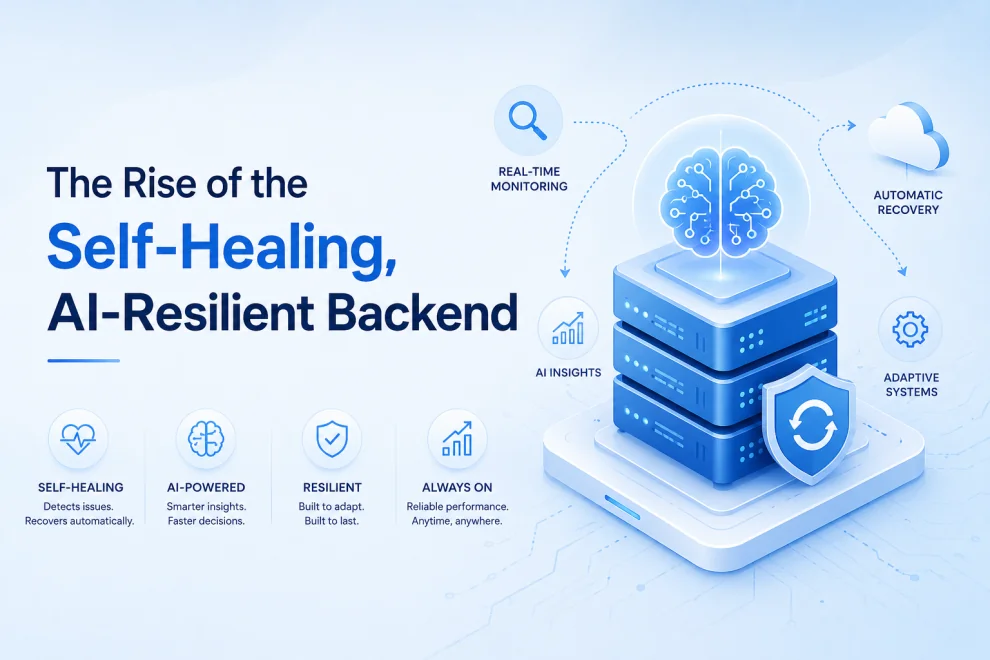
This is the foundation of the self-healing, AI-resilient backend.
It does not mean creating a backend that operates without engineers. Instead, it means using automation and AI to reduce repetitive operational work while giving engineering teams better visibility and faster recovery.
What Makes a Backend Self-Healing?
A self-healing backend is designed to respond automatically to certain classes of failures.
Consider a service that suddenly starts consuming excessive memory.
A conventional system might trigger an alert.
An operations team receives the notification, investigates the issue, identifies the affected service, and manually restarts or scales it.
A self-healing system can detect the abnormal condition, compare it with known patterns, and execute an approved recovery action automatically.
That action might involve restarting a container, moving traffic, scaling a service, clearing a queue, replacing an unhealthy instance, or temporarily disabling a problematic dependency.
The important point is that the system operates within predefined boundaries.
Self-healing does not mean giving an AI unrestricted access to production infrastructure.
It means combining observability, automation, policies, and increasingly intelligent decision-making to reduce the time between detecting a problem and responding to it.
AI Changes the Way Systems Understand Failures
Traditional automation works well when the failure condition is predictable.
If CPU usage exceeds a specific threshold, scale the service.
If a container stops responding, restart it.
If a health check fails repeatedly, remove the instance.
The difficulty begins when failures do not follow simple rules.
A backend may experience increased latency because of a combination of database contention, unusual traffic patterns, an external API slowdown, and a deployment that happened earlier in the day.
Individually, none of those signals may look severe.
Together, they can indicate a developing incident.
AI can help engineers correlate these signals and identify patterns that are difficult to spot manually.
Instead of looking at hundreds of independent alerts, an AI-assisted operational system can help determine whether multiple signals are likely connected to the same underlying problem.
That can make incident response considerably more efficient.
Resilience Is More Than Automatic Restarting
Restarting failed services is useful, but it is only one layer of resilience.
A resilient backend needs to anticipate different types of failure.
Dependencies can become unavailable.
Networks can become unreliable.
Databases can become overloaded.
Queues can grow unexpectedly.
APIs can return unexpected responses.
Traffic can spike.
New deployments can introduce regressions.
AI services themselves can experience latency, rate limits, degraded availability, or unexpected outputs.
A resilient architecture therefore needs multiple mechanisms working together.
Circuit breakers can prevent cascading failures.
Retries can handle temporary problems.
Rate limiting can protect critical services.
Caching can reduce dependency pressure.
Queues can decouple workloads.
Health checks can identify unhealthy instances.
Automated rollback can reduce the impact of problematic deployments.
AI can sit above these mechanisms and help teams understand how they are behaving together.
The AI Layer Needs Guardrails
The idea of an AI system changing production infrastructure automatically sounds powerful.
It can also be dangerous.
An AI system that incorrectly identifies the cause of an incident and starts modifying infrastructure could make the situation worse.
This is why AI-resilient backend architecture needs strong boundaries.
Low-risk actions can potentially be automated.
Higher-risk actions may require human approval.
For example, automatically restarting an unhealthy application instance may be reasonable.
Automatically deleting production resources because an AI system believes they are causing an incident is a very different proposition.
The level of autonomy should therefore correspond to the potential impact of the action.
This creates a practical model for AI-assisted operations:
Observe → Analyze → Recommend → Approve → Act → Learn.
Over time, organizations can automate more of this cycle as confidence grows.
Observability Becomes the Foundation
AI cannot make sense of a system that does not produce useful operational data.
Logs, metrics, traces, events, deployment information, infrastructure signals, and application behavior all contribute to the system’s understanding of what is happening.
This makes observability a fundamental requirement for self-healing architectures.
A backend might know that latency has increased, but that alone does not explain why.
Distributed tracing can show where the delay is occurring.
Application logs can reveal errors.
Infrastructure metrics can expose resource pressure.
Deployment records can show whether a recent release correlates with the problem.
Dependency monitoring can identify external failures.
When these signals are connected, AI-assisted systems have a much stronger foundation for diagnosis.
Without reliable telemetry, AI can simply become a sophisticated guess generator.
Self-Healing Can Reduce Operational Fatigue
Engineering teams spend significant time dealing with repetitive incidents.
A service crashes.
A queue becomes stuck.
A container needs to be restarted.
A resource threshold is exceeded.
A known dependency temporarily fails.
These incidents may not require deep engineering expertise, but they still consume attention.
Repeated operational interruptions create another problem: fatigue.
When engineers are constantly responding to low-level incidents, they have less time to work on architecture, performance, security, and product improvements.
Self-healing automation can absorb some of this repetitive work.
The goal is not to eliminate engineers from operations.
It is to allow engineers to focus on incidents that actually require human reasoning.
AI-Resilient Systems Need Fallbacks
AI itself cannot be treated as an infallible component.
If an application depends on an AI service, that dependency can fail.
The model may become unavailable.
Response latency may increase.
Rate limits may be reached.
A provider may change model behavior.
An AI-generated response may not meet the required quality threshold.
A resilient application needs to know what happens next.
Sometimes the correct fallback is a conventional software workflow.
Sometimes it is a cached response.
Sometimes another model can handle the request.
Sometimes the user should be informed that the intelligent feature is temporarily unavailable while the rest of the application continues functioning.
This is an important distinction.
AI resilience means designing for AI failure, not assuming AI will never fail.
From Reactive Monitoring to Predictive Operations
Traditional monitoring is largely reactive.
Something happens, the system generates an alert, and engineers respond.
AI creates the possibility of moving toward predictive operations.
Suppose a system repeatedly experiences database performance degradation after traffic reaches a particular level.
Over time, operational data may reveal the pattern.
Instead of waiting for the database to become unhealthy, the system could identify the conditions that typically precede the problem and recommend or trigger preventive action.
This could involve scaling resources, adjusting workloads, moving traffic, or notifying the team before customers experience significant degradation.
Predictive operations are still an evolving area, and organizations should validate these systems carefully.
But the direction is clear: backend infrastructure is moving from simply reporting what happened toward helping teams understand what is likely to happen next.
The Business Value Is Faster Recovery
Self-healing technology can sound like an infrastructure project.
Its real value is often visible to customers.
If an application recovers from a failure faster, customers experience fewer interruptions.
If an incident is detected earlier, the affected user base may be smaller.
If engineers spend less time resolving repetitive infrastructure problems, they can focus more on product improvements.
This means engineering leaders should evaluate self-healing capabilities through operational outcomes rather than technology adoption alone.
Useful measurements include recovery time, incident frequency, service availability, deployment rollback time, engineering hours spent on repetitive incidents, and the number of incidents resolved without escalation.
The objective is not simply to say that a system uses AI.
The objective is to make the system more dependable.
Building Self-Healing Capabilities Incrementally
Organizations do not need to redesign their entire backend to begin.
A practical approach is to start with predictable failure scenarios.
Identify recurring incidents that already have known solutions.
Automate those recovery actions first.
Once the automation is reliable, introduce better correlation across logs, metrics, traces, and events.
AI can then assist with incident analysis and recommendations.
Eventually, organizations can consider controlled autonomous actions for low-risk scenarios.
This incremental approach is safer than attempting to build a completely autonomous backend from the beginning.
It also gives engineering teams an opportunity to measure whether each layer is actually delivering value.
Where Engineering Partners Can Accelerate the Transition
Building resilient backend systems often requires expertise across application architecture, APIs, cloud infrastructure, DevOps, observability, automation, and AI.
For teams that do not have all of these capabilities internally, an engineering partner can help accelerate modernization while allowing internal developers to retain ownership of the resulting architecture.
GeekyAnts works across software engineering, backend development, cloud technologies, AI solutions, and digital product development, making this type of multidisciplinary approach relevant when organizations are modernizing backend systems and introducing AI capabilities.
Other technology providers are also contributing to this shift. Google Cloud provides cloud infrastructure, observability, and AI capabilities that can support resilient application architectures, while Amazon Web Services offers a broad set of infrastructure and managed services for building scalable and fault-tolerant systems.
The right choice depends on the existing technology environment.
For engineering leaders, the important question is not which provider has the most impressive AI offering. It is whether the architecture can improve reliability without creating unnecessary operational complexity.
The Future Backend Will Be Adaptive
Backend engineering is moving toward systems that can observe themselves more effectively, respond to known problems automatically, and provide engineers with better context when unfamiliar failures occur.
AI is an important part of that evolution, but it is not the entire solution.
A self-healing backend still needs strong architecture, reliable telemetry, sensible automation, clear policies, security controls, and human oversight.
AI can make those systems more intelligent.
Engineering discipline makes them dependable.
For growing technology companies, that distinction matters. The goal should not be to create a backend that claims to be completely autonomous.
The goal should be to create a backend that can detect earlier, respond faster, recover safely, and give engineers better information when human judgment is required.
That is what makes a backend genuinely AI-resilient.
The most successful systems will not simply use AI to react to failures. They will combine AI with proven engineering principles to create infrastructure that is increasingly adaptive, observable, and capable of recovering without turning every incident into an emergency for the engineering team.
FAQs
What is a self-healing backend?
A self-healing backend uses monitoring, automation, predefined policies, and sometimes AI to detect specific failures and perform approved recovery actions automatically.
Does self-healing mean AI controls production without humans?
No. Self-healing systems should operate within carefully defined boundaries. Low-risk actions can be automated, while high-impact actions can require human approval.
How does AI improve backend resilience?
AI can correlate operational signals, identify unusual patterns, assist with root-cause analysis, predict potential problems, and recommend recovery actions.
What technologies are needed for a self-healing backend?
Common building blocks include observability, distributed tracing, automated deployment, health checks, alerting, infrastructure automation, circuit breakers, retries, monitoring, and appropriate AI capabilities.
Can AI itself become a failure point?
Yes. AI services can experience outages, latency, rate limits, or unexpected outputs. AI-resilient applications therefore need fallbacks and should never assume that an AI dependency is always available.
Should companies automate every incident?
No. Automation should begin with predictable, low-risk incidents where the appropriate recovery action is well understood. More complex situations should continue to involve engineers.
What should engineering leaders measure?
Useful metrics include recovery time, service availability, incident frequency, deployment rollback time, repetitive operational effort, and the percentage of suitable incidents resolved automatically.
Is self-healing useful for mid-sized technology companies?
Yes. Mid-sized teams can benefit significantly because automated recovery can reduce operational workload without requiring a large operations team. The key is to start with targeted, measurable use cases rather than attempting to automate everything at once.
For more, visit our homepage!


Add Comment