










An AI application can use a powerful model and still feel painfully slow.
The problem is often not the LLM itself.
A production AI request can pass through authentication, an API gateway, application logic, prompt construction, database queries, retrieval systems, reranking, model routing, external APIs, safety checks, tool calls, output processing, and observability before the user sees a response. If even a few of these components add unnecessary latency, the entire experience suffers.
This is why LLM performance should be treated as a backend architecture problem, not simply a model-selection problem.
For engineering teams building production AI applications in 2026, improving performance means understanding the complete request path, identifying where time is being spent, and designing the backend so that expensive operations happen only when they are necessary.
Start by Measuring the Entire AI Request
The first mistake teams make is looking only at model inference time.
Suppose an AI request takes eight seconds. The model may be responsible for three seconds, while the remaining five seconds come from authentication, retrieval, database operations, network calls, tool execution, prompt construction, and application processing.
Replacing the model may therefore produce only a marginal improvement.
A useful LLM performance trace should break the request into measurable stages:
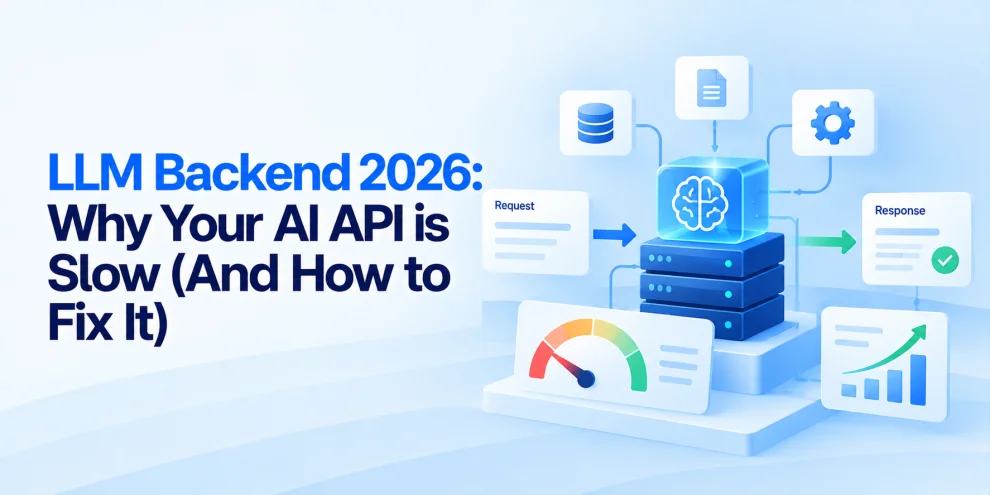
Authentication → API gateway → application logic → retrieval → prompt construction → model request → tool calls → response processing → delivery
Each stage should have its own latency measurement.
For streaming applications, teams should also track time to first token (TTFT) separately from total response time. Users often perceive an application as faster when meaningful output begins quickly, even if the complete response still takes several seconds to generate.
Without this level of measurement, optimization becomes guesswork.
Reduce Everything That Happens Before the Model
Model inference gets most of the attention, but backend work before the model request can become a significant source of latency.
Authentication services may introduce network calls. Permission checks may query databases. Retrieval systems may perform multiple searches. Reranking may add another processing stage. Prompt construction may involve assembling large amounts of information from different sources.
None of these operations should automatically happen on every request.
Engineering teams should examine the request path and ask a simple question:
Does this operation need to happen synchronously before the model can respond?
Some operations can be cached. Others can run in parallel. Some can be moved to asynchronous workflows.
For example, if an application needs user preferences and product metadata before generating a response, those independent data sources may be retrieved concurrently rather than sequentially.
Reducing unnecessary sequential work can have a substantial effect on overall latency.
Your RAG Pipeline May Be the Real Bottleneck
Retrieval-augmented generation is essential for many enterprise AI applications, but RAG can introduce several latency points.
A typical retrieval workflow may involve query transformation, embedding generation, vector search, metadata filtering, reranking, document retrieval, and context assembly.
If the application retrieves too many documents, the system spends more time processing unnecessary information. It also creates a larger prompt, which can increase model processing time and potentially reduce response quality.
The solution is not always a faster vector database.
The better question is whether the application is retrieving the right information.
Teams should evaluate retrieval latency, number of retrieved documents, filtering performance, reranking cost, cache effectiveness, and context size.
A smaller, more relevant context can often be more valuable than a large collection of loosely related documents.
Context Windows Have a Performance Cost
Large context windows are useful, but sending more information to a model is not free.
Applications sometimes solve retrieval problems by continuously increasing the amount of context included in the prompt. This can create another performance problem.
If an agent receives thousands of tokens when a few hundred relevant tokens would be sufficient, the backend is effectively paying a latency and compute penalty for information the model may never use.
Context engineering should therefore be treated as a backend optimization discipline.
Teams can improve performance by removing redundant instructions, filtering irrelevant retrieval results, summarizing older conversation history, selecting only relevant fields, and separating persistent information from temporary context.
The objective is not to provide the model with everything available.
It is to provide the model with what it needs to complete the current task.
Caching Can Change the Economics of AI APIs
Caching is one of the most effective backend techniques for reducing repeated work, but AI applications require more careful cache design than conventional APIs.
Potential candidates include embeddings, retrieval results, system-generated metadata, model responses, and frequently requested context.
However, an AI response cannot simply be cached based on the user prompt alone.
The result may depend on user permissions, tenant identity, model version, prompt version, retrieved data, application configuration, or time-sensitive information.
A cache key therefore needs to account for the factors that determine whether two requests are genuinely equivalent.
For example, a response generated for one enterprise tenant should never accidentally become available to another tenant simply because both users submitted the same question.
Performance improvements should never bypass authorization boundaries.
Parallelize Independent Operations
AI backends frequently contain unnecessary sequential execution.
Consider an agent that needs information from three independent services before calling the model. If the backend calls each service one after another, total latency becomes the sum of all three operations.
If those requests are independent, they can potentially execute concurrently.
The same principle applies to retrieval, user context, metadata services, policy checks, and other backend operations where dependencies allow parallel execution.
The architectural question should be:
Which operations actually depend on the result of another operation?
Everything else should be evaluated for concurrent execution.
This is particularly important for agentic applications, where a single user request may trigger multiple backend operations.
Tool Calls Can Create Hidden Latency Chains
AI agents introduce another performance challenge: tool calls.
An agent may call a database service, then an external API, then another internal service, before returning to the model for another reasoning step.
A single user request can therefore become a chain of model and backend operations.
If the agent performs five sequential tool calls and each call takes one second, the application has already accumulated five seconds before accounting for model latency.
Backend teams should therefore monitor tool-call frequency, execution duration, failure rates, retries, and dependency relationships.
Tools should also be designed to return the information the agent actually needs. A poorly designed tool that retrieves excessive data can increase both network latency and model context size.
For expensive operations, asynchronous execution may be more appropriate than blocking the entire user request.
Connection Management Still Matters
Traditional backend performance practices remain relevant in AI systems.
Database connection pools, HTTP keep-alive, efficient serialization, connection reuse, DNS behavior, network placement, and service-to-service communication can all influence AI application latency.
An AI request does not become magically efficient because an LLM is involved.
If the backend repeatedly establishes connections to databases and external services, those costs accumulate.
Engineering teams should therefore examine the infrastructure around the model with the same discipline they would apply to any high-throughput API.
Be Careful With Retries
Retries can improve reliability, but uncontrolled retries can make an AI application slower and more expensive.
Imagine a retrieval service that fails. The backend retries it three times. The model request then times out and is retried. A tool call also fails and triggers another attempt.
A single user request can quickly become several backend operations.
Retries should have explicit limits, appropriate backoff, and clear failure policies. Teams should distinguish between transient failures that are worth retrying and failures where another attempt is unlikely to help.
A timeout without a retry strategy is a reliability problem.
An unlimited retry strategy is a performance problem.
Model Routing Is Becoming a Backend Capability
Not every request needs the same model.
A simple classification task does not necessarily require the most capable model available. A complex reasoning task may justify a larger model. Some requests may be suitable for a local or edge model, while others require cloud inference.
This makes model routing an increasingly important backend capability.
The routing layer can consider factors such as task complexity, latency requirements, cost limits, privacy requirements, model availability, and user experience.
Instead of sending every request to the same model, the backend can select an appropriate inference path.
This can improve both performance and infrastructure efficiency.
Streaming Changes Perceived Performance
Users do not necessarily need the entire response before they see value.
Streaming allows applications to begin delivering generated output as it becomes available.
This can dramatically improve perceived responsiveness because the interface begins responding while the model is still generating.
But streaming does not eliminate backend performance problems.
If retrieval takes four seconds before generation begins, streaming cannot hide that initial delay. The backend therefore needs to optimize both pre-generation latency and generation behavior.
A good architecture combines fast retrieval, efficient prompt construction, appropriate model routing, and streaming delivery.
Concurrency Changes the Scaling Problem
An AI backend that performs well for ten simultaneous users may behave very differently under thousands of concurrent requests.
LLM applications can consume significant CPU, memory, network bandwidth, database connections, and external API capacity. Agentic workflows can amplify this because one incoming request may generate several downstream operations.
Teams should therefore measure concurrency rather than focusing only on average response time.
Useful signals include request queue depth, active model requests, connection pool utilization, tool-call concurrency, database saturation, timeout rates, and downstream service capacity.
Backpressure is particularly important.
When downstream systems are overloaded, the backend should have a controlled way to slow incoming work rather than allowing every request to continue consuming resources until the entire system becomes unstable.
Observability Should Follow the AI Request
Traditional application monitoring is not enough for complex AI systems.
A useful AI trace should allow engineers to move from the original request through authentication, retrieval, model calls, tool execution, external services, and final response generation.
This makes it possible to answer questions such as:
Where did the latency occur?
Which retrieval operation was slow?
How many model calls were made?
Did the agent call a tool repeatedly?
Which model handled the request?
How much time was spent waiting on external services?
Did retries increase the total response time?
Distributed tracing with AI-specific metadata can make these questions much easier to answer.
At the same time, teams should avoid storing sensitive prompts, responses, credentials, or customer data unnecessarily in observability systems.
Performance visibility and data protection need to be designed together.
Reliability, Security, and Cost Cannot Be Optimized Separately
An AI backend is not successful simply because it responds quickly.
A faster architecture that leaks customer data is unacceptable. A low-latency system that becomes unstable under load is not production-ready. A highly available system that spends excessively on unnecessary inference is also poorly optimized.
Backend teams therefore need to balance four dimensions:
Performance, reliability, security, and cost.
For example, aggressive caching may reduce latency but require careful authorization boundaries. Larger models may improve quality but increase cost. More retries may improve resilience but increase latency and infrastructure consumption.
Optimization should therefore be based on the application’s actual requirements rather than a single performance metric.
Define an AI Latency Budget
Engineering teams should establish explicit latency budgets for important AI workflows.
For example, a product team may define targets for authentication, retrieval, prompt construction, model time to first token, generation, and total response time.
The exact numbers will differ by application.
The important part is assigning responsibility.
If the overall target is five seconds and retrieval consumes three seconds, the team needs to understand why retrieval is consuming most of the available budget.
Latency budgets turn performance from a vague objective into an engineering constraint that can be measured across services.
Where Engineering Partners Fit
Optimizing an LLM backend requires more than changing models. It involves API architecture, distributed systems, retrieval infrastructure, databases, observability, security, caching, concurrency, and cloud infrastructure.
Engineering organizations such as GeekyAnts work across these layers, helping teams design AI applications where model capabilities are supported by production-ready backend architecture rather than isolated AI integrations.
The goal is to make the entire AI request path efficient, reliable, secure, and scalable.
What Backend Teams Should Audit
Before declaring an AI API production-ready, engineering teams should ask:
Can the full request path be traced?
Do engineers know where latency is being introduced?
Is retrieval returning more information than the model actually needs?
Are independent backend operations executed concurrently?
Are caches protected by tenant and authorization boundaries?
Are model calls routed according to workload requirements?
Are tool calls creating unnecessary sequential latency?
Are retries bounded?
Can the system handle high concurrency without exhausting downstream resources?
Is backpressure implemented?
Can teams distinguish time to first token from total response latency?
Are sensitive prompts and responses being protected in telemetry?
Does every major AI workflow have a defined latency budget?
These questions reveal performance problems that are difficult to identify by looking at model inference time alone.
The Future of LLM Backend Performance
As AI applications become more agentic, backend performance will become even more important.
The next generation of AI applications will not simply send a prompt to a model and display the response. They will retrieve information, call tools, interact with APIs, access databases, execute workflows, maintain state, and potentially switch between multiple models.
That means every additional capability creates another potential source of latency.
The strongest architectures will therefore treat AI as a distributed backend workload rather than a single API call.
Model selection will matter.
But so will retrieval design, caching, concurrency, network architecture, database performance, tool design, observability, and failure handling.
The central lesson is simple:
If your AI API is slow, do not immediately blame the model.
Trace the entire request.
Find where the time is going.
Remove unnecessary work.
Parallelize what you can.
Reduce context.
Cache carefully.
Route requests intelligently.
Control retries.
And design the backend around explicit performance budgets.
In 2026, fast AI applications will not necessarily come from teams with the biggest models.
They will come from teams that understand the entire system surrounding the model.
FAQs
What causes LLM API latency?
LLM API latency can come from model inference, retrieval, database queries, authentication, prompt construction, network calls, tool execution, retries, and other backend operations.
How can I improve LLM backend performance?
Start by tracing the complete request path. Then optimize retrieval, reduce unnecessary context, parallelize independent operations, introduce appropriate caching, improve connection management, control retries, and use model routing.
What is time to first token?
Time to first token measures how long it takes before the model begins returning generated output. It is particularly important for streaming AI applications because it strongly affects perceived responsiveness.
How can RAG latency be reduced?
Reduce unnecessary retrieval, improve indexing and filtering, limit the number of retrieved documents, optimize reranking, cache suitable results, and avoid sending irrelevant context to the model.
Does caching work for LLM applications?
Yes, but AI caching requires careful consideration of authorization, tenant identity, model versions, prompt versions, retrieved information, and other factors that can change the validity of a response.
What is model routing?
Model routing is the process of selecting different AI models based on factors such as task complexity, latency, cost, privacy, and capability requirements.
Why are AI tool calls slow?
Agentic workflows can create multiple sequential calls to APIs, databases, and external services. Each operation adds latency, and retries or repeated tool calls can increase it further.
How does streaming improve AI performance?
Streaming allows generated output to reach the user as it is produced, reducing perceived waiting time. It does not, however, eliminate latency caused by retrieval, authentication, or other work that happens before generation begins.
Why does concurrency matter for AI APIs?
AI requests can consume significant compute, database, network, and external-service resources. High concurrency can therefore create queues, timeouts, connection exhaustion, and cascading performance problems.
What should backend engineers monitor in an LLM application?
Teams should monitor total latency, time to first token, retrieval latency, model latency, tool-call duration, retries, errors, concurrency, resource utilization, cache performance, and the complete distributed trace of each AI workflow.
For more, visit our homepage!


Add Comment