






AI agents are moving beyond chat interfaces and into real business workflows. They can retrieve information, interact with APIs, inspect code, query databases, and help automate software delivery. But as organizations connect agents to more systems, a fundamental engineering problem emerges: every integration introduces another interface, authentication mechanism, permission model, and maintenance requirement.
The Model Context Protocol (MCP) is designed to simplify this challenge by providing a standardized way for AI applications to connect with external tools and data sources. Instead of building a separate integration for every AI client and backend service, developers can expose capabilities through MCP-compatible servers and reuse those integrations across supported clients.
For backend engineers, platform teams, and technology leaders, MCP represents an important shift in AI application architecture. It separates the interface through which an agent accesses a capability from the underlying system that performs the work. This can reduce integration complexity, improve reuse, and make AI-enabled workflows easier to extend.
However, MCP is not a complete agent framework, and standardizing communication does not automatically make an integration secure or reliable. Its real value depends on how organizations design, deploy, and govern the systems behind the protocol.
Why AI Agent Integration Needs a Standard
Traditional application integrations usually rely on APIs, SDKs, webhooks, and custom connectors. These approaches work well, but AI agents introduce a different requirement: they need to discover available capabilities, understand how those capabilities can be used, and invoke them based on the current task.
Consider an AI assistant that helps a development team investigate a failed deployment. It might need to retrieve CI/CD logs, inspect Kubernetes events, examine recent code changes, query monitoring data, and create an incident ticket.
Without a shared integration approach, developers may need to implement separate tool definitions and communication logic for each AI application. Adding another agent or switching AI clients can introduce more integration work.
MCP provides a common protocol for connecting compatible AI applications with systems that expose tools, resources, and reusable prompt templates.
The underlying services do not need to become AI-specific. An MCP server can act as an adapter around existing APIs, databases, repositories, or operational systems.
This creates a more modular architecture in which the AI client and the connected services can evolve independently, provided they maintain compatible interfaces.
What Is the Model Context Protocol?
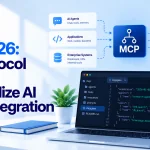
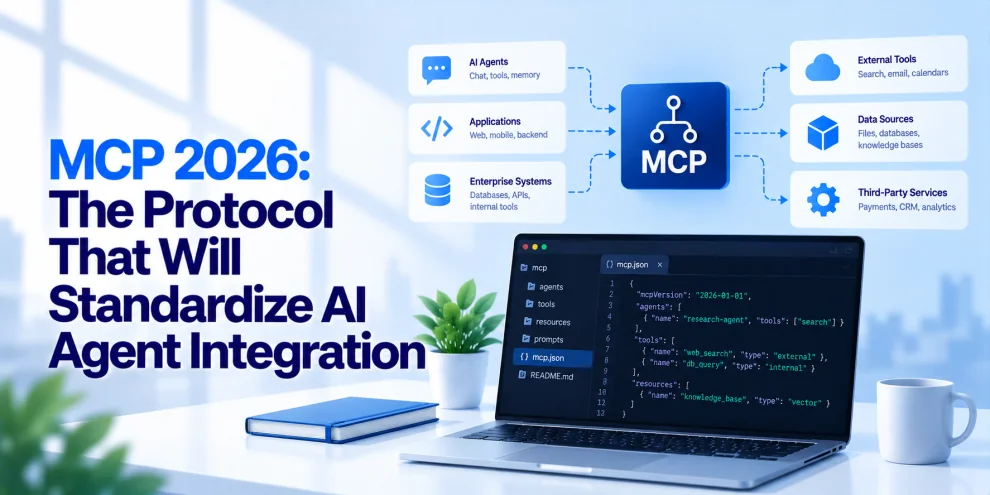
The Model Context Protocol is an open protocol that defines how AI applications communicate with external systems. It provides a consistent way to discover and access capabilities exposed by MCP servers.
A typical MCP architecture has three components.
MCP host: The AI application that coordinates the interaction, such as an AI assistant or agent runtime.
MCP client: The component within the host that establishes communication with an MCP server.
MCP server: The service that exposes capabilities from an external system, such as a database, repository, monitoring platform, or business application.
MCP servers can expose three important types of capabilities:
- Tools: Executable operations that an AI application can invoke, such as retrieving deployment status or creating an issue.
- Resources: Information that can provide context, such as documentation, service metadata, or configuration details.
- Prompts: Reusable templates that help structure interactions with a server’s capabilities.
These capabilities serve different purposes. A resource can provide the information an agent needs to understand a situation, while a tool can perform a defined operation.
For example, an MCP server connected to a source repository might expose tools for retrieving commits and pull requests, along with resources containing repository documentation. An agent can combine those capabilities to investigate a code change without requiring a custom integration for every AI client.
MCP standardizes the communication layer, while the server remains responsible for implementing the actual operations.
How MCP Changes AI Application Architecture
Without a shared protocol, AI applications can accumulate tightly coupled integrations. Each connector may have its own configuration, error handling, authentication logic, and interface definitions.
MCP introduces a more modular pattern:
AI application → MCP client → MCP server → Existing API or system
The AI application communicates through the protocol. The MCP server translates requests into operations supported by the underlying system and returns the results in a format the client can process.
This separation offers several architectural advantages.
First, integration logic can be reused across compatible AI clients. Second, existing systems can remain unchanged while an MCP server provides an additional interface. Third, engineering teams can define explicit capabilities rather than exposing entire systems without restrictions.
It also creates a clearer place to implement input validation, access controls, rate limits, and audit logging.
However, MCP does not eliminate all integration work. Every server still needs to handle the underlying service’s API, authentication requirements, errors, data formats, and operational constraints. Organizations must also verify that their selected clients and servers support the protocol versions and capabilities they require.
MCP and the Rise of Tool-Calling Agents
One of the most important applications of MCP is connecting AI agents to external tools.
A language model can interpret a request and propose a tool call, but it cannot independently access an organization’s systems without an integration mechanism.
MCP provides a standardized way for compatible clients to discover and invoke supported tools. The AI application can use those tools as part of a larger workflow.
For example, a customer support agent might need to retrieve an order, check a delivery status, and create a support ticket. Rather than embedding every integration directly into the agent, developers can expose these operations through appropriate MCP servers.
The agent can then coordinate the workflow while the underlying systems continue to enforce their own business rules.
This distinction is essential. MCP does not make an agent inherently intelligent or trustworthy. It provides a structured mechanism for accessing capabilities, while the application determines how the model selects tools, handles errors, and decides what to do next.
MCP in Backend Development
Backend engineering is one of the areas where MCP can provide practical value because many business capabilities already exist behind APIs and service boundaries.
Consider a SaaS application with separate services for customer accounts, billing, subscriptions, reporting, and support. An AI assistant may need information from several of these services to answer a complex question.
Developers can expose narrowly scoped operations through MCP servers instead of building a completely separate integration for each assistant.
A billing assistant, for example, might receive access to tools such as retrieving an invoice, checking subscription status, or generating a usage summary. It should not automatically receive unrestricted database access or permission to modify billing records.
The backend continues to validate identity, resource ownership, business constraints, and authorization. MCP provides the interface through which the AI application requests those operations.
For backend teams, the strongest use cases are those where MCP makes existing capabilities easier to discover and reuse without weakening the architecture’s security boundaries.
MCP Can Simplify DevOps and Platform Engineering
DevOps environments contain a wide range of systems, including source control, CI/CD pipelines, Kubernetes, cloud infrastructure, observability platforms, and incident management tools.
An MCP-enabled engineering assistant can connect to selected systems and gather information needed for operational tasks.
For example, when a deployment fails, the assistant might retrieve build logs, inspect recent commits, query application health metrics, and summarize relevant Kubernetes events. It could then present a likely explanation and recommend the next diagnostic step.
This can reduce the effort engineers spend switching between dashboards and manually collecting information.
MCP can also support workflows for release reporting, incident documentation, infrastructure investigation, and development assistance. The exact capabilities depend on the servers and tools that the organization deploys.
Read-only diagnostics are a sensible starting point. Operations that change infrastructure, modify permissions, or deploy software should have stricter controls and should continue to use established authorization and approval mechanisms.
MCP and Retrieval-Augmented Generation
Retrieval-augmented generation (RAG) allows AI applications to retrieve relevant information from external sources and use it as context for generating responses.
MCP can provide a standardized interface to retrieval systems, documentation stores, and other information sources. An MCP server might expose tools for searching internal documentation or resources containing relevant service information.
This can make retrieval capabilities easier to integrate into different AI applications.
However, MCP does not replace the retrieval pipeline itself. Document ingestion, chunking, embeddings, ranking, access filtering, and relevance evaluation remain separate engineering concerns.
Security is particularly important when retrieving internal information. The server must ensure that users and agents can access only the data they are authorized to see. Retrieved content should also be treated as untrusted data because documents can contain misleading or malicious instructions.
The protocol makes retrieval capabilities accessible. It does not guarantee that retrieved information is correct, relevant, or safe.
Security Must Be Built Into MCP Integrations
Standardized interfaces can make integrations easier to manage, but they can also create new pathways into sensitive systems.
An MCP server connected to a database, cloud environment, or repository may expose information or operations that should be restricted. If the server accepts untrusted input or operates with excessive permissions, a compromised agent could misuse its capabilities.
A production implementation should include several safeguards.
Authentication and authorization: Verify identities and enforce permissions at the MCP server and underlying service layers. Remote deployments should follow the applicable MCP authorization specification and use appropriately scoped credentials.
Least privilege: Expose only the tools required for the intended workflow. A diagnostic assistant should not automatically receive permission to delete production resources or modify access policies.
Input validation: Validate tool arguments, resource identifiers, parameter types, and business constraints before invoking downstream operations.
Approval controls: Require additional authorization or human approval for high-impact actions, including destructive infrastructure changes and sensitive production deployments.
Secret management: Avoid exposing credentials, private keys, tokens, or confidential configuration through tool responses. Use approved secret-management mechanisms.
Audit logging: Record tool invocations, requesting identities, authorization decisions, execution outcomes, and relevant correlation identifiers. Minimize sensitive payloads in logs.
Protection against prompt injection: Treat repository files, documents, logs, and retrieved content as untrusted input. The presence of an instruction inside retrieved content should not grant it authority to override application policy.
The fundamental rule is that an AI model should never become the sole security boundary. MCP tools must operate within deterministic permissions and backend controls.
Observability for MCP-Based Applications
Once MCP becomes part of a production application, engineering teams need visibility into both the protocol layer and the systems behind it.
A failed agent workflow might result from an unavailable MCP server, an invalid tool argument, an authorization failure, a downstream API timeout, or an error in the AI application’s orchestration logic.
Without correlated telemetry, diagnosing the problem can require manually examining several independent systems.
Useful operational metrics include request latency, tool invocation volume, success and failure rates, authorization failures, downstream API errors, timeout frequency, retry counts, and resource consumption.
Teams should also correlate MCP requests with existing application traces and incident identifiers wherever possible.
This allows engineers to distinguish between failures in the integration layer and failures in the underlying services.
Observability should also support security investigations. Unusual tool usage, repeated authorization failures, unexpected access patterns, and attempts to invoke restricted operations may indicate a misconfiguration or attack.
The goal is to make MCP integrations as observable as other production services.
Deploy MCP Servers Like Production Infrastructure
An MCP server should not be treated as a temporary connector once business-critical workflows depend on it.
It needs a clear owner, deployment process, versioning strategy, security configuration, monitoring, and recovery plan.
Containerization can provide consistent deployment environments. Kubernetes can help manage scheduling, scaling, and rollout controls where it fits the organization’s infrastructure.
Remote MCP servers should be designed for the transport and state-management model they use. Stateless request handling can simplify horizontal scaling, while persistent workflow or application state should be managed explicitly where necessary.
Teams should also establish:
- Health checks and availability monitoring.
- Timeouts and bounded retries for downstream calls.
- Rate limits and resource quotas.
- Secure configuration and credential rotation.
- Compatibility testing for clients and server versions.
- Controlled deployment and rollback procedures.
- Isolation between development, staging, and production.
These practices reduce the likelihood that an MCP server becomes a fragile dependency inside a larger AI workflow.
How to Adopt MCP Without Overengineering
Organizations do not need to connect every application to MCP immediately. The best starting point is a workflow where standardized tool access solves a clear integration problem.
Choose a limited use case, such as retrieving deployment information, searching internal documentation, or investigating failed CI jobs.
Begin with read-only capabilities and a small number of systems. Define exactly what the agent can access, how permissions are enforced, and which operational metrics will indicate success.
Then test failure scenarios. What happens when a server is unavailable? How does the agent handle invalid arguments? Can it access data belonging to another tenant? Does it behave safely when retrieved content contains malicious instructions? Can engineers trace a tool call back to the original request?
Once the integration proves reliable, expand to additional tools and workflows.
For actions that modify business or infrastructure state, integrate with existing policy engines, authorization controls, and approval processes rather than creating a separate, weaker security model for AI.
This phased approach allows teams to establish sound operational practices before MCP becomes a shared platform capability.
What MCP Does Not Replace
MCP is an integration protocol, not a substitute for the rest of the AI application stack.
It does not replace existing APIs, identity systems, databases, observability platforms, workflow engines, or agent orchestration frameworks. It does not guarantee that a model will choose the correct tool, interpret results accurately, or produce a valid conclusion.
Nor does every application need MCP. A simple application with one fixed integration may be better served by a direct API call. A complex workflow may require conventional orchestration, event-driven processing, or durable execution capabilities in addition to MCP.
The decision should depend on the integration problem being solved.
MCP is most useful when teams need a common way to expose capabilities to multiple compatible AI clients and want to reduce duplicated integration logic.
Where Engineering Teams Fit
Building production-ready AI integrations requires coordination across backend architecture, API design, AI engineering, identity management, security, and DevOps. Teams like GeekyAnts and Thoughtworks work across these engineering areas, helping organizations connect AI capabilities with existing application systems while accounting for scalability, access controls, and production operations.
The objective is not to introduce another layer of technology without a clear need. It is to create reusable, well-governed integration points that allow AI-enabled workflows to evolve without compromising the reliability of the underlying systems.
The Future of AI Agent Integration
As AI agents become more capable of interacting with business applications and engineering infrastructure, integration design will become an increasingly important part of production architecture.
MCP offers a shared protocol for compatible AI applications to discover and invoke external capabilities. That can reduce duplicated connector development and make it easier to reuse integrations across supported clients.
But standardization alone is not enough. Organizations still need secure tool definitions, reliable backend services, carefully scoped permissions, meaningful observability, and clear rules governing what an agent can execute.
The strongest MCP implementations will not give AI agents unrestricted access to every connected system. They will expose the capabilities each workflow actually needs and enforce clear boundaries around how those capabilities are used.
In 2026, the opportunity is not simply to connect more tools to AI. It is to make AI integration more reusable, more manageable, and safer to operate in production.
For more, visit our homepage!


Add Comment