






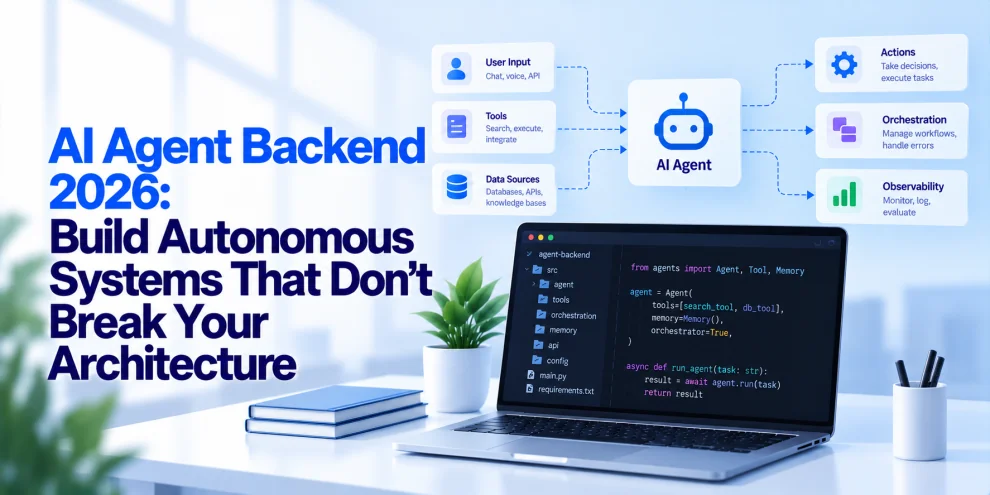

AI agents are changing how modern applications interact with users, APIs, databases, and external services. Instead of responding to a single request and stopping, an AI agent can interpret a goal, plan a sequence of steps, call tools, retrieve information, evaluate results, and continue working until it reaches an outcome. This creates opportunities for automation across customer support, analytics, financial operations, internal workflows, and software development. However, connecting an LLM to a backend API does not automatically create a reliable autonomous system. Without clear architectural boundaries, AI agents can introduce unpredictable workloads, duplicate operations, expose sensitive data, overwhelm downstream services, and make debugging significantly harder. In 2026, the challenge for backend engineers is not simply building agents that can act. It is building agents that operate safely within the constraints of a production architecture.
Why AI Agents Need a Different Backend Architecture
Traditional backend applications usually follow predefined execution paths. An API receives a request, validates the input, executes business logic, interacts with a database, and returns a response. Although the implementation may involve many services, the application’s control flow is largely determined by code.
AI agents introduce a more dynamic execution model. Based on the user’s request and the information they discover, an agent may choose different tools, perform multiple model calls, retry operations, or change its approach during execution.
For example, an AI agent handling a customer refund might retrieve an order, inspect its payment status, check refund eligibility, call a payment API, update a database record, and generate a confirmation. Each step introduces dependencies and potential failure points.
The backend must account for more than the model’s response. It must manage execution state, permissions, retries, timeouts, resource consumption, consistency, and recovery.
The fundamental principle is that an AI agent should operate within the backend architecture, not become the architecture itself.
Start With a Dedicated Agent Orchestration Layer
One common mistake is placing agent logic directly inside existing API controllers. This may work for a prototype, but it creates tightly coupled code as the number of tools, models, and workflows increases.
A better approach is to introduce an agent orchestration layer between the application interface and the backend capabilities the agent can use.
A typical architecture looks like this:
Client Application → API Gateway → Agent Orchestrator → Model Provider and Tool Layer → Backend Services → Databases
Each component has a defined responsibility.
The API gateway handles request routing, authentication integration, rate limiting, and other edge controls. The agent orchestrator manages the execution lifecycle, including planning, tool selection, step limits, and completion conditions. The model provider supplies inference, while the tool layer exposes approved operations. Existing backend services remain responsible for business rules and data access.
This separation makes it easier to change models, introduce new tools, evaluate different orchestration strategies, and enforce policies without rewriting the core application.
For larger systems, agent execution can also run in separate workers rather than inside the request-serving process. This prevents long-running reasoning tasks from consuming API server capacity.
Treat Tool Calls as Untrusted Requests
An AI agent becomes operationally powerful when it can call tools. Those tools may read customer records, search internal documents, update application state, create transactions, or interact with third-party services.
But a model-generated tool call is still an untrusted request.
The model may select the wrong tool, generate invalid parameters, misinterpret retrieved information, or respond to a malicious prompt. Backend services must not assume that an action is safe simply because an agent proposed it.
Consider an agent that generates a request to update a customer’s billing information. Before the operation executes, the backend should validate the authenticated identity, resource ownership, permitted fields, business rules, and authorization scope.
A safer design exposes narrow, purpose-built tools such as get_order_status, check_refund_eligibility, or create_support_ticket instead of unrestricted database access or general-purpose administrative APIs.
Each tool should have a clear input schema, explicit permissions, defined side effects, and predictable error handling.
The model can propose an operation. The backend must decide whether that operation is allowed.
Build a Permission Model for Autonomous Agents
Authentication and authorization become more complicated when an application can act on behalf of a user.
An agent may need to access resources using the user’s permissions, perform limited operations under a service identity, or execute an approved background task. These cases should not share one unrestricted permission model.
A production architecture should distinguish between:
- User authority: What the authenticated user is allowed to access or change.
- Agent authority: Which tools and operations the agent is permitted to invoke.
- Service authority: Which backend resources the executing service can access.
- Action-specific policy: Which conditions must be satisfied before a particular operation executes.
These boundaries help prevent an agent from using its own broad service permissions to bypass a user’s access restrictions.
Sensitive operations should be authorized at the point of execution, not only when the agent session begins. Permissions may change while a task is running, and an earlier authorization decision should not automatically authorize every subsequent action.
For high-impact operations, additional controls may include human approval, transaction limits, step-up authentication, or a second independent validation.
Make Agent Execution Durable
An AI agent may take several seconds or minutes to complete a complex task. It may depend on a remote model, a third-party API, a background job, or a human approval step.
Keeping the entire workflow inside a synchronous HTTP request is rarely a good long-term strategy.
Instead, the backend can create an execution record, enqueue the task, and process it through a worker system. The client receives an execution identifier and can retrieve status or receive updates through polling, server-sent events, or WebSockets.
A durable execution record might contain:
- Execution ID and initiating user
- Agent and workflow versions
- Current execution state
- Completed steps and tool results
- Retry count and deadline
- Approval requirements
- Error information and recovery status
The exact data model depends on the application’s requirements, but the important point is that the workflow’s state should not exist only in the model’s context window or in worker memory.
If a worker crashes or a model provider times out, the system should be able to resume, retry safely, or mark the execution for investigation without losing track of what already happened.
Design for Retries Without Duplicate Side Effects
Retries are essential in distributed systems, but they become dangerous when an agent can initiate real-world actions.
Imagine an agent submits a payment request. The payment provider processes it successfully, but the response times out. The agent sees a failure and tries again. Without appropriate controls, the customer could be charged twice.
The same problem can occur with ticket creation, email delivery, order placement, account updates, and deployment operations.
Backend engineers should design side-effecting tools with idempotency in mind. A stable operation identifier can help ensure that repeated requests refer to the same logical action. The backend should persist operation status and use the downstream service’s idempotency capabilities where available.
Retries should also be bounded by attempt limits, deadlines, exponential backoff, and jitter. Permanent validation failures should not be retried as if they were temporary network problems.
A critical distinction is that retrying an agent step is not always the same as safely retrying the underlying business operation. The backend must track which side effects have already occurred before deciding how to continue.
Keep Long-Running Agents Away From Critical Request Paths
An agent can make multiple model calls and invoke several services before completing a task. If every step happens within a single API request, latency can become unpredictable and connection pools can remain occupied for too long.
Separating agent execution from request handling helps protect the rest of the application.
A common pattern is to accept the request, validate it, create a durable job, and return an execution ID. Workers then process the job asynchronously, with bounded concurrency and controlled access to downstream services.
The backend can expose states such as queued, running, waiting_for_approval, completed, failed, and cancelled. Clients can use those states to display progress and handle incomplete work clearly.
For short, predictable interactions, synchronous execution may still be appropriate. The architecture should choose the execution model based on the expected workload rather than forcing every agent into a background job.
Control Concurrency, Cost, and Resource Consumption
Autonomous agents can generate workloads that are difficult to predict. A single request might trigger several model calls, retrieval operations, and tool invocations. Multiple agents may also execute simultaneously.
Without controls, a burst of requests can exhaust model-provider quotas, saturate worker pools, overload databases, or increase inference costs unexpectedly.
Backend systems should enforce limits at multiple levels. These can include requests per user, concurrent agent executions, maximum steps per task, maximum tool calls, execution deadlines, token budgets, and limits on expensive operations.
Concurrency controls should also protect downstream dependencies. An agent queue may contain thousands of tasks, but that does not mean thousands of workers should be allowed to query the same database simultaneously.
Use bounded queues, worker concurrency limits, backpressure, circuit breakers, and service-specific rate limits. When a downstream dependency becomes unhealthy, the agent system should pause or reduce activity rather than continuing to generate more load.
Cost monitoring should connect inference consumption to useful business outcomes. Tracking cost per completed task, successful workflow, or customer request provides more actionable information than monitoring token usage alone.
Prevent Infinite Loops and Repeated Tool Calls
Agents can get stuck in repetitive behavior. A tool may return an unexpected result, causing the model to retry the same operation. A planning loop may repeatedly alternate between two tools without making progress.
A production agent needs explicit termination rules.
These may include a maximum number of steps, a wall-clock deadline, a maximum number of repeated tool calls, a retry budget, and a clear completion condition. The orchestrator should also detect recurring action patterns and stop execution when the workflow is no longer making meaningful progress.
A model’s own judgment that a task is complete should not be the only termination mechanism.
When an execution reaches its limits, the system should return a controlled outcome, preserve diagnostic context, and provide a path for retry or human intervention.
Protect Data Across Retrieval and Agent Memory
AI agents often use conversation history, vector databases, document stores, caches, and intermediate execution state to maintain context. These components can introduce data exposure risks if they are not scoped correctly.
A retrieved document should not be accessible merely because it exists in an index. Retrieval must enforce the user’s identity, tenant, permissions, and resource access rules before content reaches the model.
Conversation memory and cached results require similar controls. A response generated for one user must not be reused for another user if the underlying data is authorization-dependent. Persistent agent state should also have explicit retention rules and access restrictions.
Prompt injection adds another complication. Instructions embedded in uploaded documents, websites, or retrieved records may attempt to influence the agent’s behavior. Treat this content as untrusted data, and never rely on a prompt instruction as the sole defense against unauthorized actions.
Data filtering, tenant isolation, tool permissions, output validation, and server-side authorization should work together to reduce the risk of leakage.
Make Agent Workflows Observable
Traditional backend observability focuses on HTTP requests, service latency, database queries, and infrastructure health. Agent-based applications need to connect those signals to the agent’s execution lifecycle.
When a task fails, engineers should be able to determine which model calls occurred, which tools were invoked, where time was spent, which downstream services failed, and whether any side effects were completed before the failure.
Distributed tracing can connect the original request to the orchestration process, model calls, retrieval operations, tool invocations, and downstream APIs. Metrics can track task completion rates, execution duration, model usage, retry frequency, tool errors, escalation rates, and cost per task.
Logs and traces should use correlation identifiers and include relevant agent, workflow, and tool versions. Raw prompts, responses, and retrieved documents should not automatically be recorded in full because they may contain confidential or personal information.
The objective is to understand how an agent behaved without turning the observability platform into another repository of sensitive data.
Test Agents Like Distributed Systems
Testing an AI agent is more complicated than checking whether an API returns the expected status code. The model’s decisions may vary, external services may fail, and the same goal may produce different execution paths.
A strong testing strategy should combine conventional software tests with agent-specific evaluation.
Unit tests can verify tool schemas, permission checks, validation rules, and orchestration logic. Integration tests can simulate model-provider failures, slow APIs, duplicate messages, and database timeouts. Workflow tests can evaluate whether an agent reaches the intended outcome under representative conditions.
Security testing should include unauthorized tool calls, cross-tenant retrieval attempts, malformed parameters, prompt injection, and attempts to bypass approval requirements. Load tests should measure what happens when many agents execute simultaneously or when a downstream dependency slows down.
Teams should also evaluate task success, unnecessary tool usage, policy violations, recovery behavior, and the frequency of human intervention.
A successful demonstration is not proof of production readiness. Agents need repeatable tests around both their intended behavior and their failure modes.
Choose Frameworks Without Coupling the Entire Backend to Them
Agent frameworks can accelerate development by providing tool abstractions, orchestration patterns, state management, and model integrations. However, placing framework-specific types and execution logic throughout the entire application can make future changes expensive.
Keep framework integration behind a dedicated boundary. Define application-owned interfaces for agent execution, tool invocation, state persistence, and policy evaluation. Keep core business rules in existing domain services rather than embedding them inside model prompts or framework callbacks.
This allows teams to change orchestration libraries or model providers without rewriting authorization, billing, customer management, or other critical backend capabilities.
The objective is not to avoid frameworks. It is to ensure that the application remains maintainable when frameworks, models, and agent patterns evolve.
A Production-Ready AI Agent Backend Architecture
A reliable design separates the system into several cooperating layers:
1. API and identity layer: Authenticates requests, validates inputs, applies rate limits, and establishes user context.
2. Agent orchestration layer: Manages execution state, tool selection, step limits, deadlines, and completion conditions.
3. Policy and tool layer: Defines approved operations, validates parameters, enforces authorization, and applies additional checks to sensitive actions.
4. Execution layer: Runs long-lived tasks through workers and queues with bounded concurrency, retry policies, and durable state.
5. Data and integration layer: Connects agents to business services, databases, retrieval systems, and third-party APIs through controlled interfaces.
6. Observability and evaluation layer: Tracks execution traces, errors, cost, performance, security events, and task outcomes.
This structure is not a requirement to create six separate microservices. Smaller applications may implement several layers within one deployable system. The important part is maintaining clear responsibilities and trust boundaries.
What Backend Engineers Should Audit Before Launch
Before deploying an autonomous agent, engineering teams should verify that every tool has explicit permissions and input validation. They should confirm that long-running executions have durable state, bounded retries, deadlines, and clear cancellation behavior. Side-effecting operations should be protected against duplicate execution, while expensive workflows should have concurrency and budget limits.
Teams should also test tenant isolation, prompt-injection defenses, authorization changes during execution, downstream outages, worker restarts, and incomplete operations. Finally, every production workflow should have sufficient observability to reconstruct what happened without unnecessarily storing sensitive content.
These checks help reveal architectural weaknesses that a successful prototype may conceal.
Where Engineering Teams Fit
Building production-grade AI agents requires more than model integration. Backend architecture, API design, data systems, authorization, workflow orchestration, observability, and reliability engineering must work together. Teams like GeekyAnts and Thoughtworks work across AI engineering and application development, helping organizations integrate intelligent workflows into maintainable software architectures with the backend controls needed for production use.
The focus should be on building agents that improve application capabilities without compromising the reliability, security, or scalability of the systems around them.
The Future of Backend Engineering Is Controlled Autonomy
AI agents will continue to make applications more capable, but autonomy introduces a new class of engineering responsibility. A model can reason about a task, select a tool, and propose an action. It cannot replace the backend’s responsibility for identity, authorization, consistency, resource limits, and recovery.
The strongest architectures will combine flexible AI reasoning with deterministic software controls. Agents will work through narrowly scoped tools, execute within bounded workflows, preserve durable state, and remain observable from the initial request to the final outcome.
For backend engineers, the goal is not to eliminate unpredictability from every model decision. It is to prevent that unpredictability from becoming uncontrolled system behavior.
A production-ready AI agent is not one that can do everything. It is one that can accomplish useful work within clearly defined architectural boundaries.
For more, visit our homepage!


Add Comment