









Cloud transformed enterprise software. AI accelerated it. Now edge computing is reshaping where applications run, how data is processed, and what customers expect from digital experiences.
For engineering leaders, the conversation has shifted. The question is no longer whether cloud is enough. It is whether cloud alone can deliver the speed, resilience, and intelligence modern businesses require.
As enterprises continue investing in AI, IoT, connected devices, autonomous systems, and real-time analytics, centralized architectures are beginning to show their limits. Every millisecond of latency affects customer satisfaction. Every unnecessary data transfer increases cloud costs. Every dependency on a distant region introduces another point of failure.
This is why edge computing has moved from an emerging technology to a boardroom discussion.
Why the Cloud Isn’t Always Close Enough
Over the last decade, enterprises consolidated workloads into centralized cloud platforms to improve scalability and reduce operational complexity.
That strategy worked exceptionally well for traditional web applications.
However, today’s enterprise platforms generate data continuously from factories, retail stores, hospitals, vehicles, cameras, payment terminals, and smart devices distributed across thousands of locations.
Sending every interaction to a centralized cloud introduces several challenges:
- Higher latency for real-time decisions
- Increasing bandwidth costs
- Regulatory concerns around data residency
- Network reliability issues
- Slower customer experiences
When milliseconds influence operational efficiency or customer engagement, processing data closer to its source becomes a business necessity rather than an architectural preference.
The Shift Toward Distributed Intelligence
Edge computing is fundamentally about moving computation closer to where data is generated.
Instead of relying exclusively on centralized cloud infrastructure, organizations distribute processing across regional locations, retail branches, manufacturing facilities, edge servers, or intelligent devices.
The result is faster decision-making without sacrificing the scalability of cloud infrastructure.
Rather than replacing cloud platforms, edge computing complements them.
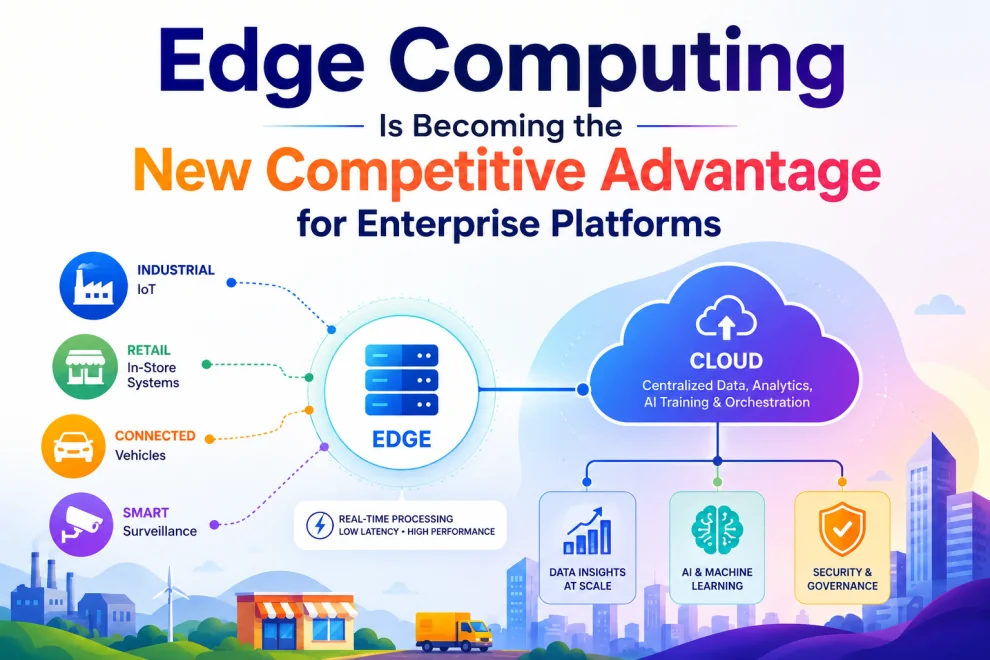
A practical enterprise architecture increasingly looks like this:
- Edge handles immediate decisions.
- Regional infrastructure aggregates operational intelligence.
- Cloud manages long-term storage, analytics, AI training, governance, and enterprise-wide orchestration.
This hybrid approach allows organizations to optimize both performance and operational efficiency.
AI Is Accelerating Edge Adoption
Artificial intelligence has unexpectedly become one of the biggest drivers of edge computing.
Many enterprise AI applications cannot tolerate several hundred milliseconds of latency.
Consider examples such as:
- Fraud detection during payment authorization
- Manufacturing defect detection
- Warehouse robotics
- Autonomous vehicles
- Smart surveillance
- Personalized retail recommendations
- Industrial safety monitoring
Waiting for cloud round trips slows decision-making.
Running optimized AI models at the edge enables near real-time inference while reserving cloud infrastructure for model training, monitoring, and continuous improvement.
This separation significantly reduces operational costs while improving user experiences.
Customer Experience Now Depends on Infrastructure Decisions
Digital experience is no longer owned exclusively by product teams.
Infrastructure decisions increasingly shape customer perception.
A customer rarely knows whether latency comes from an overloaded API, a distant cloud region, or network congestion.
They simply experience slow software.
Engineering leaders responsible for digital products are recognizing that infrastructure architecture directly influences metrics such as:
- Customer retention
- Checkout conversion
- Application responsiveness
- Service availability
- Employee productivity
Edge computing helps eliminate unnecessary network hops, enabling faster interactions even during periods of unstable connectivity.
For organizations competing on customer experience, this becomes a meaningful differentiator.
Industries Leading the Edge Revolution
Some industries have embraced edge computing earlier because their operations naturally demand real-time processing.
Manufacturing
Factories generate enormous amounts of machine telemetry every second.
Processing production data locally enables predictive maintenance, quality inspection, and operational monitoring without depending on constant cloud connectivity.
Healthcare
Medical imaging, connected devices, and clinical monitoring systems often require immediate analysis while complying with strict privacy regulations.
Processing sensitive information closer to healthcare facilities reduces latency while supporting compliance requirements.
Financial Services
Banks increasingly deploy edge infrastructure for fraud detection, branch operations, ATM networks, and low-latency financial transactions where every millisecond matters.
Retail
Modern retailers process inventory updates, digital signage, personalized promotions, and checkout operations directly inside stores while synchronizing with centralized enterprise systems.
Logistics
Fleet management, warehouse automation, and shipment tracking rely on localized intelligence that continues operating even during intermittent network conditions.
The Operational Benefits Beyond Performance
Latency often dominates discussions around edge computing, but performance is only part of the story.
Large enterprises also gain advantages in operational resilience.
If connectivity to the cloud is interrupted, edge systems can continue supporting essential business operations.
This resilience becomes increasingly valuable for organizations managing global operations across hundreds or thousands of locations.
Additional benefits include:
- Lower cloud bandwidth consumption
- Reduced infrastructure costs
- Improved business continuity
- Better regulatory compliance
- Localized data governance
- Higher application availability
For engineering executives, these improvements translate into measurable business outcomes rather than purely technical achievements.
Challenges That Cannot Be Ignored
Despite its advantages, edge computing introduces new architectural complexity.
Organizations suddenly manage hundreds or thousands of distributed compute environments instead of a handful of cloud regions.
Key considerations include:
- Secure software deployment
- Remote infrastructure management
- Device identity
- Centralized observability
- Configuration consistency
- Software updates
- Fleet monitoring
- Zero-trust security
Without standardized operational practices, distributed infrastructure can quickly become difficult to manage.
This is why successful edge strategies combine platform engineering, automation, observability, and cloud governance rather than treating edge as an isolated initiative.
Edge Computing and Platform Engineering Go Hand in Hand
Many enterprises underestimate the operational maturity required to scale edge deployments.
The organizations seeing the strongest results invest in internal platforms that standardize deployment, monitoring, security, and lifecycle management across thousands of distributed environments.
Instead of asking every engineering team to solve these challenges independently, platform teams provide reusable infrastructure capabilities.
This approach reduces operational overhead while enabling product teams to innovate more quickly.
Edge computing is therefore becoming closely connected with platform engineering rather than existing as a separate infrastructure initiative.
Building an Enterprise Edge Strategy
Before expanding edge infrastructure, engineering leaders should evaluate several strategic questions:
- Which workloads genuinely require low latency?
- What data must remain local?
- Which applications can tolerate intermittent connectivity?
- How will software updates be deployed globally?
- What observability platform will monitor distributed infrastructure?
- How will AI models be versioned across edge locations?
- How will governance remain consistent across every deployment?
Answering these questions early prevents costly architectural redesigns later.
From Technology Trend to Business Strategy
Edge computing is no longer simply another infrastructure trend.
It represents a shift toward distributed digital operations where intelligence exists closer to customers, employees, devices, and business processes.
Organizations that embrace this model are creating faster customer experiences, improving resilience, lowering operational costs, and preparing their platforms for the next generation of AI-powered applications.
As enterprise architectures continue evolving, engineering leaders will increasingly evaluate success not only by cloud scalability but by how effectively computation is distributed across the business.
Several technology partners are helping enterprises navigate this transition by combining cloud modernization with platform engineering expertise. Companies such as GeekyAnts, for example, have been working with organizations on scalable digital platforms where modern backend architecture, cloud-native engineering, and AI readiness come together. As edge adoption grows, this type of engineering-first approach becomes increasingly valuable for enterprises looking to move beyond isolated proofs of concept and build production-ready distributed systems.
Final Thoughts
The future of enterprise computing will not be cloud-only or edge-only.
It will be intelligently distributed.
The enterprises that succeed over the next decade will be those that place computation where it creates the greatest business value, whether that is in a hyperscale cloud region, a regional data center, a retail location, a factory floor, or directly on an intelligent device.
For technology executives, edge computing is ultimately less about infrastructure and more about enabling faster decisions, better customer experiences, and resilient digital operations at enterprise scale.
Those are outcomes that every engineering organization is being measured against.
For more, visit our homepage!




Add Comment