







For years, API strategy was largely a conversation between architects and backend engineers. In 2026, it has become a boardroom discussion.
Every major digital initiative, whether it’s deploying AI-powered customer support, modernizing legacy systems, launching a new digital banking platform, or building connected healthcare experiences, depends on one fundamental capability: how systems communicate with each other.
Choosing between REST, GraphQL, and gRPC is no longer about following industry trends. It is about designing a communication strategy that supports long-term scalability, operational efficiency, developer productivity, and customer experience.
Large enterprises rarely struggle because they picked the “wrong” technology. More often, they struggle because they apply one technology to every problem.
The organizations building resilient digital platforms today understand that REST, GraphQL, and gRPC each solve different challenges, and knowing where each belongs is becoming a competitive advantage.
The New Reality of Enterprise Backend Systems
Enterprise applications no longer consist of a single frontend communicating with a monolithic backend.
A typical digital platform may include web applications, native mobile apps, AI assistants, partner portals, IoT devices, analytics platforms, internal dashboards, and hundreds of independently deployed microservices. Each of these systems has different latency requirements, security constraints, and data consumption patterns.
Adding AI into the mix changes the equation even further.
Instead of requesting a single resource, AI agents often gather information from dozens of services simultaneously. A customer support assistant, for example, may retrieve account details, payment history, product information, knowledge base articles, shipping updates, recommendation models, and fraud signals before generating a response.
The communication layer has become one of the most critical components of modern platform architecture.
REST: Still the Foundation of Enterprise APIs
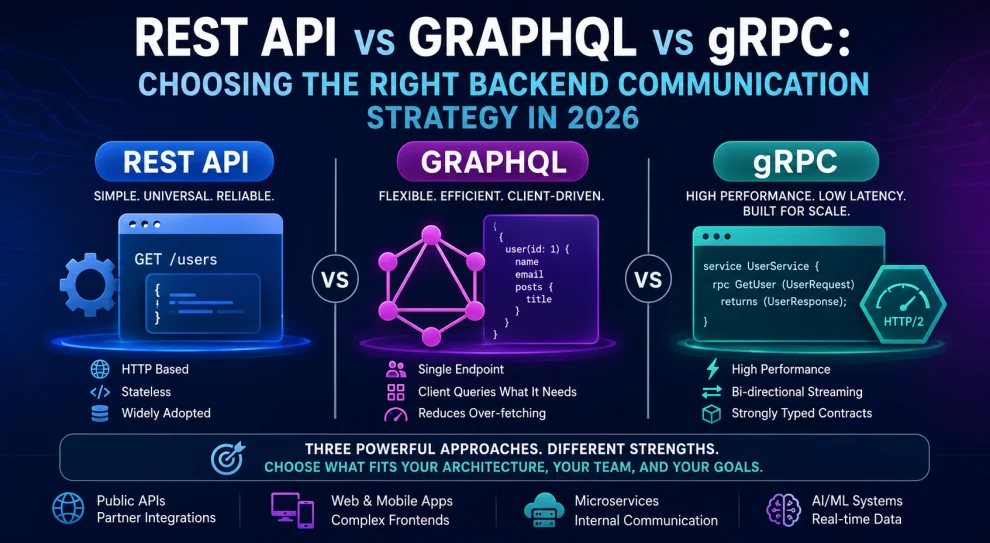
Despite frequent predictions about its decline, REST remains the dominant communication standard across enterprise software.
Its success comes from simplicity.
Every developer understands HTTP methods. Every cloud platform supports REST. Every API gateway, monitoring platform, authentication provider, and security framework has mature REST integration.
That maturity matters.
Organizations operating thousands of APIs across multiple business units value predictability far more than novelty. REST provides stable interfaces, straightforward documentation, and decades of operational knowledge.
For public APIs, partner ecosystems, third-party integrations, payment gateways, and external developer platforms, REST continues to be the safest architectural choice.
Its resource-oriented design also aligns naturally with business domains, making APIs easier to understand for distributed engineering teams.
However, modern applications expose REST’s limitations.
Complex user interfaces frequently require multiple API requests to build a single screen. Mobile applications operating over unreliable networks suffer from unnecessary round trips. AI applications often retrieve significantly more information than they actually need.
These inefficiencies may appear small in isolation, but across millions of daily requests they directly impact latency, infrastructure costs, and customer experience.
REST is not becoming obsolete. It is simply no longer sufficient for every workload.
GraphQL: Optimizing Data Consumption Rather Than Endpoints
GraphQL approaches backend communication from a fundamentally different perspective.
Instead of exposing fixed resources, it allows clients to define exactly what data they require.
For frontend teams, this removes a common source of friction.
Rather than requesting backend teams to create new endpoints whenever product requirements change, applications can compose their own queries while relying on a single schema.
This becomes particularly valuable for digital products where personalization drives competitive advantage.
Customer dashboards, e-commerce platforms, streaming services, healthcare portals, and enterprise SaaS products rarely display identical information to every user. Each interface presents different combinations of data based on permissions, preferences, device type, or business context.
GraphQL reduces unnecessary payloads while eliminating the over-fetching and under-fetching problems commonly associated with REST.
The productivity gains can be substantial.
Frontend teams iterate faster because data requirements evolve independently of endpoint design. Backend teams spend less time maintaining narrowly specialized APIs.
However, GraphQL introduces complexity that many organizations underestimate.
Since clients control query structure, poorly designed schemas can generate expensive database operations. Authorization moves beyond endpoint-level security and often requires field-level access control. Performance optimization becomes significantly more sophisticated.
Without governance, GraphQL APIs can evolve into highly flexible but operationally unpredictable systems.
Successful enterprise adoption depends as much on schema management and observability as it does on the technology itself.
gRPC: Built for Performance at Scale
While GraphQL focuses on client flexibility, gRPC focuses on efficiency.
Originally developed to support Google’s distributed infrastructure, gRPC uses Protocol Buffers and HTTP/2 to deliver highly optimized communication between services.
Unlike REST, which exchanges human-readable JSON, gRPC transmits compact binary messages.
The result is lower bandwidth consumption, reduced serialization overhead, faster communication, and stronger type safety.
These characteristics make gRPC particularly attractive for large-scale distributed systems.
Financial transaction processing, recommendation engines, AI inference pipelines, telemetry platforms, industrial IoT, and cloud-native microservices frequently require extremely high throughput with minimal latency.
In these environments, milliseconds matter.
Organizations running thousands of internal service calls every second can realize measurable infrastructure savings by adopting gRPC.
Streaming capabilities also distinguish gRPC from traditional REST APIs.
Instead of repeatedly polling for updates, services maintain persistent bidirectional communication channels that support continuous data exchange.
For real-time applications, this dramatically improves responsiveness.
The tradeoff is accessibility.
Binary payloads are less intuitive to inspect than JSON. Browser support remains limited compared to REST. Public developer ecosystems generally expect HTTP-based APIs rather than Protocol Buffer contracts.
Consequently, most enterprises use gRPC where it performs best: inside the platform rather than at its edges.
AI Is Reshaping API Design
Perhaps the biggest shift occurring in backend architecture is the rise of AI-native applications.
Traditional applications followed deterministic workflows.
Users clicked buttons.
Applications returned predefined responses.
AI systems operate differently.
They reason, retrieve context, invoke external tools, chain multiple services together, and dynamically determine which information is required to complete a task.
This creates entirely new communication patterns.
Backend services increasingly need to support streaming responses, contextual retrieval, structured outputs, long-running operations, and low-latency interactions with multiple systems simultaneously.
An architecture designed exclusively around REST often struggles under these requirements.
Conversely, replacing every REST endpoint with GraphQL or gRPC introduces unnecessary operational complexity.
The future is not about replacing one protocol with another.
It is about designing communication layers that support diverse workloads without compromising maintainability.
Why Hybrid API Architectures Are Becoming the Standard
One of the clearest trends across enterprise engineering organizations is the adoption of hybrid communication strategies.
Rather than standardizing on a single protocol, modern platforms combine multiple technologies based on workload characteristics.
REST continues to expose public APIs, partner integrations, and third-party developer interfaces because interoperability remains its greatest strength.
GraphQL powers customer-facing applications where frontend flexibility directly influences user experience.
gRPC handles internal communication between microservices where performance and efficiency take priority.
This layered approach allows engineering organizations to optimize individual systems without forcing every application into the same architectural model.
The result is greater resilience, improved scalability, and lower long-term operational costs.
Governance Determines Success More Than Technology
Technology choices receive disproportionate attention.
Governance determines outcomes.
Large organizations rarely encounter failures because REST, GraphQL, or gRPC lacked capability.
They struggle because APIs evolve without ownership, schemas drift between teams, versioning becomes inconsistent, security policies differ across business units, and observability is treated as an afterthought.
An enterprise API strategy should define much more than communication protocols.
It should establish consistent authentication models, lifecycle management practices, schema governance, monitoring standards, performance objectives, documentation requirements, and developer experience guidelines.
Organizations that invest in governance generally discover that technology selection becomes significantly easier.
Choosing the Right Communication Strategy
There is no universal winner.
REST remains the strongest option for interoperability, public ecosystems, and predictable business APIs.
GraphQL excels when applications require flexible data access across multiple user experiences.
gRPC delivers exceptional efficiency for high-performance distributed systems.
The most successful engineering organizations understand that these technologies complement one another rather than compete.
Selecting the appropriate communication model begins with understanding workload characteristics, consumer expectations, operational maturity, and long-term platform strategy instead of chasing architectural trends.
Looking Beyond the Protocol
Backend communication has evolved from an implementation detail into a strategic capability.
The organizations leading digital transformation in 2026 are not asking whether REST, GraphQL, or gRPC is better.
They are asking which combination enables faster product delivery, lower infrastructure costs, stronger governance, and better customer experiences.
That perspective is changing how enterprise platforms are built.
Rather than treating APIs as isolated interfaces, engineering leaders increasingly view them as the foundation of intelligent, composable digital ecosystems capable of supporting cloud-native applications, AI workloads, and future business models.
This is also why experienced product engineering partners increasingly recommend architecture-first decision making instead of advocating a single technology stack. Firms such as GeekyAnts, for example, approach API modernization by aligning communication patterns with business objectives, scalability requirements, and platform maturity rather than promoting REST, GraphQL, or gRPC as universal solutions.
In the years ahead, the organizations that gain the greatest advantage will not necessarily adopt the newest protocol first. They will be the ones that design backend communication as a strategic asset, giving every application, every service, and every engineering team the right tool for the job.
For more, visit our homepage!

Add Comment