






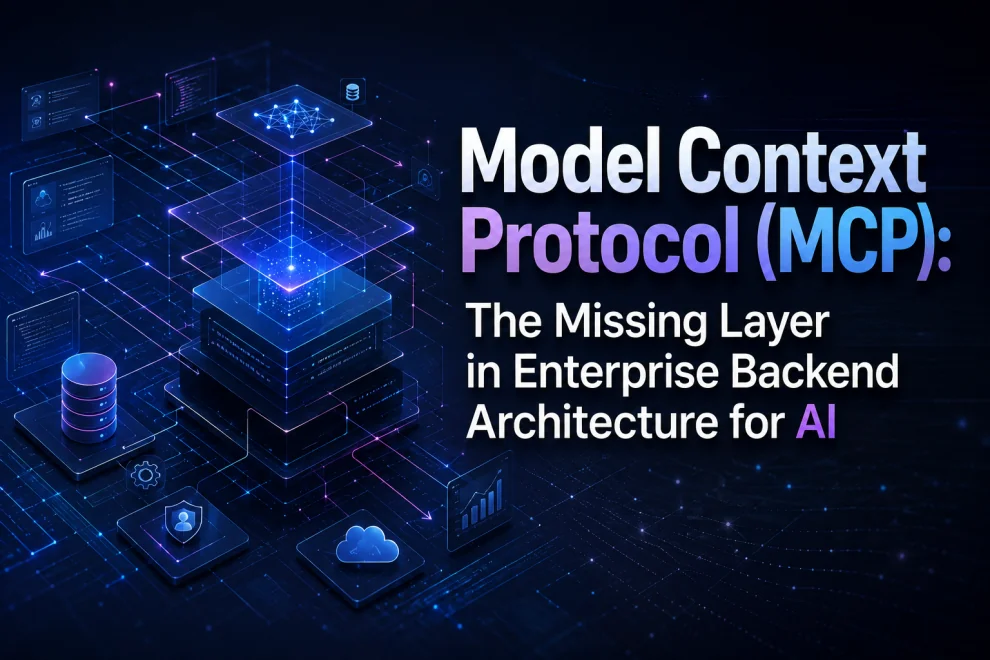

Artificial intelligence has moved beyond experimentation. Across North America, large enterprises are embedding AI into customer experiences, internal operations, software engineering, and decision-making. Yet as organizations accelerate AI adoption, many are discovering that the biggest obstacle isn’t choosing the right large language model. It’s the backend architecture supporting it.
For years, enterprises have invested in APIs, microservices, cloud-native platforms, and digital transformation programs. These investments created scalable systems for applications and users, but they weren’t designed for autonomous AI agents that can retrieve information, invoke tools, coordinate workflows, and interact with multiple enterprise systems in real time.
This architectural gap is why Model Context Protocol (MCP) is attracting attention from engineering leaders. Rather than being another AI framework, MCP provides a standardized way for AI systems to discover and interact with enterprise services. For organizations planning long-term AI strategies, it has the potential to become as significant as REST APIs were for web applications.
Enterprise AI Has Outgrown Traditional Integrations
The first generation of enterprise AI focused on chatbots, document summarization, and content generation. Most implementations relied on isolated integrations between a language model and one or two business systems.
Today’s AI initiatives are fundamentally different.
An AI-powered customer support assistant may need to retrieve CRM records, check inventory, create a support case, update billing information, and notify multiple internal teams before completing a single request. An engineering copilot might search documentation, analyze code repositories, query observability platforms, and trigger deployment workflows. These interactions span dozens of systems, each with its own APIs, authentication model, and governance policies.
As AI becomes more capable, maintaining custom integrations for every application quickly becomes unsustainable. Engineering teams spend more time building connectors than delivering business value, while platform teams inherit an increasingly complex ecosystem that is difficult to govern and scale.
Why Model Context Protocol Matters
Model Context Protocol addresses this challenge by introducing a common interface between AI models and enterprise systems.
Instead of building unique integrations for every AI application, organizations expose business capabilities through MCP servers. AI clients can then discover available tools, understand how they should be used, and securely execute actions using a standardized protocol.
The existing technology stack remains intact. APIs continue serving applications, microservices continue handling business logic, and cloud infrastructure continues operating as before. MCP simply provides an AI-native layer that allows intelligent systems to interact with enterprise platforms in a consistent way.
For engineering organizations, this reduces integration complexity while improving reusability. Once a capability is exposed through MCP, it can support multiple AI applications without requiring each team to develop and maintain its own connector.
A Platform Engineering Opportunity, Not Just an AI Initiative
For platform engineering teams, MCP represents more than a new integration standard. It aligns with the broader goal of creating reusable, governed, and developer-friendly platforms.
Over the past decade, platform engineering has helped organizations standardize infrastructure, automate deployments, simplify developer workflows, and improve operational consistency. AI introduces a new class of platform consumer. Instead of serving only developers and applications, enterprise platforms must now support AI agents capable of interacting with services autonomously.
This shift requires backend services to become discoverable, machine-readable, and governed by consistent security policies. It also demands greater visibility into how AI systems use enterprise tools, consume data, and execute workflows.
MCP provides the foundation for this evolution by enabling platform teams to expose enterprise capabilities in a way that is both scalable and manageable.
Governance Becomes a Competitive Advantage
As enterprises expand AI adoption, governance is becoming one of the most important architectural considerations.
AI agents may eventually gain access to financial systems, customer records, internal documentation, software delivery pipelines, and operational dashboards. Without strong governance, organizations risk introducing security vulnerabilities, inconsistent permissions, and compliance challenges.
Successful MCP implementations extend existing enterprise security practices rather than replacing them. Identity management, role-based access control, audit logging, approval workflows, encryption, and policy enforcement remain essential components of the architecture.
For technology executives, this is an important distinction. AI governance should not be viewed solely as a model-level responsibility. It begins with the backend infrastructure that determines what an AI system can access, how it authenticates, and which actions it is permitted to perform.
Organizations that establish these controls early will be better positioned to scale AI responsibly across business units.
Modernizing Without Rebuilding
One of the strongest advantages of MCP is that it complements existing enterprise investments instead of requiring wholesale replacement.
Large organizations have spent years modernizing legacy applications, migrating workloads to the cloud, and implementing microservices. Replacing those systems simply to support AI is rarely practical.
Instead, MCP enables enterprises to extend current platforms.
Existing APIs remain operational. Business logic continues running within established services. Infrastructure investments in Kubernetes, containers, API gateways, and cloud platforms continue delivering value. The organization simply introduces a standardized interaction layer that makes those capabilities accessible to AI systems.
This incremental approach allows engineering leaders to support AI innovation while minimizing operational risk and protecting previous modernization investments.
Customer Experience Will Depend on Backend Intelligence
Many organizations associate AI primarily with conversational interfaces. In reality, the quality of customer experience increasingly depends on backend intelligence rather than the chatbot itself.
Customers expect immediate answers, personalized recommendations, and seamless resolution of complex requests. Delivering those outcomes requires AI to access accurate business data, coordinate multiple systems, and execute workflows reliably.
Without a standardized backend architecture, even the most advanced AI model struggles to deliver meaningful business value.
MCP helps bridge that gap by enabling AI systems to interact with enterprise services through consistent interfaces, reducing integration friction while improving reliability and operational efficiency.
Preparing for the Next Phase of Enterprise AI
The pace of AI innovation shows no signs of slowing. New models, frameworks, and developer tools will continue to emerge, but organizations that focus exclusively on model selection risk overlooking the infrastructure required to support long-term AI adoption.
Enterprise success will increasingly depend on platforms that are secure, observable, interoperable, and capable of supporting multiple AI applications without duplicating integration efforts.
That is precisely where Model Context Protocol fits.
It provides a common architectural layer that allows AI systems to interact with enterprise software in a standardized and governed manner, helping organizations move from isolated AI experiments to enterprise-wide AI capabilities.
The Road Ahead
Technology leaders have seen standards reshape enterprise software before. REST transformed application integration. OAuth standardized secure authorization. Kubernetes changed infrastructure management. OpenTelemetry improved observability across distributed systems.
Model Context Protocol has the potential to become another foundational standard, this time for enterprise AI.
Organizations that begin preparing their backend architecture today will be in a stronger position to adopt future AI capabilities without repeatedly rebuilding integrations or compromising governance.
Building that foundation requires expertise across backend engineering, cloud-native architecture, platform engineering, and AI integration. Companies like GeekyAnts are helping enterprises modernize digital platforms with these principles in mind, enabling organizations to integrate AI into existing ecosystems while maintaining the scalability, security, and operational discipline expected of enterprise-grade software.
As AI becomes embedded across every business function, the conversation will shift from “Which model should we use?” to “Is our platform ready for intelligent systems?” For many enterprises, the answer will depend less on the AI itself and more on the architecture that powers it.
Frequently Asked Questions
Is Model Context Protocol a replacement for REST APIs?
No. MCP complements existing APIs by providing a standardized interface for AI systems to discover and use enterprise services. REST, GraphQL, and gRPC remain essential components of modern backend architecture.
Why should large enterprises consider MCP now?
Organizations are deploying more AI-powered applications across customer service, software engineering, operations, and analytics. MCP reduces integration complexity and creates a reusable foundation that supports these initiatives at scale.
Does adopting MCP require rebuilding existing systems?
No. Most enterprises can introduce MCP alongside their current APIs, microservices, and cloud infrastructure, allowing AI capabilities to be added incrementally without disrupting existing applications.
How does MCP improve governance?
MCP works with existing enterprise security controls, including identity management, role-based access, audit logging, and policy enforcement, helping organizations manage AI interactions in a secure and compliant manner.

Add Comment