











Backend development has always involved a certain amount of uncertainty. An API receives a request, parses its payload, checks a few fields, calls a database, and returns a response. Developers define TypeScript interfaces, create database models, and write validation logic to make sure everything behaves as expected.
But there is a fundamental problem: TypeScript types do not automatically validate data at runtime.
A request can contain an unexpected value even when the application has carefully defined interfaces. A database query can return a different shape than the developer expects. An API can expose a response that no longer matches its documented contract. These inconsistencies become harder to manage as backend systems grow.
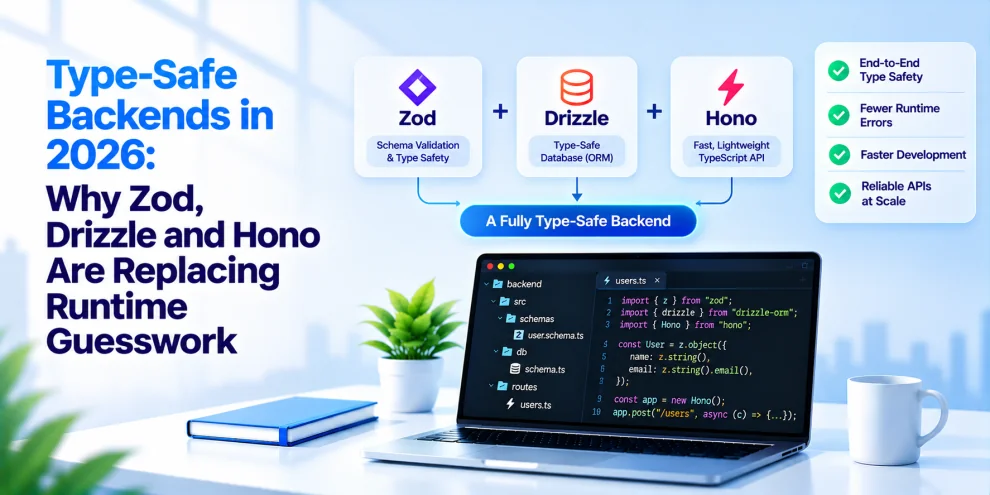
In 2026, more engineering teams are adopting a type-safe approach that connects request validation, application logic, database queries, and API responses. Tools such as Zod, Drizzle ORM, and Hono make this approach increasingly practical.
Rather than maintaining separate definitions across multiple layers, developers can build backend systems where data contracts are validated and reused throughout the application.
The goal is not simply to write more TypeScript. It is to reduce the gap between what the code assumes and what the system actually receives, stores, and returns.
The Problem With Runtime Guesswork
Consider a typical TypeScript backend.
A developer defines an interface:
interface CreateUserInput {
  name: string;
  email: string;
  age: number;
}
The application uses this interface to describe the expected request body.
However, TypeScript types are primarily enforced during development and compilation. They do not automatically validate incoming HTTP requests.
A client can still submit:
{
  "name": "Alex",
  "email": "not-an-email",
  "age": "twenty"
}
The application may accept this payload unless a runtime validation layer checks it.
This creates a gap between the expected data structure and the actual data entering the backend.
The same problem can occur with database results, environment variables, third-party API responses, webhooks, and messages received from queues.
A backend that trusts its TypeScript definitions without validating external data is still vulnerable to runtime inconsistencies.
Type Safety Needs to Extend Beyond TypeScript
TypeScript provides significant value by catching many mistakes before code reaches production. However, it cannot guarantee that external data matches the types declared in the application.
A complete type-safe backend needs to address three different responsibilities:
Runtime validation: Confirm that incoming and external data actually matches the expected structure.
Database type safety: Ensure that application queries, inserts, updates, and database schemas remain consistent.
API contract safety: Keep request parameters, responses, validation rules, and application logic aligned.
This is where Zod, Drizzle, and Hono complement each other.
They address different parts of the backend architecture while allowing TypeScript types to flow through the system.
Zod: Validate What Actually Enters the Application
<text color=”default”>Zod</text> is a TypeScript-first schema validation library. It allows developers to define schemas that validate data at runtime and infer corresponding TypeScript types.
Instead of creating a TypeScript interface and a separate validation rule, developers can define a schema and derive the type from it.
For example:
import { z } from "zod";

const CreateUserSchema = z.object({
  name: z.string().min(2),
  email: z.string().email(),
  age: z.number().int().positive(),
});

type CreateUserInput = z.infer<typeof CreateUserSchema>;
The schema describes what valid input looks like. Zod can then validate an actual request payload:
const result = CreateUserSchema.safeParse(requestBody);

if (!result.success) {
  return {
    error: "Invalid request",
    details: result.error.issues,
  };
}

const user = result.data;
If the payload does not match the schema, the application can reject it before it reaches business logic.
This makes validation an explicit part of the backend rather than an assumption based on compile-time types.
Why Schema Inference Matters
One of the biggest advantages of Zod is that the same schema can provide both runtime validation and static TypeScript types.
Without schema inference, developers may maintain separate definitions for:
- Request interfaces
- Validation rules
- API documentation
- Database input types
- Business logic parameters
Over time, these definitions can drift apart.
A shared schema reduces duplication and makes changes easier to manage.
For example, if the application changes the minimum password length, the validation rule can be updated in one place and reused wherever that schema is applied.
Use Different Schemas for Different Operations
A common mistake is using one schema for every operation involving an entity.
A user creation request, profile update, internal database record, and public API response do not necessarily have the same requirements.
A better design separates these contracts.
const CreateUserSchema = z.object({
  name: z.string().min(2),
  email: z.string().email(),
  password: z.string().min(12),
});

const UpdateUserSchema = CreateUserSchema
  .omit({ password: true })
  .partial();

const PublicUserSchema = z.object({
  id: z.string(),
  name: z.string(),
  email: z.string().email(),
});
This prevents internal fields from accidentally becoming public API fields and makes validation rules specific to each operation.
For production applications, schema design should also account for transformations, optional values, defaults, and strictness around unexpected properties.
Drizzle ORM: Bring Type Safety Closer to the Database
Runtime validation protects the application boundary, but backend consistency also depends on how data is stored and queried.
This is where <Entity value=”Drizzle ORM” category=”software” disambig=”TypeScript SQL ORM and database toolkit”/> becomes useful.
Drizzle is a TypeScript ORM that provides a SQL-oriented approach to database interaction. Developers define database schemas in TypeScript and use those definitions to obtain typed query operations.
For example, a PostgreSQL user table can be defined as:
import {
  pgTable,
  uuid,
  varchar,
  integer,
} from "drizzle-orm/pg-core";

export const users = pgTable("users", {
  id: uuid("id").defaultRandom().primaryKey(),
  name: varchar("name", { length: 255 }).notNull(),
  email: varchar("email", { length: 255 }).notNull().unique(),
  age: integer("age"),
});
The application can then query the table using Drizzle:
const user = await db.query.users.findFirst({
  where: (users, { eq }) => eq(users.email, email),
});
The query builder understands the table definition and provides TypeScript support for the fields and operations being used.
Why Drizzle Appeals to Backend Teams
Traditional ORMs often introduce abstraction layers that can make it difficult to understand the SQL being generated.
Drizzle takes a more SQL-oriented approach. Developers work with familiar database concepts while benefiting from TypeScript inference.
This is useful when teams want:
- Typed database queries
- Schema definitions close to application code
- SQL-oriented query construction
- Explicit relationships and constraints
- Migration workflows
- Better visibility into database operations
Drizzle also supports multiple database systems and drivers, so teams can choose an appropriate deployment and database configuration.
Database Types Are Not Runtime Guarantees
There is an important distinction here.
Drizzle provides type safety based on the schema definitions available to the application. It does not automatically guarantee that an existing production database has the exact same structure.
A schema change still needs to be applied through a migration process. Database constraints remain important for enforcing rules such as uniqueness, non-null values, and referential integrity.
For example, TypeScript may understand that an email field is required, but the actual database should also enforce the appropriate constraint.
Application types and database constraints should reinforce each other rather than replace each other.
Hono: Build APIs Around Typed Contracts
The third part of this stack is <Entity value=”Hono” category=”software” disambig=”Lightweight web framework for JavaScript and TypeScript”/>.
Hono is a lightweight web framework designed for JavaScript and TypeScript environments. It supports multiple runtimes, including Cloudflare Workers, Bun, Deno, and Node.js through the appropriate adapter.
Its lightweight architecture and TypeScript support make it useful for building APIs without introducing a large framework abstraction.
For example:
import { Hono } from "hono";
import { zValidator } from "@hono/zod-validator";
import { z } from "zod";

const app = new Hono();

const CreateUserSchema = z.object({
  name: z.string().min(2),
  email: z.string().email(),
});

app.post(
  "/users",
  zValidator("json", CreateUserSchema),
  async (c) => {
    const data = c.req.valid("json");

    return c.json({
      message: "User created",
      user: data,
    }, 201);
  }
);
The Zod validator middleware checks the incoming request before the route handler executes.
The handler then receives validated data instead of having to assume that the request body is correct.
Why Hono Fits This Architecture
Hono is particularly useful when developers want a lightweight API layer with explicit request handling and middleware.
Its strengths include:
- Lightweight routing
- TypeScript-first development
- Middleware support
- Runtime flexibility
- Integration with validation libraries
- Support for different deployment environments
For teams building APIs that need to run across edge and server environments, Hono offers flexibility without requiring a heavyweight application framework.
However, framework choice should still depend on the application’s requirements. Large systems may need additional conventions, dependency management, background processing, and service-layer architecture beyond what a lightweight routing framework provides.
How Zod, Drizzle and Hono Work Together
The real value of this stack comes from combining the three tools rather than evaluating them independently.
Each one protects a different part of the backend.
| Technology | Primary responsibility | What it improves |
|---|---|---|
| Zod | Runtime validation | Ensures incoming data matches defined schemas |
| Drizzle ORM | Database interaction | Provides typed queries and schema definitions |
| Hono | HTTP and API layer | Handles routing, middleware, and validated request processing |
A typical request flow looks like:
Client Request → Hono Route → Zod Validation → Business Logic → Drizzle Query → Database → Typed Response
Consider a user registration endpoint.
- Hono receives the HTTP request.
- Zod validates the incoming JSON payload.
- The application applies business rules.
- Drizzle inserts the validated information into the database.
- The API returns a controlled response.
Each layer has a defined responsibility.
The API framework handles HTTP concerns. The validation library handles runtime data checks. The ORM handles database operations. Business logic remains responsible for application-specific decisions.
This separation makes the backend easier to test, maintain, and evolve.
Build a Type-Safe Backend Without Duplicating Contracts
A common goal of this architecture is to avoid maintaining separate definitions for the same data across multiple layers.
For example, a user schema can be used to validate an incoming request and infer the TypeScript type consumed by the service layer.
Drizzle can independently define the database structure and infer types from database operations.
However, developers should not assume that a Zod schema and a Drizzle schema are automatically synchronized. They are separate schema systems unless an integration or generation approach is deliberately introduced.
Teams can use libraries and patterns that connect database schemas with validation schemas, but they should establish a clear source of truth and migration strategy.
The objective is to reduce duplication without creating hidden dependencies between layers.
Type-Safe Responses Matter as Much as Requests
Many backend teams focus heavily on validating incoming requests but overlook outgoing responses.
This can create another form of contract drift.
Imagine an API initially returns:
{
  "id": "user_123",
  "name": "Alex",
  "email": "[email protected]"
}
Later, a developer changes the database query and accidentally includes an internal field such as passwordHash in the response.
TypeScript may not prevent this if the response is not explicitly shaped or validated.
A public response schema helps define exactly what the API is allowed to return.
For example:
const PublicUserSchema = z.object({
  id: z.string(),
  name: z.string(),
  email: z.string().email(),
});

const response = PublicUserSchema.parse({
  id: user.id,
  name: user.name,
  email: user.email,
});
In many applications, explicit response mapping is sufficient. Runtime response validation can be added where the additional assurance justifies the overhead.
The important principle is that database records and public API responses should not automatically be treated as interchangeable.
Handle Environment Variables With Runtime Validation
Environment variables are another common source of runtime errors.
A TypeScript application might expect:
const port: number = Number(process.env.PORT);But the value could be missing, malformed, or outside the permitted range.
A validated environment schema provides a stronger boundary:
const EnvSchema = z.object({
  DATABASE_URL: z.string().url(),
  PORT: z.coerce.number().int().positive().default(3000),
  NODE_ENV: z.enum([
    "development",
    "test",
    "production",
  ]),
});

const env = EnvSchema.parse(process.env);
The application can validate configuration during startup and fail immediately if required values are invalid.
This is preferable to discovering configuration problems after a request reaches a production endpoint.
The same approach can be used for external service configuration, feature flags, and integration settings.
Type Safety Does Not Replace Authorization
There is an important security distinction between validating data and deciding whether an operation is permitted.
Zod can confirm that a request contains a valid user ID. Drizzle can ensure that a query uses a correctly typed field. Hono can handle the route and middleware.
None of these automatically determines whether the authenticated user is allowed to access that record.
Consider:
const userId = c.req.param("id");Even if the ID is valid, the backend must still check whether the authenticated user has permission to access the requested account.
A secure backend needs separate controls for:
- Authentication
- Authorization
- Tenant isolation
- Resource ownership
- Business rule enforcement
- Input validation
- Database constraints
Type safety reduces accidental errors. It does not eliminate the need for security architecture.
Avoid the Trap of Over-Engineering Types
Type-safe development can become counterproductive when teams try to model every possible condition through increasingly complex types.
A backend can become difficult to maintain if developers introduce excessive generic abstractions, deeply nested schemas, or complicated type transformations for relatively simple operations.
The goal should be clarity.
Use schemas where they provide meaningful validation. Keep database models understandable. Define clear service boundaries. Avoid duplicating types unnecessarily, but do not force unrelated layers into a single universal schema.
A practical architecture should make it easy for another engineer to understand where data is validated, where business rules are applied, and where database operations occur.
Testing a Type-Safe Backend
A strong type-safe architecture still needs comprehensive testing.
TypeScript compilation catches many development-time errors, but it does not prove that the complete request flow behaves correctly.
Teams should test:
Validation: Invalid payloads, missing fields, incorrect types, unexpected properties, and boundary values.
Database behavior: Constraints, relationships, transactions, migrations, and query results.
API contracts: Request parameters, response structures, status codes, and error formats.
Security: Authentication, authorization, tenant boundaries, and sensitive-field exposure.
Integration behavior: External API responses, webhook payloads, and environment configuration.
Deployment compatibility: Runtime support, database drivers, environment variables, and production migrations.
A useful testing strategy combines unit tests, integration tests, contract tests, and end-to-end tests.
The objective is to verify that the contracts defined in code remain accurate when the application interacts with real systems.
When This Stack Makes Sense
Zod, Drizzle, and Hono are particularly relevant for teams building TypeScript-based APIs that value lightweight architecture, explicit validation, and strong type inference.
They can be a good fit for:
- New Node.js and TypeScript backend services
- Serverless and edge API workloads
- Internal APIs and microservices
- SaaS applications
- Backend-for-frontend services
- Applications using PostgreSQL or other supported databases
- Teams looking to reduce duplicated validation and type definitions
However, this stack is not automatically the best choice for every backend.
Organizations with established frameworks, complex enterprise integrations, specialized ORM requirements, or significant existing infrastructure should evaluate migration costs and operational requirements before adopting it.
The right architecture is the one that fits the system’s performance, security, maintainability, and team requirements.
What Backend Engineers Should Start Doing in 2026
Teams looking to reduce runtime uncertainty should begin with their existing API boundaries.
Identify endpoints that accept unvalidated JSON. Review where external API responses enter the application. Check whether environment variables are validated at startup. Examine whether database constraints match the assumptions made by the application.
Then introduce runtime schemas where they provide the most value.
A practical adoption approach could look like this:
- Start with Zod validation for critical API inputs.
- Establish shared schemas for common request and response contracts.
- Introduce typed database operations through Drizzle where appropriate.
- Use Hono for lightweight API services where its runtime and middleware model fit.
- Separate validation, business logic, and database access.
- Add tests for invalid inputs, database constraints, and API responses.
- Establish consistent error handling and migration practices.
This incremental approach is often more effective than rewriting an entire backend simply to adopt a new technology stack.
Where Engineering Teams Fit
Building a reliable TypeScript backend requires more than selecting a framework or ORM. API contracts, database design, runtime validation, authorization, testing, deployment, and long-term maintainability need to work together.
Teams like GeekyAnts and Thoughtworks work across backend engineering, application architecture, and modern product development, making this broader engineering perspective relevant for organizations modernizing their TypeScript services. The focus should be on creating backend systems where data contracts are explicit, application boundaries are secure, and engineering teams can evolve services without introducing unnecessary runtime uncertainty.
The Future of Backend Development Is Contract-Driven
TypeScript has made backend development more predictable, but compile-time types alone cannot guarantee that external data is valid or that production systems behave as expected.
That is why runtime validation, typed database operations, and explicit API contracts are becoming increasingly important.
Zod helps validate the data entering and moving through an application. Drizzle provides typed interaction with database schemas and queries. Hono offers a lightweight foundation for building APIs around those contracts.
Together, they provide a practical approach to reducing runtime guesswork.
The real benefit is not simply fewer type errors. It is a backend architecture where developers have a clearer understanding of what data is accepted, how it is stored, and what the application exposes.
In 2026, type safety should not stop at the editor. It should extend to the boundaries where real application data enters, moves through, and leaves the backend.
For more, visit our homepage!





Add Comment