










Modern enterprise applications are expected to remain responsive across unreliable networks, distributed teams, and geographically dispersed operations. For organizations operating across North America and other regions, depending entirely on a centralized backend can introduce latency, connectivity issues, and synchronization challenges.
This is where local-first architecture is becoming increasingly relevant. Instead of making the network a requirement for every user action, local-first applications keep important data and application state close to the user. Changes can then synchronize with backend systems when connectivity is available.
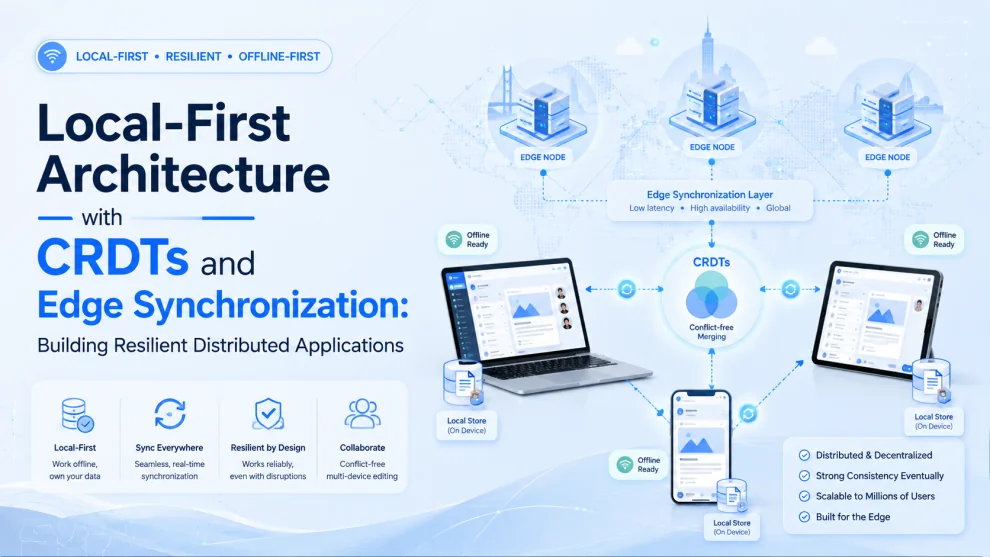
When combined with Conflict-Free Replicated Data Types (CRDTs) and edge synchronization, this approach can help organizations build applications that remain responsive while maintaining distributed data consistency.
What Is Local-First Architecture?
Traditional applications generally follow a centralized model:
User → Application → API → Database
A user performs an action, the application sends a request to the backend, and the response determines the next state.
Local-first architecture changes this relationship by allowing the application to perform important operations locally.
The model becomes:
User → Local State → Synchronization Layer → Backend
The application can respond immediately to many interactions instead of waiting for a round trip to a remote server.
This is especially useful for mobile applications, field-service platforms, logistics systems, collaboration products, industrial applications, and enterprise workflows where connectivity cannot always be guaranteed.
Why Edge Synchronization Matters
Geographic distance can introduce latency into centralized systems. Edge infrastructure addresses this by placing certain computing and synchronization capabilities closer to users.
A distributed application might use a structure such as:
Device → Local State → Edge Service → Regional Infrastructure → Central Platform
The objective is not to replace centralized systems. Instead, organizations can distribute workloads based on latency, availability, consistency, and security requirements.
For example, a retail application used across hundreds of locations could allow users to continue working locally while synchronizing changes through regional infrastructure. This can reduce dependency on a distant centralized service and improve the user experience during temporary network disruptions.
Understanding CRDTs
Synchronization becomes complicated when multiple users or devices modify the same information independently.
Imagine two employees editing the same record while both are temporarily offline. When their devices reconnect, the system must determine how those changes should be combined.
A simple last-write-wins approach can cause one update to overwrite another.
Conflict-Free Replicated Data Types, commonly known as CRDTs, provide a way to handle certain distributed updates without requiring every replica to communicate with a central system before making changes.
CRDTs are data structures designed so independently made changes can be merged according to deterministic rules. Replicas can therefore accept changes independently and eventually converge toward the same logical state.
How CRDT-Based Synchronization Works
The process is relatively straightforward.
A user makes a change on their device. The application records that change locally, allowing the user to continue working without waiting for the backend.
When connectivity becomes available, the change is transmitted to the appropriate synchronization service. Other replicas receive the update and apply the CRDT merge rules.
Over time, the replicas converge.
This creates an important separation between local responsiveness and global synchronization. The user experience does not necessarily have to depend on the availability of a central service for every interaction.
CRDTs Are Not a Universal Solution
CRDTs are useful for specific classes of distributed problems, but they should not automatically be used in every architecture.
They are well suited to scenarios where independent changes can be merged according to clearly defined rules, such as collaborative editing, shared tasks, distributed notes, and certain offline-first applications.
Other systems require stronger transactional guarantees. Financial transactions, inventory reservations, and workflows requiring strict ordering may need different consistency models.
The right starting point is therefore the application’s consistency requirement rather than the technology itself.
Designing the Local Data Layer
The local data layer becomes one of the most important components of a local-first application.
Engineering teams need to determine what information users actually need while offline and what data should remain centralized.
Replicating everything to every device can increase security, storage, synchronization, and operational complexity.
A better approach is to determine which data is essential for local workflows and define how that information should be synchronized.
The design also needs to account for data sensitivity, update frequency, user permissions, retention requirements, and synchronization conflicts.
Security Considerations
Local-first architecture introduces an additional security surface because data may exist on user devices for longer periods.
Organizations need to consider how local information is encrypted, how authentication is managed, what happens when permissions change, and how data can be removed when a device is lost or a user leaves the organization.
For enterprise applications, local storage may need strong encryption, secure authentication, device management, access controls, and remote invalidation mechanisms.
Security should be part of the architecture from the beginning rather than added after synchronization has been implemented.
Observability Across Distributed Systems
Local-first systems also require a broader approach to observability.
Traditional monitoring focuses heavily on centralized services. Distributed applications require visibility across devices, synchronization services, edge infrastructure, APIs, and backend systems.
Engineering teams need to understand whether a synchronization problem originated from a device, network connection, edge service, API, or central database.
Useful operational signals include synchronization latency, failed synchronization attempts, conflict frequency, queue delays, and replica convergence.
Without this visibility, diagnosing distributed application failures can become significantly harder.
CI/CD for Local-First Applications
Testing a local-first application requires more than validating normal connected operation.
Engineering teams need to reproduce the conditions that make synchronization difficult.
Network interruptions, offline updates, reconnection, concurrent edits, duplicate operations, out-of-order events, partial synchronization, and application version differences should all be considered during testing.
This makes automated testing particularly important for enterprise applications where synchronization issues can affect large numbers of users.
A mature CI/CD pipeline should validate both application behavior and distributed data behavior before releases reach production.
Local-First Architecture and AI
AI applications can also benefit from distributing processing closer to users.
Some lightweight workloads may run directly on devices, while more demanding inference can be handled by edge or centralized infrastructure.
This creates a layered model:
On-device AI → Edge AI → Central AI Services
On-device processing can reduce latency and, in certain cases, limit how much data needs to leave the device. Edge infrastructure can handle workloads that require more resources while remaining geographically closer to users.
However, teams need to consider device capabilities, model size, privacy, accuracy, energy consumption, inference costs, and model update strategies before adopting this architecture.
A Practical Enterprise Scenario
Consider a field-service organization whose technicians work across locations with inconsistent connectivity.
A conventional application may require constant access to centralized APIs for customer information, equipment records, inspection forms, and work orders.
With a local-first architecture, the required information can be made available locally. Technicians can continue completing their workflows even when connectivity is temporarily unavailable.
Once the connection returns, the application synchronizes changes with the backend. If multiple users changed the same information, the synchronization layer applies the appropriate conflict-resolution rules.
For organizations operating across large geographic areas, an edge layer can further improve synchronization performance.
This approach can turn network interruptions from a workflow blocker into a condition the application is designed to handle.
Building the Architecture Requires Cross-Functional Engineering
Local-first systems sit at the intersection of application development, backend engineering, distributed data, APIs, infrastructure, security, and DevOps.
For organizations that need engineering support across these areas, companies such as GeekyAnts can contribute to mobile and web application development, backend systems, AI integration, and DevOps. The important consideration is to treat local-first architecture as an end-to-end system design problem rather than simply adding a synchronization layer to an existing application.
The architecture should be based on actual workflows, connectivity patterns, data requirements, security constraints, and consistency expectations.
A Practical Adoption Approach
Organizations do not need to redesign their entire application estate around local-first principles.
A more practical approach is to start with a workflow where connectivity problems have a measurable impact.
The first step is identifying which user journeys genuinely need offline capability. From there, teams can classify the data required for those workflows and determine what level of consistency each operation requires.
Once those requirements are clear, engineering teams can evaluate CRDTs, event-based synchronization, replication, queues, or other approaches.
Edge infrastructure can then be introduced where it provides measurable improvements in latency or availability.
Observability and automated testing should be incorporated from the beginning so teams can monitor synchronization behavior and reproduce failure scenarios before they become production problems.
The Future of Distributed Applications
Centralized architectures will remain appropriate for many enterprise workloads. But applications that require offline capability, real-time collaboration, geographic distribution, or consistently responsive experiences may benefit from a different model.
Local-first architecture provides a way to separate user experience from constant network availability. CRDTs can help solve specific synchronization problems, while edge infrastructure can bring services closer to users.
The real value comes from combining these technologies with thoughtful data modeling, security, observability, and DevOps practices.
For enterprise engineering leaders, the question is no longer simply whether an application is cloud-based or on-premises. It is whether the architecture can remain responsive, resilient, and consistent when users, devices, and infrastructure are distributed across the real world.
For more, visit our homepage!



Add Comment