










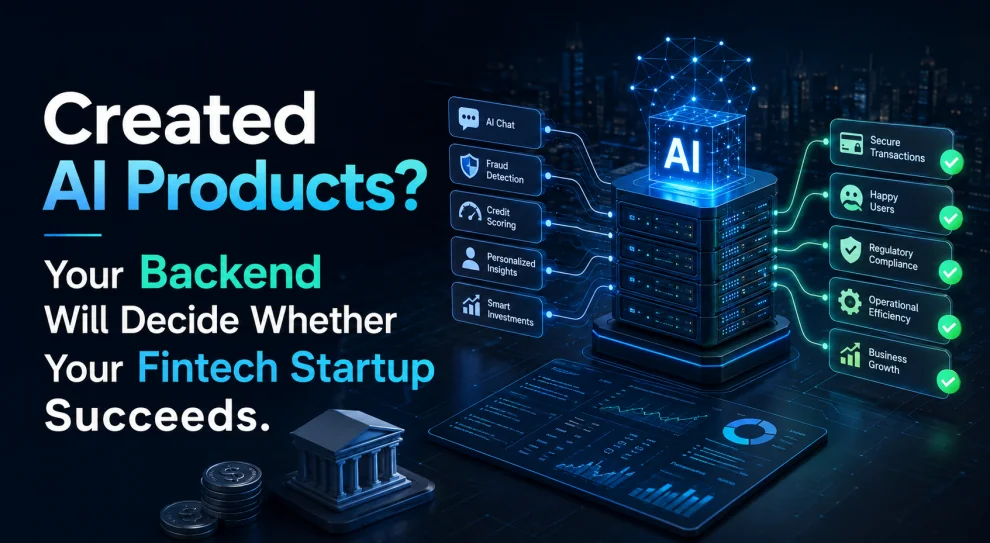

The race to build AI-powered fintech applications has never been faster. Generative AI has made it possible for startups and enterprises alike to launch financial assistants, fraud detection systems, lending platforms, investment copilots, and customer support agents in a matter of months instead of years. While these products often impress with polished interfaces and conversational experiences, their long-term success depends on something users rarely notice: the backend.
Behind every AI-generated recommendation, every payment authorization, and every automated financial decision is a backend responsible for processing sensitive data, orchestrating AI services, maintaining compliance, and ensuring that every transaction is accurate and secure. For engineering leaders, this shift changes the conversation from “How do we add AI?” to “Can our backend support AI at production scale?”
Traditional fintech applications were primarily designed to process transactions, authenticate users, and integrate with banking systems. AI changes those requirements entirely. A modern fintech backend is expected to coordinate large language models, vector databases, real-time analytics, fraud detection engines, document processing pipelines, payment gateways, and external financial APIs simultaneously. Instead of serving as a data layer, the backend has become the intelligence layer that connects every moving part of an AI-driven financial platform.
This evolution also introduces a level of complexity that many organizations underestimate. Every AI interaction generates additional requests, consumes compute resources, and relies on multiple services working together in real time. If even one component experiences delays, the impact extends across the entire customer journey. A chatbot responding slowly may frustrate users, but an AI-powered payment recommendation or lending decision arriving too late can directly affect business outcomes and customer trust.
Many engineering teams have started recognizing that production-ready AI requires far more than integrating an LLM API. Companies such as GeekyAnts have highlighted this shift through their work on AI product engineering, emphasizing scalable backend architectures, secure API ecosystems, and cloud-native infrastructure that allows financial applications to move from prototypes to reliable production systems. It reflects a broader trend across the fintech industry: success increasingly depends on engineering discipline rather than AI features alone.
Scalability has therefore become one of the defining characteristics of successful fintech backends. Unlike conventional applications with relatively predictable workloads, AI platforms experience highly variable traffic patterns driven by inference requests, document analysis, semantic searches, and automated workflows. Backend architectures need to accommodate these fluctuations without sacrificing response times or driving cloud costs out of control. Engineering teams increasingly rely on distributed services, asynchronous processing, intelligent caching, and event-driven systems to maintain consistent performance under growing demand.
Security becomes even more critical as AI enters financial systems. Banks and fintech companies already operate under strict regulatory frameworks, but AI introduces entirely new attack surfaces. Protecting customer data now involves more than encryption and authentication. Organizations must secure AI pipelines against prompt injection, unauthorized model access, data leakage, and malicious API usage while maintaining detailed audit trails for every automated decision. Backend systems must enforce these protections without slowing down user experiences, making security an architectural principle rather than a feature added later.
Compliance follows the same pattern. Financial regulations require complete visibility into how transactions are processed and how decisions are made. When AI contributes to fraud detection, credit assessment, or customer onboarding, backend services must record every request, response, model interaction, and approval step. This level of observability enables organizations to satisfy regulatory requirements while also providing engineering teams with the information needed to diagnose issues before they affect customers.
Another defining characteristic of AI-powered fintech platforms is the growing dependence on APIs. Modern applications rarely operate in isolation. They continuously communicate with payment processors, banking networks, identity verification providers, anti-money laundering services, tax platforms, investment systems, and AI inference providers. Each integration introduces additional latency, dependencies, and potential failure points. Backend engineering therefore shifts toward resilient API orchestration that gracefully handles outages, retries failed requests, manages rate limits, and ensures that financial operations remain consistent even when external services become unavailable.
This focus on resilient engineering is also influencing how organizations choose technology partners. Beyond AI expertise, businesses increasingly evaluate backend architecture, DevOps maturity, cloud scalability, and long-term maintainability. Firms like GeekyAnts have positioned themselves around this production-first approach, helping organizations modernize backend systems so AI capabilities can operate securely and reliably within complex financial ecosystems rather than existing as isolated features.
Observability has also taken on a broader meaning. Traditional infrastructure monitoring focused on server health, database utilization, and application uptime. AI systems demand visibility into inference latency, token usage, prompt success rates, API performance, queue delays, infrastructure spending, and model behavior. Without these insights, engineering teams struggle to distinguish between application bugs, infrastructure bottlenecks, and AI-related performance issues. Comprehensive monitoring enables faster troubleshooting while providing valuable data for optimizing both system reliability and operational costs.
Cost efficiency has emerged as another competitive differentiator. Running AI continuously across financial platforms can significantly increase infrastructure expenses if backend systems are not carefully designed. Organizations that optimize request routing, reduce redundant inference, implement intelligent caching, and choose appropriate models for specific workloads often achieve better performance while spending considerably less on cloud resources. In many cases, backend optimization delivers greater business value than upgrading to larger or more capable AI models.
These challenges explain why backend engineering is becoming central to fintech innovation. Building an AI application is no longer simply a matter of connecting a language model to an existing platform. It requires designing systems capable of processing sensitive financial data, scaling intelligently, maintaining regulatory compliance, integrating seamlessly with complex financial ecosystems, and remaining resilient under constant operational pressure. The quality of that architecture ultimately determines whether an AI product becomes a trusted financial service or another short-lived technology demonstration.
As AI continues to reshape financial services, the most successful organizations will not necessarily be those with the most sophisticated models or the most impressive interfaces. They will be the ones that invest in backend platforms capable of supporting intelligent applications reliably, securely, and at scale. Customers may never see the infrastructure that powers their financial experiences, but they notice when payments fail, recommendations arrive too late, or services become unavailable. In the AI era, backend engineering has become one of the most important competitive advantages a fintech company can build.





Add Comment