







The future of retail is not being shaped only by AI. It is being shaped by the backend systems that make AI practical at enterprise scale.
Introduction
Artificial intelligence has rapidly become one of the biggest drivers of innovation in retail. From personalized product recommendations and intelligent search to dynamic pricing and conversational shopping assistants, AI is changing how customers discover, compare, and purchase products. While these experiences are highly visible, the technology enabling them operates behind the scenes.
For enterprise retailers across the United States, the focus has shifted from adding AI features to rebuilding the backend infrastructure that powers them. Many organizations have discovered that legacy commerce platforms were designed for predictable online transactions, not for AI systems that continuously analyze data, make recommendations, and respond to customer interactions in real time.
As a result, backend modernization has become a strategic priority for engineering leaders responsible for digital transformation. Modern backend architecture is no longer viewed as a technical upgrade. It is becoming the foundation for scalable AI adoption, operational resilience, and long term business growth.
Why Legacy eCommerce Platforms Are Reaching Their Limits
Many enterprise retailers still rely on backend systems built years ago when online shopping primarily involved browsing products and completing transactions. These platforms were successful because they supported stable business operations, but they were not designed for today’s AI driven workloads.
Modern commerce platforms now process customer behavior, inventory updates, pricing changes, supplier information, logistics data, loyalty programs, and payment transactions simultaneously. AI systems consume this information continuously to generate recommendations, predict demand, optimize pricing, and improve customer experiences.
Legacy architectures often struggle under these requirements because they depend on tightly connected services, outdated integration methods, and limited scalability. Engineering teams frequently spend more time maintaining existing systems than delivering new capabilities.
Rather than extending these environments further, many retailers are choosing to modernize the backend itself.
AI Shopping Requires a Different Type of Backend
Traditional commerce applications were built around customer requests. A shopper searched for a product, added it to the cart, and completed a purchase. AI introduces a completely different operating model where backend systems must constantly process information, analyze patterns, and make decisions before customers even perform an action.
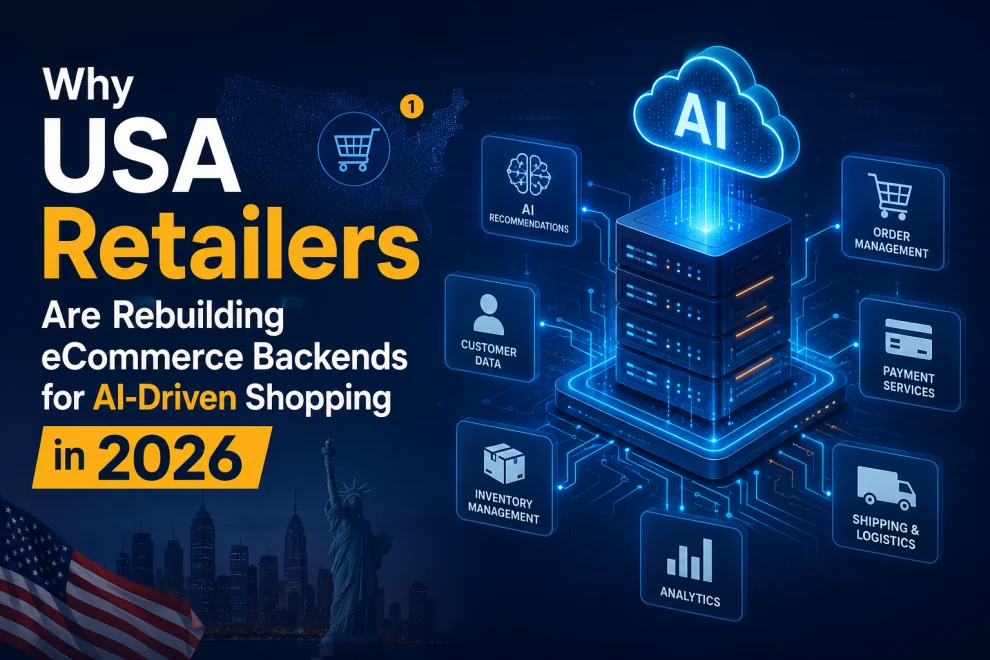
Recommendation engines continuously evaluate browsing history, purchase behavior, inventory availability, regional demand, and seasonal trends. Conversational shopping assistants retrieve product information, shipping estimates, pricing rules, and customer account details within seconds. Fraud detection systems inspect transactions while payments are being processed.
These capabilities require backend services that can exchange information quickly, scale independently, and remain available under heavy workloads.
API First Development Has Become Essential
Modern retail platforms interact with significantly more systems than they did only a few years ago. Mobile applications, websites, AI assistants, warehouse management systems, payment providers, delivery partners, customer support platforms, and analytics tools all rely on APIs to exchange information.
An API first approach allows organizations to introduce new technologies without rebuilding the entire platform. Engineering teams can integrate AI services, launch new customer experiences, or expand into additional sales channels while keeping core business operations stable.
This flexibility has become especially valuable as AI capabilities continue to evolve at a rapid pace.
Microservices Improve Scalability and Speed
Many enterprise organizations are replacing monolithic commerce platforms with microservices based architectures.
Instead of maintaining one large application, retailers separate critical business functions into independent services such as product catalogs, customer accounts, inventory management, order processing, payments, promotions, and search. Each service can be developed, deployed, and scaled independently.
This approach reduces deployment risk, accelerates software delivery, and allows engineering teams to improve individual components without affecting the entire platform. It also makes AI integration easier because new services can be introduced alongside existing business capabilities instead of replacing them.
Real Time Data Has Become a Competitive Advantage
Artificial intelligence depends on accurate and current information. If inventory levels, pricing, customer preferences, or order status are delayed, AI recommendations quickly lose their value.
Many enterprise retailers are replacing scheduled synchronization processes with event driven architectures that distribute updates immediately across connected systems.
When inventory changes in a warehouse, pricing is updated, or a customer completes a purchase, these events become instantly available to AI models, customer applications, and operational systems. This enables faster decision making while improving customer satisfaction and operational efficiency.
Cloud Native Infrastructure Supports Enterprise Growth
Retail demand is becoming increasingly unpredictable. Seasonal shopping events, promotional campaigns, social media trends, and AI powered marketing initiatives can generate dramatic increases in customer traffic within minutes.
Cloud native infrastructure provides the flexibility needed to respond to these changes automatically. Applications can scale according to demand, maintain high availability, and reduce operational costs without requiring engineering teams to provision excess infrastructure months in advance.
For organizations managing millions of customers across multiple regions, cloud native platforms have become a critical part of backend modernization strategies.
Security Cannot Be an Afterthought
As backend systems become more connected, the attack surface also expands.
Enterprise retailers must protect customer identities, payment information, internal APIs, AI services, supplier integrations, and sensitive business data across multiple environments.
Modern backend platforms increasingly adopt Zero Trust security principles, encrypted communication, strong identity management, API authentication, continuous monitoring, and automated threat detection. These capabilities are no longer optional for organizations operating at enterprise scale, particularly when AI systems access large volumes of customer and operational data.
Data Quality Determines AI Success
Organizations often focus on selecting the most advanced AI models while overlooking the importance of backend data quality.
AI systems depend on reliable customer profiles, consistent product catalogs, accurate inventory information, clean transaction histories, and standardized business data. If this information is incomplete or inconsistent, AI generated recommendations become less reliable regardless of the sophistication of the underlying model.
Successful AI initiatives therefore begin with strong data governance supported by modern backend architecture.
Observability Is Becoming a Business Requirement
Enterprise engineering teams can no longer measure success only through server uptime.
Modern retail platforms require visibility into API performance, database latency, recommendation quality, checkout completion rates, event processing, infrastructure utilization, and AI response times.
Comprehensive observability allows engineering teams to identify performance issues before they affect customers, enabling faster incident response while improving system reliability across the entire commerce platform.
Choosing the Right Engineering Partner
Modernizing an enterprise commerce backend is a long term architectural initiative rather than a short term development project.
Engineering leaders increasingly evaluate partners based on their experience with distributed systems, cloud native technologies, API design, DevOps practices, security, platform engineering, and enterprise scale software delivery. Technical leadership, open source contributions, and proven expertise in building scalable digital products are also becoming important evaluation criteria.
Companies such as GeekyAnts are often included in these conversations because of their work across modern application development, cloud native engineering, and open source technologies. Rather than focusing solely on implementation, enterprise organizations increasingly value partners who can contribute to long term platform evolution while supporting complex engineering initiatives.
Conclusion
The next generation of retail innovation will be built on modern backend architecture rather than customer interfaces alone.
Artificial intelligence is increasing the complexity of commerce platforms, making scalable backend systems essential for delivering personalized experiences, supporting real time operations, protecting customer data, and enabling continuous innovation.
For engineering executives responsible for enterprise technology strategy, backend modernization is no longer simply an infrastructure project. It is an investment that influences customer experience, operational efficiency, business agility, and competitive advantage for years to come.
Frequently Asked Questions
Why are enterprise retailers rebuilding their eCommerce backends?
Retailers are modernizing backend systems because legacy architectures cannot efficiently support AI powered recommendations, real time personalization, dynamic pricing, and rapidly growing digital commerce workloads.
Why is backend architecture important for AI powered shopping?
AI applications rely on backend systems to process customer data, inventory information, pricing, payments, and order management in real time. Without scalable backend architecture, AI experiences become slower and less accurate.
What technologies are commonly used in modern eCommerce backend development?
Many enterprise organizations adopt microservices, API first architecture, cloud native infrastructure, event driven systems, containerization, distributed databases, and automated DevOps pipelines to improve scalability and reliability.
How does backend modernization improve customer experience?
A modern backend enables faster search results, real time inventory visibility, accurate product recommendations, seamless checkout experiences, improved order tracking, and better application performance across digital channels.
What should engineering leaders consider when selecting a backend development partner?
Organizations should evaluate experience with enterprise architecture, cloud technologies, security, DevOps, distributed systems, API development, AI integration, and long term platform modernization rather than focusing only on implementation costs.
Why is data quality important for AI in retail?
Artificial intelligence depends on accurate and consistent business data. Clean customer information, reliable inventory records, and standardized product catalogs help AI systems deliver better recommendations and more accurate business insights.
For more, visit our homepage!


Add Comment