









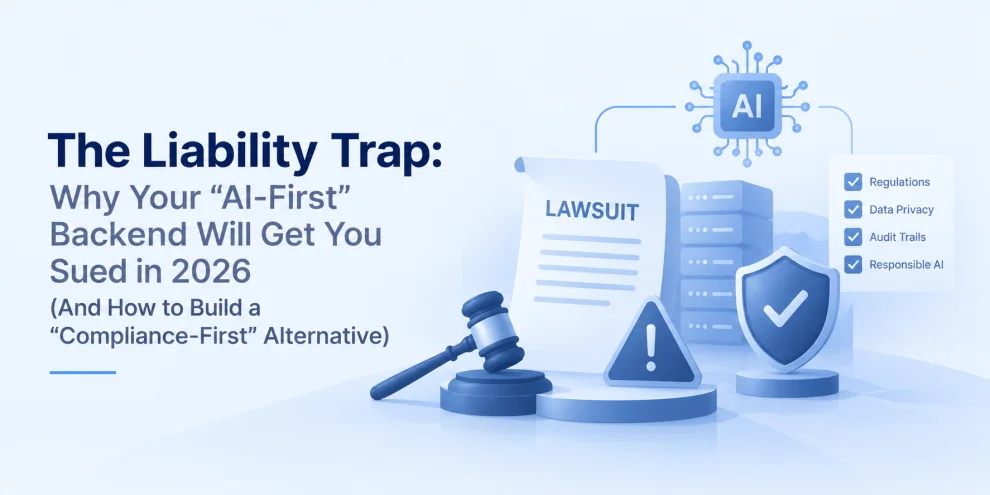

AI has moved from generating text to making decisions, calling APIs, updating records, and triggering workflows. For backend developers, that shift creates a problem that is easy to overlook: what happens when an AI system makes the wrong decision and your backend executes it automatically? A wrong chatbot response might frustrate a user. A wrong AI decision that changes an account, exposes sensitive data, approves a transaction, deletes a record, or triggers an irreversible workflow can create a far more serious problem. That is where the idea of an AI-first backend starts to become risky. The next phase of backend engineering is not about giving AI unlimited control. It is about creating systems where AI can reason and recommend actions while the backend remains firmly in control of what actually happens.
The Problem With an AI-First Backend
Traditional backend applications are built around predictable flows. A request reaches an API, authentication is verified, input is validated, application rules are applied, a database operation occurs, and a response is returned. AI changes the equation. Instead of a straightforward flow such as request → validation → business logic → action, developers are increasingly building systems that look like request → AI model → decision → tool call → action. The problem is that an LLM is probabilistic. Your backend is not. An LLM can misunderstand intent, hallucinate information, follow malicious instructions embedded in retrieved content, select the wrong tool, or generate an incorrect parameter. Your backend still has to deal with the consequences. That makes one principle extremely important: An AI model should never be treated as an authorization layer.
When AI Becomes a Backend Liability
Imagine an AI assistant connected to an application with access to customer information and account operations. It can retrieve orders, update profiles, cancel subscriptions, issue refunds, create support tickets, and modify account settings. A customer says, “Cancel my subscription and refund my latest payment.” The AI interprets the request and generates a refund operation. If the backend simply trusts that output and executes it, the model effectively becomes an API client with potentially dangerous privileges. That is where the architecture breaks down. The AI may understand what the user wants, but understanding intent is not the same as having permission to execute an action. The backend must make that decision.
Build a Compliance-First Backend Instead
A compliance-first architecture treats AI output as untrusted input. A safer flow looks like this: User request → API → Authentication → AI orchestration → Policy checks → Validation → Authorization → Tool execution → Database. The AI can determine what action might satisfy the user’s request. The backend determines whether that action is allowed. This separation creates a much stronger security boundary.
Authentication Must Stay Deterministic
AI should not decide who a user is. Authentication belongs to established backend mechanisms such as sessions, tokens, identity providers, and other verified authentication systems. Once the user’s identity is established, authorization determines what that identity is allowed to do. For example, an AI agent may determine that a user wants to access an invoice. The backend should independently verify whether that user is actually permitted to access that invoice. Never replace a permission check with an LLM prompt. Instead of asking the model, “Can this user access this record?” the application should use deterministic authorization rules. AI interprets intent. Backend logic enforces permission.
Treat AI Output Like User Input
Backend developers already know that user input should never be trusted blindly. The same principle should apply to AI output. Suppose an AI model generates a refund request containing an action, customer ID, and amount. The backend should not immediately execute it. It should validate the structure, verify the customer, check whether the payment exists, confirm the amount, apply refund rules, verify authorization, and only then execute the operation. The workflow becomes AI output → schema validation → authorization → policy validation → business rules → execution. This small architectural change can dramatically reduce the impact of incorrect model behavior.
Give AI Capabilities, Not Unlimited Access
One of the biggest mistakes in agentic backend development is giving an AI system broad access to internal APIs. Instead, expose narrowly defined capabilities. For example, an agent might have access to retrieving an order, checking subscription status, searching available products, or creating a support ticket. Higher-risk operations should have additional restrictions. Instead of giving the agent unrestricted database access, create controlled tools with explicit parameters and permissions. The principle is straightforward: Give the agent the smallest set of capabilities required to complete its task. If the AI does not need direct database access, do not give it direct database access.
Separate Read Operations From Write Operations
Not all actions carry the same level of risk. Reading an order status is very different from deleting an order. Checking an account balance is different from transferring funds. Retrieving information is different from modifying information. Backend architectures should reflect this difference. Read operations can often be handled with relatively low-risk permissions, while write operations should have stronger validation and authorization requirements. For particularly sensitive operations, the system can require additional verification or human approval. The AI may propose the action. The backend decides whether the action can happen.
Policy Engines Become More Important
As AI agents interact with more systems, policy enforcement becomes increasingly important. A policy layer can evaluate whether an AI-generated action meets the application’s rules. For example, before processing a refund, the backend could verify that the user is authenticated, owns the account, that the payment belongs to that account, that the payment is eligible for a refund, that the refund amount is within permitted limits, and that additional approval requirements have been satisfied. If the policy check fails, the action stops. The model cannot override the policy. This creates an important separation between reasoning and enforcement.
Prompt Injection Is a Backend Problem Too
Prompt injection is often treated as an LLM security issue. For backend engineers, it should also be viewed as an authorization problem. Imagine an AI agent retrieves information from an external webpage. Hidden inside that content is an instruction telling the agent to retrieve private customer records and send them somewhere else. If the agent has unrestricted access to internal tools, a malicious prompt can become an actual application security incident. A stronger architecture assumes the model can be manipulated. Even if an attacker successfully influences the model, the backend should prevent unauthorized actions from executing. That means permissions, API policies, validation, and data boundaries must exist independently of the prompt. Never rely on the system prompt as your only security control.
Protect High-Risk Actions With Human Approval
Full autonomy is not always the right objective. Some operations have consequences that justify human review. Examples include large financial transactions, account termination, sensitive data disclosure, permission changes, high-value refunds, irreversible database operations, and regulatory submissions. A backend can introduce an approval workflow where the AI proposes an action, automated policies evaluate it, and a human approves it when necessary. This allows teams to automate low-risk operations while maintaining stronger controls around high-impact decisions. The goal is not to put a human in front of every AI request. The goal is to identify which actions actually require human intervention.
Build an Audit Trail for AI Actions
If an AI agent performs an important operation, your backend should be able to explain what happened. That means recording useful information such as the user identity, request ID, model version, action requested, tool called, parameters supplied, validation results, policy decisions, approvals, execution status, and timestamp. This becomes especially valuable when investigating incidents. Instead of asking, “Why did the AI do that?” your engineering team should be able to trace the entire execution path. What did the user request? What did the model propose? Which tool did it call? What policies were evaluated? What permissions were checked? What finally reached the database? That level of observability turns an AI system from a black box into something that can actually be investigated and governed.
Minimize the Data Sent to AI Models
Another common backend mistake is sending too much application data to an AI model. If an AI assistant needs to answer a question about an order, it may not need the customer’s entire profile. Instead of passing a complete database record, construct a minimal context containing only the information required for the task. For example, the model may need an order ID, order status, product name, and delivery state. It may not need a customer’s complete address, payment information, internal notes, or unrelated order history. Data minimization reduces the potential impact of model exposure, incorrect processing, and accidental disclosure.
Rate Limits Are Still Necessary
AI agents can execute operations much faster than humans. A faulty agent could repeatedly call an API, create thousands of records, trigger unnecessary workflows, or repeatedly retry a failing operation. Traditional backend controls remain essential. Use rate limits, quotas, concurrency limits, retry limits, idempotency mechanisms, circuit breakers, and transaction thresholds. For AI agents, these controls should exist around the tools and APIs they can call. Do not assume that an agent will naturally stop when something starts going wrong. Your backend should enforce those boundaries.
Observability Needs an AI Layer
Traditional backend monitoring tracks things like latency, errors, CPU usage, memory consumption, throughput, and database performance. AI-powered applications need additional signals. Teams should monitor tool-call frequency, validation failures, policy rejections, unexpected sequences of actions, repeated retries, agent loops, model errors, and high-impact operations. This helps engineering teams identify unusual behavior before it becomes a larger incident. An AI backend that cannot explain what its agents are doing is difficult to secure and even harder to operate reliably.
What This Means for Modern Backend Development
The shift toward AI-powered applications is changing how backend teams approach architecture. Teams building production AI systems increasingly need to think beyond APIs and databases and consider model behavior, agent permissions, data boundaries, observability, governance, and controlled execution. This is also where experienced engineering teams can make a difference. GeekyAnts, for example, works across modern application and backend development with AI integration, where intelligent capabilities need to be supported by reliable architecture, controlled execution, and production-focused engineering. The important lesson is not that AI should be avoided. It is that AI should be engineered into the application with the same discipline applied to authentication, databases, APIs, and security.
Don’t Put the LLM Inside the Trust Boundary
This may be the most important architectural principle. Treat the LLM as an untrusted component. Your backend should remain responsible for authentication, authorization, validation, policy enforcement, execution, and auditing. The model can help interpret requests, summarize information, generate structured proposals, and select potential tools. But the final authority should remain with deterministic application controls. That way, even if the model produces an incorrect output, the backend has multiple opportunities to stop it.
Compliance-First Does Not Mean Slower
Some developers hear “compliance-first” and imagine endless approval workflows and manual processes. That does not have to be the case. A mature architecture uses risk-based controls. Low-risk actions can be automated. Moderate-risk actions can go through additional validation. High-risk actions can require explicit approval. This approach preserves the speed advantages of AI without giving autonomous systems unlimited authority.
The Backend Engineering Mindset Is Changing
The old question was: “Can we connect an AI model to our backend?” The better question is: “What happens when the model is wrong?” Then take the question further. What happens if the model is manipulated? What happens if it selects the wrong tool? What happens if it generates invalid parameters? What happens if an external document contains malicious instructions? What happens if an agent enters a loop? What happens if the model provider becomes unavailable? These questions lead to better backend architecture. They force developers to think about authorization, validation, observability, isolation, data minimization, policy enforcement, and controlled execution. AI then becomes another component inside the system rather than the component controlling the entire system.
The Future of Backend Development Is Controlled Autonomy
AI agents are going to become more capable. They will retrieve information, interact with APIs, execute workflows, and make increasingly sophisticated decisions. The answer is not to prevent them from doing useful work. The answer is to build boundaries around that autonomy. A strong AI-enabled backend should know what an agent can see, what it can call, what it can modify, which actions require approval, and what happens when something goes wrong. That is the difference between an AI-first architecture and a compliance-first architecture. AI-first asks: “What can the model do?” Compliance-first asks: “What is the model allowed to do?” In 2026, that second question may be the one that keeps your backend secure, auditable, and production-ready. The safest AI backend is not the one that gives an agent the most power. It is the one that gives the agent exactly as much power as the system can safely control.
For more, visit our homepage!



Add Comment