










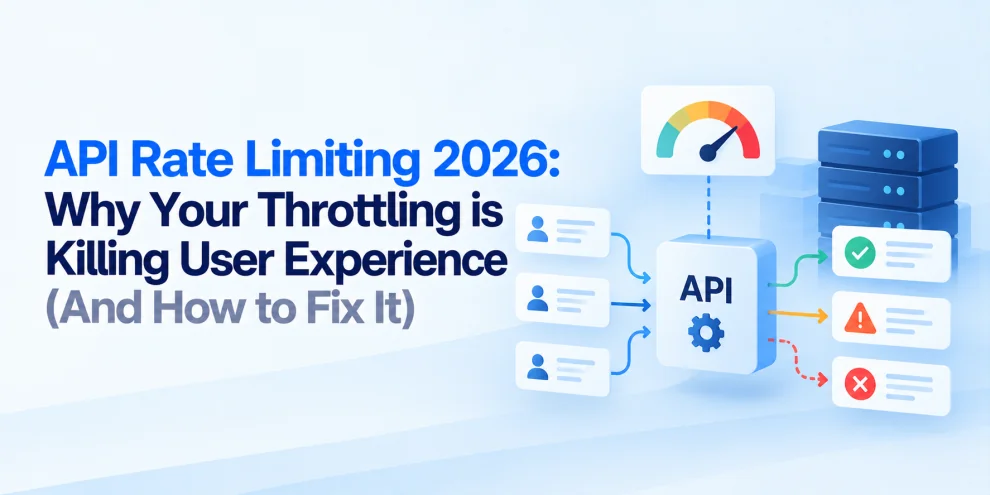

API rate limiting is supposed to protect backend systems. It prevents abuse, controls traffic spikes, protects databases, and keeps one consumer from overwhelming shared infrastructure. But poorly designed throttling can create a different problem: the API remains technically healthy while the product becomes frustrating to use. A user submits a request and receives a 429 Too Many Requests response. They try again and hit the same limit. A mobile application retries automatically and makes the situation worse. A legitimate enterprise customer suddenly reaches a quota because several services share the same API identity. An AI agent generates multiple tool calls and gets throttled even though the workflow itself is legitimate.
The problem is not rate limiting itself. The problem is treating every request as equally expensive and every consumer as equally risky. In 2026, APIs increasingly serve mobile applications, web clients, third-party integrations, microservices, automation platforms, and AI agents simultaneously. A fixed request-per-minute limit is rarely enough to manage that complexity.
Rate Limiting Is More Than “100 Requests Per Minute”
The simplest rate limiter looks attractive because it is easy to understand: allow 100 requests per minute and reject everything above that threshold. The problem is that requests do not have equal costs. A lightweight health check is not equivalent to a database-heavy search query. Reading a cached object is not equivalent to generating a report. A metadata request is not equivalent to an AI-powered operation that triggers retrieval, model inference, and several downstream API calls.
A request-count-only strategy therefore creates an inaccurate picture of backend load. Modern rate limiting needs to consider more than volume. Cost, identity, endpoint sensitivity, concurrency, resource consumption, and workload characteristics can all matter.
The User Experience Problem
A rate limiter operates at the infrastructure layer, but its consequences are experienced at the product layer. Imagine a mobile application that allows users to scroll through a feed. The client makes several API requests as the user moves through the interface. If the application reaches a global rate limit, requests may suddenly fail even though the user is behaving normally.
The same problem appears in enterprise applications. A customer may have hundreds of employees using the same platform. If the quota is attached only to an organization-level API key, one team’s activity can consume capacity needed by another. The backend may technically be protected, but the customer experience becomes unpredictable.
Good rate limiting should therefore protect infrastructure without making legitimate usage feel randomly blocked.
The Difference Between Rate Limits and Quotas
Rate limits and quotas are related, but they solve different problems. A rate limit controls how quickly requests can be made. A quota controls how much of a resource can be consumed over a longer period. For example, an API might allow a customer to make 100 requests per second while also limiting the account to one million requests per month.
Rate limits are primarily useful for controlling bursts and protecting infrastructure. Quotas are more useful for managing aggregate consumption, billing, contractual limits, or resource allocation. Confusing the two can lead to poor product design. A customer who has reached a monthly quota should receive a different experience from a user who has temporarily exceeded a short-term burst limit.
Fixed Windows Can Create Strange Traffic Patterns
A fixed-window limiter is easy to implement. Count requests during a defined period and reject requests once the threshold is reached. But fixed windows can create boundary problems. Suppose an API allows 100 requests per minute. A client sends 100 requests at 12:00:59 and another 100 at 12:01:01. The system may technically allow 200 requests within only a few seconds because the counter reset between windows.
This can create traffic bursts that the limit was supposed to prevent. For many workloads, sliding-window approaches provide a more accurate view of recent traffic. Token-bucket and leaky-bucket algorithms can also provide more controlled behavior by allowing limited bursts while maintaining a sustainable average rate. The right algorithm depends on the traffic pattern rather than the popularity of a particular implementation.
Token Buckets Are Useful for Bursty APIs
The token-bucket model is particularly useful when legitimate clients occasionally need short bursts. Tokens accumulate in a bucket up to a defined capacity. Each request consumes tokens. If tokens are available, the request proceeds. If the bucket is empty, the request is delayed or rejected.
This allows a client to make a short burst without permanently increasing its sustained request rate. For example, a dashboard might make several requests when a user opens a page. Blocking those requests simply because they arrive simultaneously can make the application feel slow. A token bucket can accommodate the burst while still enforcing an overall rate.
The important part is choosing a bucket size that reflects real application behavior.
Concurrency Limits Can Be Better Than Request Limits
Some APIs do not have a problem with request volume. They have a problem with simultaneous work. Consider an endpoint that performs expensive database queries or generates documents. Ten concurrent requests might consume more resources than hundreds of lightweight cached requests.
In that situation, limiting concurrent operations can be more effective than limiting requests per second. Concurrency controls can prevent expensive operations from overwhelming worker pools, databases, queues, or external services.
For backend teams, this distinction is important: rate limiting controls how quickly requests arrive, while concurrency limiting controls how much work is happening at the same time. Many production systems need both.
Your Database Often Determines the Real Limit
An API may appear capable of handling thousands of requests per second until those requests reach the database. A poorly designed rate limiter might therefore protect the API server while allowing database connections, CPU, memory, or query execution time to become the actual bottleneck.
Rate limits should be designed around the entire dependency chain. If an endpoint triggers multiple database queries, calls an external service, or performs expensive computation, the effective capacity of that endpoint may be much lower than the capacity of the HTTP server itself. Backend engineers should measure where requests actually consume resources before choosing limits.
Different Consumers Need Different Limits
A public API, mobile application, internal service, enterprise customer, and AI agent should not necessarily receive the same rate limit. Identity-aware throttling can distinguish between consumers.
Limits can be applied at multiple levels, including IP address, user, API key, organization, tenant, application, service, and endpoint. This creates more control than a single global limit. For example, an anonymous request might have a strict limit while an authenticated enterprise customer receives a larger allocation. Internal service-to-service traffic might use a separate policy entirely.
The important requirement is that the policy matches the actual trust and resource model.
Multi-Tenant Systems Need Fairness
Multi-tenant SaaS platforms have a particularly difficult rate-limiting problem. A global limiter can protect infrastructure but allow one tenant to consume most of the available capacity. A tenant-only limiter solves part of the problem but may not account for individual users or expensive endpoints.
A more sophisticated design can combine global, tenant, user, and endpoint-level controls. This creates a form of resource fairness. The objective is not necessarily to give every customer exactly the same capacity. It is to prevent one consumer from creating disproportionate impact on everyone else.
AI Agents Change the Rate-Limiting Model
AI agents make traditional API throttling even more complicated. A human might perform one action that results in one or two API calls. An AI agent may perform a sequence of tool calls, retrieval operations, validation requests, and backend mutations. One user request can therefore generate dozens of backend operations.
Applying the same request limit to an AI agent and a human user may produce poor results. AI workloads may require limits based on tool calls, concurrency, token consumption, downstream resource cost, or workflow-level budgets. For example, an agent might be allowed a certain number of tool calls per task rather than simply a fixed number of API requests per minute.
The backend should also prevent an agent from repeatedly calling tools as part of a runaway loop.
Retry Logic Can Turn Throttling Into an Outage
One of the most common rate-limiting mistakes is forgetting what clients do after receiving a 429. If every client immediately retries, the limiter can create a feedback loop: traffic spike → rate limit → client retry → more traffic → more rate limiting.
This is why clients need controlled retry behavior. Exponential backoff, jitter, retry budgets, and respect for server-provided retry information can reduce synchronized retries. Backend teams should also distinguish between errors that are safe to retry and operations that could create duplicate side effects.
An idempotency mechanism is particularly important for operations such as payments, orders, provisioning, or other state-changing requests.
Returning 429 Is Not Enough
A rate limiter should communicate what happened. A 429 response should ideally provide enough information for the client to determine when it can try again. Depending on the API design, this can include retry information and relevant rate-limit metadata.
The client should not have to guess whether the request failed because of temporary throttling, an account quota, or a permanent policy restriction. Clear API behavior leads to better client behavior.
Rate Limiting Should Be Adaptive
Static limits are easier to operate, but production workloads change. Traffic patterns can vary by time of day, customer behavior, geographic region, application version, and product activity.
An adaptive system can adjust limits based on backend capacity and observed conditions. For example, the platform may reduce expensive workloads during database pressure while allowing lightweight cached operations to continue.
This does not mean every API needs an AI-powered rate limiter. Deterministic policies remain valuable because they are predictable and easier to reason about. The important idea is that limits should reflect actual system capacity rather than arbitrary numbers chosen during initial development.
Rate Limiting Needs Observability
A rate limiter that simply counts rejected requests is not enough. Engineering teams should understand which consumers are being throttled, which endpoints generate the most rejected requests, whether legitimate users are hitting limits, which tenants consume the most capacity, whether retries are increasing traffic, which downstream dependency is creating pressure, whether AI agents are generating abnormal request patterns, and whether limits are being triggered during normal traffic or only during incidents.
Useful metrics can include request volume, throttled request percentage, rejection reason, consumer identity, endpoint, latency, concurrency, retry volume, and downstream resource utilization. Without this visibility, teams may keep increasing limits without understanding why the system is struggling.
Distributed Rate Limiting Is Harder Than It Looks
In a horizontally scaled backend, multiple API instances may need to share rate-limit state. A local in-memory counter can work for a single process, but it becomes inaccurate when traffic is distributed across many instances.
Distributed rate limiting can use centralized or coordinated state stores, gateways, proxies, or infrastructure-level controls. But the architecture introduces its own trade-offs. The rate limiter itself must be highly available. If the limiter becomes a bottleneck or fails closed unexpectedly, it can take down otherwise healthy API infrastructure.
Rate limiting is therefore part of the reliability architecture, not merely middleware.
Rate Limits Should Protect Expensive Operations First
Not every endpoint deserves the same policy. Low-cost endpoints may tolerate relatively high request rates. Expensive operations should receive tighter controls.
Examples include large database searches, report generation, file processing, AI inference, bulk exports, administrative operations, and expensive third-party API calls.
This is where cost-aware throttling becomes useful. Instead of asking only, “How many requests can this client make?” backend teams can ask, “How much work can this client cause the platform to perform?” That is a much more useful question for modern APIs.
Graceful Degradation Beats Hard Failure
When the system approaches capacity, not every feature needs to fail. A backend can prioritize critical operations while delaying or degrading non-essential workloads.
For example, an application might continue allowing authentication and checkout while temporarily reducing background recommendations, analytics enrichment, or expensive search operations. This requires prioritization at the API and infrastructure levels.
Rate limiting then becomes part of a broader traffic-management strategy rather than an isolated protection mechanism.
API Gateways Can Centralize Enforcement
API gateways are often a convenient place to implement common rate-limiting policies. They can enforce limits before requests reach application services, reducing unnecessary backend work.
However, gateway-level controls should not replace application-level protection. The application still needs to protect expensive operations, enforce authorization, manage concurrency, and understand business-specific limits.
A layered approach is usually stronger: gateway limits → application limits → resource limits. Each layer protects a different part of the system.
What Engineering Teams Should Audit
Before changing API throttling policies, backend teams should ask: Are limits based on actual resource consumption? Can legitimate customers hit limits during normal usage? Are limits applied per user, tenant, API key, and endpoint where appropriate? Do expensive operations have stricter controls? Are concurrency limits used where request rate alone is insufficient? Does the client implement exponential backoff and jitter? Are retry storms visible? Are rate-limit responses clear? Can the platform prioritize critical workloads during capacity pressure? Are AI agents subject to workflow and tool-call limits? Can the rate limiter scale with the API infrastructure? Are rate-limit decisions observable?
These questions help identify whether throttling is protecting the platform or simply shifting the problem onto users.
Where Engineering Teams Fit
Engineering organizations such as GeekyAnts work across backend architecture, API development, cloud infrastructure, scalable application engineering, and AI-enabled products. That broader experience matters when rate limiting is treated as part of system architecture rather than simply adding a middleware package to an API.
The Future of API Rate Limiting
API rate limiting is moving from a simple security control toward a broader resource-management capability. The next generation of backend systems will increasingly distinguish between users, tenants, workloads, endpoints, infrastructure costs, and AI-generated activity.
The objective will not be to reject as many requests as possible. It will be to keep the system stable while allowing legitimate work to continue.
That means combining rate limits with concurrency controls, quotas, adaptive policies, priority queues, backpressure, caching, observability, and graceful degradation.
The best throttling strategy is therefore not the most restrictive one. It is the one that protects backend capacity without making legitimate users feel like the system is constantly fighting them.
FAQs
What is API rate limiting?
API rate limiting controls how many requests a client can make within a defined period to protect backend resources, prevent abuse, and maintain service reliability.
Why can rate limiting hurt user experience?
Poorly designed limits can block legitimate traffic, create unexpected 429 responses, increase retries, and make applications feel unreliable even when backend infrastructure is healthy.
What is the difference between rate limits and quotas?
Rate limits control request frequency, while quotas generally control total resource consumption over a longer period such as an hour, day, or month.
What is a token bucket rate limiter?
A token bucket allows controlled bursts of traffic while maintaining a defined average request rate. Requests consume tokens, and new tokens are added over time.
Should API rate limits be based on users or IP addresses?
For authenticated applications, user, tenant, organization, or API-key-based limits are often more meaningful than IP-only limits because many legitimate users can share an IP address.
How should APIs handle HTTP 429 errors?
Clients should generally use controlled retries with exponential backoff and jitter, while respecting server-provided retry guidance where available.
Do AI agents need different API rate limits?
Often, yes. AI agents can generate many tool calls from a single user request, so workflow-level budgets, concurrency controls, and tool-specific limits may be more appropriate than simple request-per-minute policies.
What is the difference between rate limiting and concurrency limiting?
Rate limiting controls how quickly requests arrive, while concurrency limiting controls how many operations can execute simultaneously.
Should every API endpoint have the same rate limit?
No. Limits should reflect the cost, sensitivity, and resource requirements of individual endpoints and workloads.
How can companies improve API throttling without hurting users?
Use identity-aware limits, cost-aware policies, burst handling, concurrency controls, graceful degradation, clear 429 responses, intelligent retry behavior, and continuous observability.
For more, visit our homepage!





Add Comment