






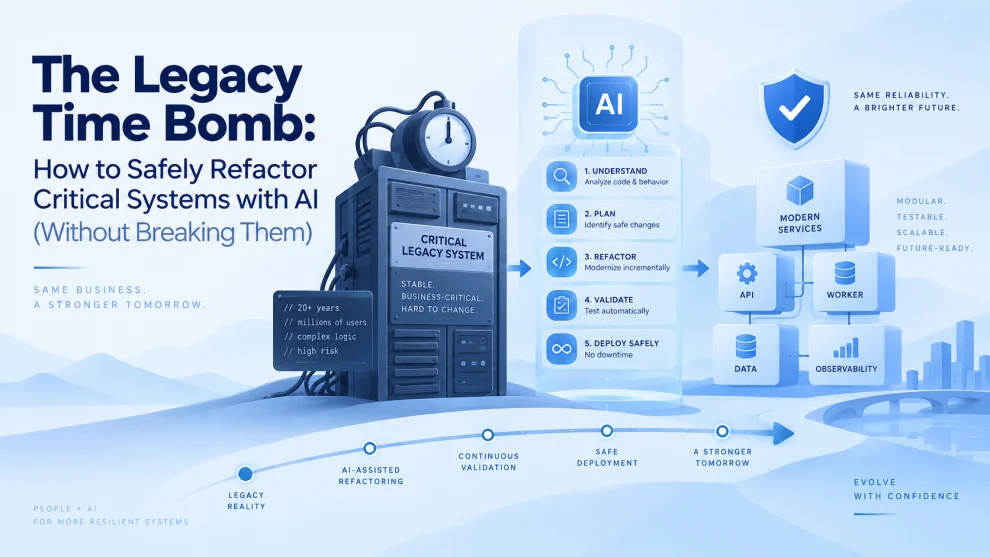

There is a dangerous assumption around legacy software: if the code is old, the answer must be to replace it. That sounds logical until you look at what actually sits behind critical legacy systems. Years of business rules, undocumented dependencies, database assumptions, scheduled jobs, third-party integrations, and edge cases that may never have been written down but somehow keep production running. Now add AI to the equation. AI can analyze unfamiliar code, explain complex functions, identify duplicated logic, generate tests, suggest refactoring strategies, translate code, and accelerate modernization. That makes it extremely useful for legacy systems. It also creates a new risk: AI can help you change critical software faster than your organization can determine whether those changes are safe. Recent modernization work has shown that AI performs best when it is grounded in evidence, testing, stable environments, and incremental changes rather than being asked to blindly rewrite an entire codebase.
Legacy Code Is Not Just Old Code
A legacy system is often treated as technical debt waiting to be removed. In reality, it is usually a historical record of decisions. Some decisions were intentional. Others were workarounds. Some exist because of limitations that no longer exist, while others remain because changing them could break something downstream. A seemingly simple function may therefore contain years of accumulated assumptions. This makes legacy refactoring fundamentally different from building a new application. With a greenfield project, engineers define the behavior. With a legacy system, engineers first have to discover the behavior.
The First Step Is Not Refactoring. It Is Understanding.
Before changing critical code, understand what already exists. Map major modules, dependencies, data flows, integrations, database relationships, scheduled jobs, authentication paths, configuration, and deployment processes. Then ask the more important question: What does the system actually do in production? Documentation can explain what a system was supposed to do, but runtime behavior reveals what it actually does. AI can accelerate this discovery by summarizing large codebases, explaining unfamiliar functions, identifying dependencies, and helping engineers connect seemingly unrelated components. But AI-generated explanations should be treated as hypotheses. Important assumptions still need to be verified against code, tests, logs, production behavior, and domain experts.
Do Not Give AI an Entire Legacy Repository and Say “Modernize It”
One of the easiest ways to misuse AI is to provide a huge legacy codebase and ask for a complete rewrite. That is not a modernization strategy. It is a fast way to generate a large amount of code without enough context to validate it. A better approach is to give AI bounded problems. Ask it to explain one module, identify dependencies for a particular function, find duplicated logic, generate tests for a specific behavior, or suggest a safer abstraction for one component. Smaller scopes make AI output easier to evaluate and reduce the blast radius when something goes wrong.
Build a Safety Net Before You Change the System
If a critical application has weak test coverage, refactoring should not begin with rewriting code. It should begin with creating confidence. Identify important user journeys and production behaviors. Add characterization tests around them. Capture expected inputs and outputs. Add integration tests where behavior depends on databases or external services. The objective is not to prove that the existing architecture is perfect. It is to establish what the system currently does. This becomes a behavioral baseline against which future changes can be evaluated.
AI can accelerate test generation, but generated tests need review too. A test that simply confirms the current implementation rather than the intended behavior can create a false sense of security.
Refactor in Slices, Not One Giant Leap
Large rewrites create large failure domains. A safer approach is incremental modernization. Take one capability, isolate it, understand it, add tests, refactor it, validate it, monitor it, and then move to the next capability. This allows teams to deliver improvements while modernization is still underway rather than waiting for a risky final cutover. Evolutionary approaches to modernization are specifically useful because they reduce the risk of changing critical systems while allowing teams to learn from each stage of the migration.
Find the Seams
One of the hardest parts of legacy refactoring is deciding where to make the first change. This is where identifying seams becomes useful. A seam is a point where behavior can be changed or redirected without modifying the entire surrounding system. It might be an interface, module boundary, adapter, service endpoint, or another location where dependencies can be separated. Creating these boundaries can make testing easier, improve observability, and allow new functionality to gradually replace older components.
Use AI to Understand Before You Use It to Generate
The most valuable role for AI in legacy modernization may not be code generation. It may be code comprehension. Developers often spend more time reading unfamiliar legacy code than writing new code. AI can accelerate that process by explaining complex modules, summarizing dependencies, identifying patterns, surfacing duplicated logic, and helping reconstruct undocumented behavior. That gives engineers more time to make architectural decisions instead of spending all their time trying to understand what the old system is doing. Research into GenAI-assisted modernization has similarly explored reverse engineering, capability mapping, dependency analysis, and extracting requirements from existing systems.
Do Not Let AI Rewrite Business Logic Blindly
This is where modernization projects become dangerous. A legacy system may contain business rules that are invisible from the code structure alone. An unusual validation rule could exist because of a regulatory requirement. A strange database query could compensate for an upstream limitation. A seemingly redundant condition could protect against an edge case that occurs only once a year. AI can identify the code, but it cannot automatically understand why every historical decision exists. Domain experts therefore remain critical. The safest model is not AI versus humans. It is AI for speed and humans for context and judgment.
Compare Old and New Behavior
When functionality is migrated, do not rely only on whether the new code compiles or whether unit tests pass. Compare behavior wherever practical. Run equivalent inputs through old and new implementations. Compare outputs. Track differences. Investigate unexpected results. This turns modernization into a measurable process instead of a subjective judgment. The question becomes not “Does the new code look better?” but “Does the new implementation preserve the behavior we intended to preserve?” Structured modernization workflows have used research, review, and rebuild stages specifically to maintain this kind of verification.
AI-Generated Code Still Needs Human Review
AI can generate large amounts of code quickly, but that does not eliminate the need for engineering review. It can produce technically valid code that changes an important edge case, removes duplication that was intentional, or simplifies logic while changing error handling. The solution is not necessarily to manually inspect every generated line. Review should happen at multiple levels: behavior, architecture, security, performance, reliability, and maintainability. AI can assist with these checks, but engineers remain responsible for deciding whether the change is safe.
Modernize the Environment Without Modernizing Everything
Another common mistake is modernization creep. Once engineers begin touching an old system, there is a temptation to upgrade everything at once: framework, database, authentication, infrastructure, deployment platform, architecture, and observability. A focused refactoring project can quickly become a complete rewrite. That dramatically increases risk. Sometimes the safer first step is to modernize the environment around the legacy system while leaving its behavior untouched. Establish a reproducible build, improve logging, introduce monitoring, containerize where appropriate, and create automated tests. Once the system becomes observable and reproducible, deeper changes become easier to control. Recent practical modernization work has demonstrated the value of containment and stable environments before significant code changes are introduced.
Keep Production Close to the Feedback Loop
Modernization should not disappear into development for months. Release smaller changes whenever possible. Monitor them. Compare performance. Track errors. Watch critical workflows. Use feature flags or controlled rollouts when appropriate. The goal is simple: make the feedback loop shorter than the failure window. If a refactored component behaves unexpectedly, the team should know quickly and have a clear path to rollback.
Observability Is Part of Refactoring
Legacy modernization without observability is like repairing an airplane without functioning instruments. You need visibility into what changed and what happened afterward. Track application errors, latency, resource usage, important transactions, integration failures, database behavior, and user-facing outcomes. Before modernization, these signals establish a baseline. After modernization, they show whether the new implementation is actually improving the system. AI can help analyze these signals, but the observability foundation needs to exist first.
Protect the Knowledge Inside People’s Heads
Some of the most valuable information about a legacy system may not exist in the repository. It may live with the engineer who knows why a particular database table cannot be changed, the developer who understands an old integration, or the operations specialist who knows which scheduled process must run before another. AI can help turn parts of this knowledge into documentation by analyzing code, tickets, logs, and historical changes. But conversations with experienced engineers and domain experts remain essential. Modernization should reduce knowledge concentration rather than simply replace undocumented code with AI-generated undocumented code.
Treat AI Like a Junior Engineer With Extraordinary Speed
A useful mental model is to treat AI like a junior engineer who can work extremely fast. Give it clearly defined tasks. Provide context. Set constraints. Review what it produces. Test the result. Do not assume it understands the system simply because it can explain the code. AI may generate a technically valid refactoring that changes an important edge case or misunderstands why a particular piece of code exists. Fast does not mean safe.
Where Teams Fit Into the Modernization Conversation
Modernizing critical systems requires more than choosing an AI coding tool. It requires engineering discipline around architecture, testing, observability, migration strategy, and controlled delivery. Teams like GeekyAnts, Thoughtworks, and other engineering-led technology teams are approaching modernization as an evolutionary engineering problem rather than treating it as a simple rewrite exercise. The strongest approach combines AI-assisted analysis and development with experienced engineers, automated validation, incremental delivery, and clear architectural boundaries. This allows teams to use AI for what it does well without giving it unchecked control over systems that cannot afford unexpected behavior.
A Practical AI Refactoring Playbook
First, map the system. Understand dependencies, data flows, integrations, critical modules, and production behavior. Second, establish a baseline. Capture tests, performance metrics, logs, and important workflows. Third, create boundaries. Identify modules or capabilities that can be safely isolated. Fourth, use AI for discovery. Let it explain code, identify dependencies, generate documentation, find duplication, and surface potential refactoring opportunities. Fifth, refactor small pieces. Avoid massive changes that are difficult to validate. Sixth, generate tests alongside changes. Treat testing as part of modernization rather than an afterthought. Seventh, compare behavior. Validate old and new implementations against meaningful scenarios. Eighth, release progressively. Use controlled deployments and monitoring. Ninth, document what was learned. Capture architectural decisions, discovered business rules, and migration knowledge. Finally, repeat. Legacy modernization is a process of controlled change, not a single AI prompt.
The Real Opportunity Is Not Rewriting. It Is Recovering the System.
AI has changed the economics of legacy modernization. For years, one of the biggest barriers was simply understanding old software. Developers had to navigate enormous codebases, incomplete documentation, unfamiliar languages, outdated frameworks, and scarce domain knowledge. AI can dramatically accelerate that discovery process. But the goal should not be to erase the past as quickly as possible. The goal is to understand it well enough to change it safely.
The most successful modernization programs will use AI in a disciplined way: discover first, test second, refactor incrementally, validate continuously, and only then replace what genuinely needs replacing.
The legacy time bomb does not become safer because AI can rewrite it faster. It becomes safer when AI helps engineers understand exactly what they are changing, why they are changing it, and how they can prove that the system still works afterward.
Frequently Asked Questions
Can AI safely refactor legacy code?
Yes, but AI should operate within clear boundaries. Critical changes require automated tests, human review, runtime validation, and incremental deployment.
How can AI help with legacy system modernization?
AI can analyze unfamiliar code, explain dependencies, generate documentation, identify duplicated logic, create tests, suggest refactoring opportunities, and accelerate migration.
Should you rewrite or refactor a legacy system?
It depends on the system. Incremental refactoring is often safer when the existing application contains valuable logic and cannot tolerate the risk of a full replacement.
What is the safest way to use AI for legacy modernization?
Start with code understanding and documentation, establish a test baseline, make small changes, validate behavior, and gradually expand the scope.
Why is testing important before legacy refactoring?
Tests provide a behavioral safety net. They help engineers distinguish intentional improvements from accidental changes to existing functionality.
What is the Strangler Fig pattern?
It is an incremental modernization strategy where new functionality gradually replaces parts of a legacy system while the existing system continues operating.
Can AI understand legacy business logic?
AI can help identify and explain patterns in legacy code, but domain experts are still needed to validate why particular rules and behaviors exist.
What is the biggest risk of AI-assisted legacy modernization?
The biggest risk is moving faster than your ability to verify the changes. AI can generate code quickly, but correctness still requires evidence, testing, context, and engineering judgment.
For more, visit our homepage!

Add Comment