






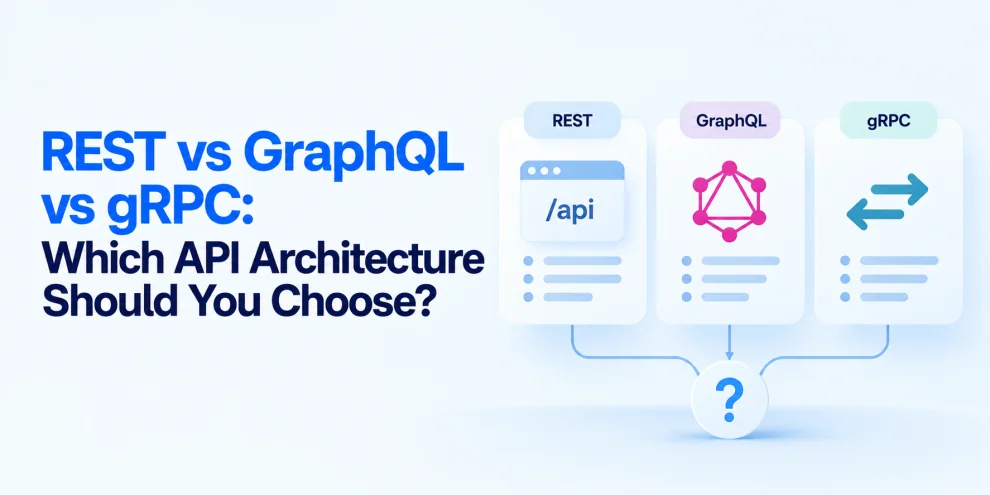

Choosing an API architecture is no longer a simple decision between familiar HTTP endpoints and newer alternatives. Modern backend applications serve web clients, mobile apps, internal services, partner integrations, real-time interfaces, and increasingly AI-powered workloads. Each of these consumers can place different demands on the backend. REST remains widely adopted because of its simplicity and compatibility with existing web infrastructure. GraphQL gives clients more control over the data they request. gRPC provides strongly typed, efficient communication that is particularly useful between backend services. The challenge is not deciding which technology is universally better. It is understanding where each architecture fits and what trade-offs it introduces.
REST: The Practical Default
REST remains a strong choice for many backend applications because it maps naturally to HTTP. Resources can be represented through predictable endpoints such as /users, /orders, or /products, while standard HTTP methods provide familiar semantics for retrieving and modifying those resources. REST also works well with existing infrastructure including API gateways, CDNs, caching layers, observability platforms, authentication systems, and web tooling. For public APIs, partner integrations, and applications where simplicity matters, REST can provide a straightforward contract between clients and backend services.
Its biggest strength is also its limitation: REST generally exposes a server-defined resource structure. A mobile application may need information from several endpoints to construct a single screen, potentially increasing network requests and client-side coordination. Backend teams can address this with aggregation endpoints, backend-for-frontend layers, or carefully designed resources, but those solutions add architectural decisions.
GraphQL: When Clients Need Flexible Data
GraphQL approaches the problem differently. Instead of exposing many resource-oriented endpoints, a GraphQL API typically exposes a schema through which clients specify the fields and relationships they need. A client can request a particular combination of user, order, product, and related information through a single query.
This can be useful for applications with multiple clients that have different data requirements. A mobile application with limited bandwidth may need fewer fields than a desktop application. A product dashboard may require several related resources at once. GraphQL allows those clients to shape the response without requiring the backend team to create a separate endpoint for every variation.
The trade-off is that GraphQL moves complexity into the backend. Query execution, authorization at field and resolver levels, query depth, query cost, caching, resolver performance, and protection against expensive queries all require careful engineering. A poorly designed GraphQL implementation can also encounter N+1 query problems where resolving nested fields generates excessive database activity.
gRPC: Efficient Communication Between Services
gRPC is designed around remote procedure calls and strongly typed service contracts. It commonly uses Protocol Buffers for interface definitions and binary serialization, making it well suited to service-to-service communication where performance, efficient payloads, and explicit contracts matter.
A backend platform with many internal services may use gRPC for communication between those services while exposing REST or GraphQL to external clients. gRPC can provide generated client and server code, streaming capabilities, and a strongly defined contract that can reduce ambiguity between services.
The trade-off is that gRPC is not always the most convenient choice for browser-based public APIs or third-party integrations. Tooling and infrastructure support have improved significantly, but REST remains easier to consume across a broad range of clients and environments.
REST vs GraphQL vs gRPC Is Really About the Boundary
The most useful way to compare these architectures is to ask where the API sits in the system.
REST is often well suited to client-to-backend communication, particularly for public APIs, mobile applications, web applications, and partner integrations.
GraphQL is often useful where clients have diverse and evolving data requirements and need to compose information from multiple backend resources.
gRPC is particularly useful for backend-to-backend communication, where strong contracts, efficient serialization, streaming, and predictable service interfaces matter.
This means an application does not necessarily have to choose only one.
Hybrid API Architectures Are Often More Practical
A modern backend might expose REST APIs to external consumers, GraphQL to selected product clients, and gRPC between internal services.
For example, a commerce platform could expose REST endpoints for partners, use GraphQL for its web and mobile applications, and use gRPC for communication between inventory, pricing, checkout, and fulfillment services.
This approach allows each boundary to use an API style that fits its requirements.
The important consideration is avoiding unnecessary duplication. Supporting three API architectures does not automatically create a better system. Each additional interface introduces schema management, documentation, testing, observability, security, and operational overhead.
Performance Depends on the Workload
API architecture discussions often become overly focused on theoretical performance. In real applications, API performance depends on much more than the protocol.
Database queries, network latency, serialization, authentication, authorization, business logic, external services, caching, connection management, and payload size can dominate the overall response time.
gRPC can reduce serialization overhead for suitable service-to-service workloads, but that advantage does not matter if the backend spends most of its time waiting for a poorly optimized database query. GraphQL can reduce unnecessary client requests, but an inefficient resolver layer can introduce significant backend work. REST can perform extremely well when endpoints are designed around actual application access patterns.
The right question is therefore not “Which API is fastest?” but “Where is the actual bottleneck in this workload?”
REST and HTTP Infrastructure Remain Important
One reason REST remains relevant is its alignment with the broader HTTP ecosystem. Standard HTTP caching, proxies, gateways, monitoring tools, browser behavior, and infrastructure controls can be applied naturally.
For read-heavy applications, properly designed HTTP caching can reduce backend load substantially. Resource-oriented URLs also make API behavior relatively easy to inspect and troubleshoot.
REST is particularly practical when API consumers are numerous and unpredictable. External developers generally benefit from straightforward HTTP requests that can be tested with common tools without requiring specialized client generation.
GraphQL Requires Strong Query Governance
GraphQL’s flexibility creates a different security and performance model.
A client can potentially construct queries that request deeply nested relationships or large amounts of data. Without controls, an apparently valid query can become expensive for the backend.
Production GraphQL systems should therefore consider query depth limits, query complexity analysis, persisted queries, resolver optimization, rate limiting, authorization, caching strategies, and appropriate observability.
Schema design also matters. A flexible API is not automatically a well-designed API. Poorly structured relationships can make authorization and performance difficult to manage.
gRPC Requires Strong Service Contracts
The strength of gRPC is closely connected to its contract-driven approach. Services define methods and message types, which can then be used to generate compatible client and server implementations.
This works particularly well in organizations with many backend services where inconsistent API contracts can become a major maintenance problem.
However, teams still need to manage backward compatibility, service discovery, authentication, retries, deadlines, error handling, load balancing, and observability. A strongly typed interface does not remove distributed-systems complexity.
API Security Is Independent of the Architecture
REST, GraphQL, and gRPC do not automatically make an application secure.
Authentication establishes identity, but authorization determines what that identity can access. Every architecture still needs appropriate controls for resource ownership, tenant isolation, sensitive data, service identity, rate limiting, input validation, and auditing.
GraphQL may require authorization at resolver or field boundaries. REST endpoints need protection against issues such as broken object-level authorization. gRPC services need authentication and authorization between workloads.
The API style changes the implementation details, not the fundamental security responsibility.
Observability Should Follow the API Boundary
API architecture also affects observability.
REST teams commonly monitor endpoint latency, HTTP status codes, request rates, payload sizes, and dependency performance. GraphQL systems need visibility into query patterns, resolver latency, query complexity, and field-level failures. gRPC environments benefit from monitoring method latency, status codes, streaming behavior, retries, deadlines, and service-to-service dependencies.
Distributed tracing becomes particularly valuable when one API request triggers multiple downstream operations. Engineers should be able to connect the original client request to the backend services, database operations, external APIs, and eventual response.
Mobile Applications May Need a Different Strategy
Mobile applications often have stricter bandwidth, latency, and battery constraints than desktop web applications. A REST design may require several requests to construct a complex screen. GraphQL can reduce this by allowing clients to request related data through a single operation.
However, GraphQL is not automatically the answer. A well-designed REST API combined with aggregation endpoints, caching, or a backend-for-frontend layer can provide similar benefits without introducing GraphQL’s additional operational complexity.
The decision should be based on actual mobile access patterns rather than assuming that one API architecture is inherently better.
AI Applications Add Another Dimension
AI-powered applications introduce new API requirements. An AI backend may need streaming responses, long-running operations, asynchronous jobs, tool execution, retrieval services, and communication between multiple model-serving components.
REST remains useful for conventional application operations. Streaming-capable APIs can support incremental responses to clients. gRPC can be valuable for internal communication between inference, retrieval, orchestration, and supporting services.
GraphQL can also serve product-facing applications that need flexible access to AI-generated data and conventional application state.
The architecture should therefore consider the entire workflow rather than selecting an API protocol in isolation.
When REST Makes Sense
REST is often a practical choice when the application needs public APIs, straightforward CRUD operations, broad client compatibility, HTTP caching, partner integrations, or a relatively simple contract between clients and backend services. It is also a sensible starting point when the team does not yet have a clear reason to introduce additional API complexity.
When GraphQL Makes Sense
GraphQL becomes more compelling when multiple clients require different views of the same data, frontend teams need greater control over response shape, applications frequently aggregate related resources, or the domain contains complex relationships that are awkward to expose through numerous REST endpoints.
The backend must be prepared to manage query complexity, resolver performance, authorization, caching, and schema evolution.
When gRPC Makes Sense
gRPC is particularly appropriate for internal service-to-service communication where strong contracts, efficient serialization, streaming, and generated clients provide meaningful benefits. It can work especially well in large distributed backend environments where teams need consistent interfaces between services.
It is less compelling when the primary consumers are browsers, external partners, or developers who expect conventional HTTP APIs.
Don’t Choose an API Architecture Based on Fashion
A common architectural mistake is choosing GraphQL because REST feels outdated or adopting gRPC because binary protocols appear faster.
Technology selection should start with workload requirements.
Ask how many clients the system serves, how data is consumed, whether clients need flexible queries, how services communicate internally, what caching model is required, how the API will be secured, how it will be observed, and how much operational complexity the engineering team can support.
An API architecture should solve an application problem, not create a new one.
Where Engineering Teams Fit
API architecture decisions become more complex as applications grow across mobile, web, cloud, microservices, AI, and third-party integrations. Engineering organizations such as GeekyAnts work across backend architecture, API development, cloud systems, mobile and web applications, and AI-enabled products, making API boundary design part of broader application engineering rather than an isolated protocol decision.
The important objective is to create an API layer that matches the application’s data patterns, security requirements, performance characteristics, and evolution strategy.
A Practical API Architecture Decision Framework
Before choosing REST, GraphQL, or gRPC, engineering teams should evaluate several factors. If broad compatibility, HTTP semantics, straightforward resources, and public consumption are priorities, REST may fit naturally. If multiple clients need different data shapes and complex resource composition is creating excessive endpoint complexity, GraphQL may be worth evaluating. If internal services require strongly typed contracts, efficient communication, or streaming, gRPC may be appropriate.
Teams should also consider whether a hybrid architecture provides a cleaner boundary than forcing one technology across the entire platform.
The Right API Is the One That Fits the System
REST, GraphQL, and gRPC solve different problems.
REST provides a familiar and broadly compatible HTTP architecture. GraphQL provides flexible data access for clients with varying requirements. gRPC provides strongly typed and efficient communication between services.
None is universally superior.
For many organizations, the strongest architecture will combine them selectively. REST can serve external consumers, GraphQL can serve complex product clients, and gRPC can connect internal services. What matters is that every interface has a clear responsibility, strong security controls, reliable observability, and a contract that the organization can maintain over time.
The API architecture should follow the system’s needs, not the other way around.
For more, visit our homepage!


Add Comment