





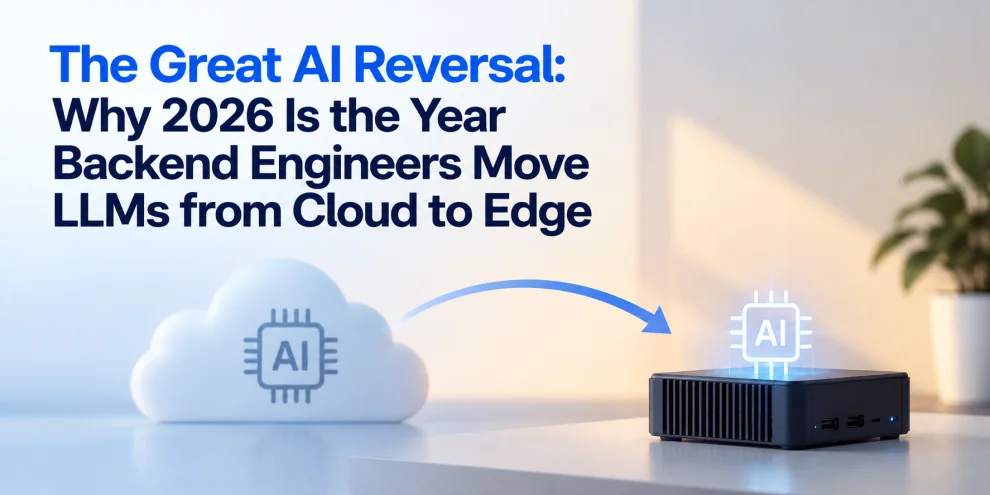

For years, the standard architecture for AI applications was straightforward. The user interacted with a mobile app, browser, or desktop application. That client sent a request to a backend, the backend called an AI service, and the response returned to the user. Almost every intelligent feature depended on a network connection and a remote model. That architecture is still useful, but it is no longer the only practical option. In 2026, smaller AI models, better device hardware, browser capabilities, and local inference runtimes are making it increasingly practical to move selected AI workloads closer to the user. Smartphones, laptops, browsers, and other edge devices can now handle tasks that previously required a cloud inference endpoint. This does not mean cloud AI is disappearing. It means backend engineers are gaining another architectural option. The important question is no longer simply which LLM an application should use. It is where each AI workload should run.
Why AI Is Moving Closer to the User
Large cloud models remain valuable for complex reasoning, long-context processing, advanced agents, multimodal workloads, and applications that require substantial computing resources. But many AI features do not need that level of infrastructure. Text classification, autocomplete, lightweight summarization, information extraction, translation, semantic search, and other constrained workloads can often be handled by smaller models. Sending every request to a remote model can introduce network latency, infrastructure costs, connectivity requirements, and additional data movement. Running an appropriate model locally can reduce some of those dependencies. The architectural shift is therefore not about replacing cloud inference. It is about deciding which requests actually need it.
The Edge Is Becoming an AI Runtime
Better hardware is one of the biggest reasons this architecture is becoming practical. Modern phones, laptops, and other devices increasingly include hardware designed to accelerate machine-learning workloads. Browsers are also becoming more capable. WebGPU gives web applications access to GPU acceleration where supported, while WebAssembly provides a portable execution environment for certain workloads. Frameworks and runtimes are expanding the options further. Google’s LiteRT ecosystem, for example, is focused on bringing machine-learning inference to edge environments, including local generative AI workloads. The result is a fundamental change in the role of the client. The device is no longer only responsible for rendering an interface and sending API requests. For some applications, it can also perform part of the application’s intelligence.
This Does Not Make Backend Engineers Less Important
Moving inference to the edge does not eliminate backend engineering. It changes the backend’s responsibilities. A traditional AI backend may spend much of its time receiving requests, forwarding prompts to a model provider, and returning responses. A hybrid architecture requires more sophisticated orchestration. The backend may need to determine whether a request should be handled locally, routed to a smaller remote model, or sent to a larger cloud model. It may need to manage model versions, authentication, synchronization, fallback behavior, security policies, telemetry, and application state. The backend effectively becomes the coordination layer between different forms of intelligence. A simple task can remain on the device. A more demanding task can move to a remote model. A highly sensitive operation can require backend validation before anything happens.
Model Routing Becomes a Backend Problem
Once multiple inference locations exist, model routing becomes an important part of backend architecture. Consider an application that receives three different requests. A short text classification task could run locally. A moderately complex summarization task might use a smaller cloud model. A request requiring extensive reasoning and retrieval could be routed to a larger model with access to backend services. The user does not necessarily need to know which model handled the request. The application needs a routing layer that can make the decision based on factors such as task complexity, device capabilities, latency requirements, privacy constraints, model availability, connectivity, and cost. The goal is no longer to maximize model capability for every request. It is to match the workload with the appropriate inference environment.
Every Device Creates a Different Runtime
Cloud infrastructure gives engineering teams relatively predictable hardware. Edge applications do not have that luxury. One user may have a modern laptop with substantial memory and GPU capabilities. Another may be using an older phone. One browser may support a required API while another may not. A model that runs comfortably on one device may create unacceptable latency or memory pressure on another. Applications therefore need a capability-aware architecture. Before attempting local inference, the application may need to evaluate available memory, processor capabilities, browser support, model availability, battery considerations, and other runtime constraints. If the device cannot handle the workload, the application can fall back to a remote inference path. This hybrid approach prevents local AI from becoming an all-or-nothing decision.
AI Models Are Becoming Part of Application Delivery
When an application relies on a remote model API, the model is largely managed outside the application’s deployment lifecycle. Local inference changes that relationship. A model becomes another application asset. Teams need to know which model version is installed, how large it is, how it is distributed, how it is updated, which devices support it, and what happens when a model update performs worse than the previous version. That creates a model lifecycle similar to software release management. Model updates may require staged rollouts, compatibility testing, evaluation, rollback mechanisms, and version tracking. Developers may also need to maintain multiple model variants for different device classes. This means AI model management increasingly becomes a backend and platform engineering concern.
Smaller Models Are Not Automatically Better
Local inference creates an obvious temptation: use the smallest model possible. That is not necessarily the right approach. A smaller model may provide excellent latency and resource efficiency but perform poorly on tasks requiring complex reasoning. A larger model may produce better results but consume substantially more memory and processing power. Model selection therefore needs to be based on workload requirements rather than model size alone. Teams should evaluate quality, latency, memory consumption, model size, device compatibility, energy usage, reliability, and user experience. The most efficient model is not necessarily the smallest model. It is the model that provides sufficient quality without imposing unnecessary infrastructure or device costs.
Privacy Can Improve, But Security Still Matters
Local inference can reduce the amount of information that needs to leave a device. For example, an application processing a private document may be able to perform classification or extraction locally without sending the entire document to a remote AI provider. That can reduce data transmission and may support stronger privacy architectures. However, local AI does not automatically make an application secure. A compromised device can expose local data. Client-side code can be modified. Local models can potentially be extracted. Offline data can be manipulated. Synchronization requests can be tampered with. Backend systems therefore remain responsible for authentication, authorization, business rules, and validation. The device can perform computation. The backend should remain the authority for sensitive operations.
Offline AI Changes the Backend’s Job
One of the strongest reasons to move selected AI workloads to the edge is offline functionality. A field-service application, for example, could allow workers to summarize notes, classify records, or extract structured information even when connectivity is unavailable. But the application does not become independent of the backend. When connectivity returns, locally generated data may need to synchronize with centralized systems. That introduces questions around retries, duplicate operations, conflicting changes, versioning, ordering, and server-side validation. Offline AI therefore increases the importance of synchronization architecture. The model can work without the network. The application still needs a reliable strategy for reconciling local state with authoritative backend state.
Observability Gets Harder at the Edge
Cloud AI runs in infrastructure that engineering teams generally control. Edge AI can run across thousands of combinations of hardware, operating systems, browsers, model versions, and network conditions. That makes observability more difficult. Teams need to understand local inference latency, model failures, fallback frequency, compatibility problems, memory pressure, and differences between device classes. At the same time, collecting detailed telemetry from user devices creates privacy considerations. The observability strategy therefore needs to capture enough information to diagnose problems without collecting unnecessary user content or sensitive information. Backend teams may increasingly need to monitor not only API performance but also the interaction between local and remote inference paths.
The Future Is Hybrid, Not Cloud Versus Edge
It would be misleading to describe edge AI as the replacement for cloud AI. The more realistic future is hybrid. Local models can handle lightweight, private, latency-sensitive, or offline workloads. Cloud models can handle complex reasoning, large contexts, advanced agents, and computationally expensive workloads. Backend systems coordinate the two. This architecture gives engineering teams more flexibility. Instead of forcing every task through the same infrastructure, the application can select the most appropriate execution environment. The backend becomes the system that coordinates identity, data, policy, model routing, synchronization, observability, and fallback behavior across those environments.
What Happens to API Architecture?
The shift toward local inference also changes how backend APIs are designed. Traditional APIs often assume that the client needs to ask the server for every piece of information or computation. Local-first AI reduces that dependency for some workloads. Instead of an API call for every interaction, the backend may provide model metadata, synchronization endpoints, configuration, authorization context, evaluation signals, and remote inference capabilities only when necessary. This can reduce unnecessary API traffic, but it also creates new responsibilities. Backend teams need to define which operations are safe to perform locally and which must always pass through trusted services. The API boundary becomes less about executing every operation and more about enforcing authority.
AI Agents Make the Boundary More Important
The hybrid model becomes particularly important when AI agents are involved. An agent running locally might classify information or prepare a draft action. But if that action involves a sensitive backend operation, the server should independently verify authorization before executing it. Similarly, an agent should not automatically gain access to every backend capability simply because the user has access to those systems. The backend should continue enforcing permissions, data boundaries, tool restrictions, and business rules. This creates a useful architectural separation: local or remote AI can make recommendations and perform reasoning, while trusted backend services determine what actions are actually allowed.
Cost Is Another Architectural Variable
Moving inference to the edge can reduce some cloud inference costs, but it does not automatically make an application cheaper. Teams still need to distribute models, maintain compatibility, support different devices, monitor performance, manage synchronization, and handle fallback infrastructure. There can also be significant engineering costs associated with optimizing local models. The right question is therefore not whether edge inference is cheaper in isolation. It is whether moving a specific workload to the edge improves the overall economics and user experience of the application. For high-volume lightweight tasks, the answer may be compelling. For complex workloads, centralized inference may remain more practical.
What Backend Engineers Should Build for
Backend engineers should start thinking about AI as a distributed capability rather than a single API dependency. That means understanding model routing, local inference, device capability detection, synchronization, model versioning, remote fallback, AI observability, authorization, and data protection. A useful architecture might allow a lightweight local model to handle common tasks while the backend determines when a request needs additional processing. For example, a local model could extract information from a document. The backend could validate the extracted data and apply business rules. A more complex request could then be routed to a cloud model with access to approved enterprise data. This approach keeps intelligence close to the user where practical while preserving backend control where necessary.
Where Engineering Teams Fit
Building hybrid AI architecture requires expertise across application development, backend engineering, AI integration, model deployment, security, observability, and infrastructure. Engineering organizations such as GeekyAnts, Thoughtworks, and other engineering teams work across these areas when building applications that combine local intelligence with cloud and backend services. The key is not to move everything to the edge or keep everything in the cloud. It is to establish a clear boundary between local computation and backend authority.
What Backend Engineers Should Learn in 2026
Backend engineers do not need to abandon their existing skills. They need to extend them. Understanding APIs, databases, authentication, distributed systems, caching, observability, and infrastructure remains essential. But engineers building AI-native systems should also become comfortable with smaller language models, local inference, model routing, RAG, AI agents, WebGPU, WebAssembly, model evaluation, and AI observability. The best way to understand these technologies is to build a hybrid application. Run a simple AI workload locally. Route a more complex request to a remote model. Measure the latency difference. Test the application across multiple devices. Introduce an offline mode. Add synchronization. Then implement backend policies that determine which operations require trusted server-side execution. That exercise exposes the real engineering challenges far better than simply connecting an application to an LLM API.
The Great AI Reversal
For years, the industry moved intelligence away from the user’s device and into centralized infrastructure. Now the pendulum is moving back. Not completely. Not permanently. But enough to change how applications are designed. AI is becoming distributed. Some intelligence will live on the device. Some will live in the backend. Some will live in powerful remote models. The important shift is not that one environment will replace another. It is that backend engineers now have to decide where intelligence belongs. The strongest AI applications will not necessarily be the ones using the largest models. They will be the ones that understand when local inference is enough, when cloud inference is necessary, and where backend systems must remain authoritative. That is why 2026 could become an important turning point for backend engineering in the age of AI.
FAQs
What is edge AI?
Edge AI refers to running AI models closer to the user, including directly on smartphones, laptops, browsers, and other edge devices, instead of sending every inference request to a remote cloud service.
Why are LLMs moving to the edge?
Smaller and more efficient models can handle many lightweight workloads locally. This can reduce latency, support offline functionality, limit some data transmission, and reduce dependence on remote inference services.
Will edge AI replace cloud AI?
No. Cloud AI remains valuable for complex reasoning, large context windows, advanced agents, and computationally intensive workloads. Most production architectures are likely to use a combination of local and cloud inference.
What does edge AI mean for backend engineers?
Backend engineers increasingly need to manage model routing, device capabilities, synchronization, authentication, authorization, model versions, fallback behavior, observability, and security across local and cloud environments.
Is local AI more private?
Local inference can reduce the amount of information transmitted to remote AI services, but it does not automatically make an application private or secure. Local storage, device security, telemetry, synchronization, and access controls still require protection.
Can LLMs work offline?
Yes. Appropriate smaller models can run locally without an internet connection. Applications may still need connectivity later to synchronize data, receive model updates, or perform tasks that require backend services.
What technologies enable browser-based AI?
Technologies such as WebGPU and WebAssembly are helping browsers execute machine-learning workloads locally. The exact capabilities depend on the browser, operating system, device hardware, and AI runtime being used.
How do applications decide between local and cloud AI?
Applications can evaluate task complexity, device capabilities, connectivity, latency requirements, privacy requirements, model availability, memory constraints, and computational requirements before selecting an inference path.
Does edge AI reduce AI infrastructure costs?
It can reduce cloud inference demand for suitable workloads, but the overall cost depends on model distribution, device compatibility, synchronization, monitoring, fallback infrastructure, and engineering complexity.
Should backend engineers learn local LLM inference?
Yes, particularly for engineers building AI-native applications. Understanding local inference, model routing, AI observability, synchronization, security, and hybrid architectures can help backend teams design more efficient AI systems.
For more, visit our homepage!

Add Comment