










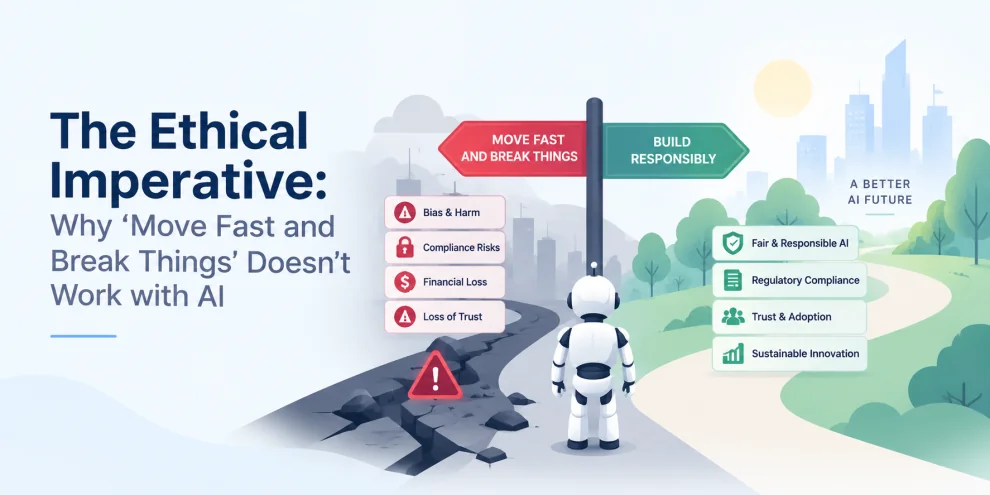

“Move fast and break things” made sense when breaking things mostly meant fixing a buggy interface, rolling back a deployment, or patching an application after launch. AI changes the equation. When intelligence becomes part of an application, a mistake can affect what users see, what data they receive, what decisions a system makes, and even what actions software takes on their behalf. For backend developers, this makes responsible engineering more than a compliance concern. It becomes part of application architecture.
An AI-powered backend is not simply another API with a model attached to it. It can process sensitive information, generate unpredictable outputs, interact with databases, call external tools, make recommendations, and increasingly act without a human approving every step. OWASP’s GenAI security guidance highlights risks including prompt injection, sensitive information disclosure, improper output handling, excessive agency, misinformation, and unbounded consumption. The faster AI becomes part of backend systems, the more important it becomes to know where speed should stop and engineering judgment should begin.
The Backend Is Where AI Meets Reality
An AI model can generate an impressive response in isolation. A production application has to do much more. The backend decides what data the model can access, which user is making the request, what tools the model can call, what gets stored, what gets returned through an API, and what happens when the model is wrong. That means many AI risks are not actually model problems. They are application architecture problems. A model may produce an inaccurate answer, but the backend decides whether that answer is shown directly to a customer. An AI agent may request a sensitive operation, but the backend determines whether that operation is authorized. A prompt injection may manipulate a model, but proper permissions and validation can prevent the resulting request from reaching critical systems. This is why ethical AI development starts much earlier than the model layer.
Speed Is Valuable Until the Cost of Failure Changes
Moving quickly is not inherently bad. Fast iteration helps teams test ideas, learn from users, and eliminate features that do not work. The problem appears when teams apply the same development mindset to systems where failure carries much greater consequences. A recommendation engine giving a poor suggestion is one thing. An AI system exposing another user’s private information is something else entirely. An AI-powered healthcare application generating an incorrect response, a financial application making an unsupported recommendation, or an agent modifying production records without sufficient authorization can create consequences that cannot simply be fixed with the next deployment. The higher the impact of failure, the more deliberately the backend needs to be designed.
AI Makes “Trust the Output” a Dangerous Assumption
Traditional backend logic is usually deterministic. If a function receives a particular input and the underlying state remains the same, developers can generally predict what it will return. AI introduces another layer of uncertainty. The same application may produce different outputs. A generated response may sound confident while being incorrect. A model may misunderstand context. An agent may select an unexpected tool. That does not mean AI is unreliable by definition. It means backend systems should not treat generated output as automatically trustworthy. Validation needs to happen before AI output becomes application behavior.
Never Let Generated Output Bypass Backend Controls
One of the most important rules for AI-enabled backend systems is simple: generated content should not automatically receive the same trust as application-generated data. Suppose an AI assistant generates a request to update a customer’s profile. The backend should not assume the request is legitimate simply because it came from an AI component. Authentication still matters. Authorization still matters. Input validation still matters. Business rules still matter. Database constraints still matter. The AI should operate within the same security boundaries as every other application component. This becomes particularly important as agentic systems gain the ability to interact with external tools and perform actions. OWASP specifically identifies excessive agency as a major GenAI application risk because giving models too much autonomy can produce unintended consequences.
Data Ethics Starts With the API
Backend developers often think about data protection in terms of database security. AI expands the problem. Consider everything that can pass through an AI-enabled API: user prompts, uploaded documents, conversation history, retrieved records, generated responses, logs, and telemetry. Not all of that data should necessarily be stored. Not all of it should be sent to a model. Not all of it should appear in logs. Not every service should have access to it. This is where data minimization becomes an architectural decision. The backend should only send the information required for a particular task and should establish clear rules around retention, access, logging, and deletion. NIST’s AI Risk Management Framework emphasizes incorporating trustworthiness considerations throughout the design, development, use, and evaluation of AI systems rather than treating risk as something that happens only after development.
Privacy Cannot Be an Afterthought
A common development pattern is to build the feature first and address privacy before launch. With AI applications, that can be too late. Imagine an application that sends customer conversations to an external model provider. During development, this may seem like a straightforward integration. But what happens to those conversations? What information is included? How long is it retained? Can internal users access the logs? Can prompts accidentally contain credentials or personal information? These questions belong in the architecture discussion. Privacy should influence what the backend collects, what it sends, what it stores, and who can access it.
Security Testing Has to Evolve
Traditional application security practices remain essential, but AI introduces new attack surfaces. Prompt injection can manipulate model behavior. Sensitive information can appear in responses. Poor output handling can turn generated content into an application vulnerability. RAG systems introduce risks around retrieved content and embeddings. Agentic systems introduce additional concerns because models can interact with tools and external systems. OWASP’s GenAI guidance includes prompt injection, sensitive information disclosure, supply-chain risks, data and model poisoning, improper output handling, excessive agency, vector and embedding weaknesses, misinformation, and unbounded consumption among the major risks developers need to consider. For backend teams, that means security testing can no longer stop at the API endpoint. The model interaction itself needs to be tested.
Build Permission Boundaries Around AI
One of the biggest architectural mistakes is giving an AI component more access than it actually needs. If an AI assistant only needs to retrieve order information, why should it have permission to modify orders? If an agent needs to create a support ticket, why should it be allowed to delete customer records? If a model can recommend a database operation, why should it automatically execute arbitrary queries? The principle of least privilege becomes even more important when AI is involved. AI components should receive narrowly defined permissions, limited tools, restricted data access, and explicit operational boundaries. The goal is not to prevent AI from being useful. The goal is to make sure a mistake has a limited blast radius.
Human Oversight Still Has a Place
There is a tendency to treat human involvement as a failure of automation. It is not. For high-impact operations, human approval can be an intentional architectural safeguard. An AI system can analyze a complex incident and recommend an action. A human can approve the action. An AI assistant can prepare a response for a sensitive customer request. A human can review it. An agent can identify a potentially fraudulent transaction. A human can make the final decision. As AI systems become more capable, the role of humans may shift from performing every task to supervising the decisions where consequences are significant. That is not slower engineering. It is controlled engineering.
Observability Should Include AI Behavior
Traditional backend observability focuses on latency, errors, throughput, database performance, and service availability. AI applications need additional visibility. Teams should understand which model was used, what inputs influenced a response, which retrieval sources were involved, what tools were called, how long inference took, and whether the final output passed validation. Without this information, debugging an AI-powered backend can become extremely difficult. A user reports that the application produced an incorrect answer. Was the model wrong? Did retrieval return poor context? Did the prompt change? Was the wrong model selected? Did a tool return stale data? Did a backend service transform the response incorrectly? Good observability makes those questions answerable.
Responsible AI Does Not Mean Slower Development
There is a misconception that ethical engineering means adding months of reviews before every AI feature can ship. That is not the goal. Responsible development can actually make teams faster because risks are identified earlier. A simple risk assessment before implementation can prevent a major redesign later. Clear permission boundaries can prevent security problems. Automated validation can catch unsafe outputs before they reach users. Testing against adversarial prompts can reveal weaknesses before attackers discover them. NIST’s secure software development guidance for generative AI recommends adapting secure development practices across the AI software lifecycle rather than treating security as a separate activity. The objective is not to slow experimentation. It is to make experimentation safer.
Build AI Backends With Failure in Mind
The most responsible AI systems are not designed around the assumption that everything will work. They are designed around what happens when something goes wrong. What happens when the model is unavailable? What happens when it produces an incorrect response? What happens when a user attempts prompt injection? What happens when retrieved information is malicious or outdated? What happens when an AI agent calls the wrong tool? What happens when an external model provider changes its behavior? These questions should have technical answers. Fallback models, rate limits, validation layers, permission controls, circuit breakers, human escalation, audit logs, and safe defaults are mechanisms that make AI applications more resilient.
Ethics Becomes an Engineering Requirement
The ethical side of AI is often discussed in abstract terms: fairness, transparency, accountability, privacy, and safety. Backend developers translate those principles into concrete systems. Privacy becomes data minimization and access control. Accountability becomes audit logging. Safety becomes permission boundaries and validation. Transparency becomes traceability. Reliability becomes monitoring, fallback mechanisms, and controlled failure. This is where responsible AI stops being a policy document and becomes software architecture.
What Backend Teams Should Change in 2026
Backend teams building AI applications should rethink what “done” means. A feature should not be considered complete simply because the model produces a good response in testing. The team should also understand the data being processed, the permissions granted to the AI, the potential failure modes, the security risks, the monitoring requirements, and the consequences of incorrect outputs. NIST’s AI Risk Management Framework provides a broader framework for managing AI risks across design, development, use, and evaluation, while OWASP provides more application-focused guidance for identifying security risks in LLM and GenAI systems. Together, they reinforce an important idea: responsible AI is not something added after development. It needs to be considered throughout the lifecycle.
Where Responsible Engineering Makes the Difference
For teams building AI-powered applications, GeekyAnts takes a production-focused approach that connects AI engineering with backend development, security, observability, testing, and responsible deployment. The important distinction is that AI becomes part of a broader application architecture rather than being treated as an isolated model integration. That approach matters because the future of AI applications will not be determined only by who can integrate the newest model fastest. It will also be determined by who can build systems people can trust.
The End of “Break Things” Thinking
“Move fast and break things” was built for an era where software failures were often recoverable. AI changes the consequences. When software can interpret information, make decisions, generate content, and take actions, breaking things can mean exposing private data, making harmful decisions, creating security vulnerabilities, or acting on behalf of users without adequate control. The answer is not to stop moving fast. It is to redefine what fast engineering means. Fast should mean faster experimentation, faster testing, faster feedback, and faster iteration. It should not mean skipping security, ignoring uncertainty, or releasing systems without understanding how they can fail. The best AI backend systems will not be the ones that move fastest at any cost. They will be the ones that move quickly without losing control of what they build.
Frequently Asked Questions
Why doesn’t “move fast and break things” work for AI applications?
AI systems can process sensitive data, generate unpredictable outputs, and take actions through connected tools. A failure can therefore have consequences beyond a normal software bug, making stronger validation, security, and oversight necessary.
What is responsible AI development?
Responsible AI development means designing AI systems with considerations such as privacy, security, transparency, reliability, accountability, human oversight, and risk management throughout the application lifecycle.
Why is backend architecture important for ethical AI?
The backend controls authentication, authorization, data access, API behavior, tool permissions, logging, validation, and database operations. These controls determine how safely an AI model can interact with the rest of an application.
How can developers secure AI-powered APIs?
Developers should use strong authentication and authorization, validate inputs and outputs, limit model permissions, protect sensitive data, apply rate limits, monitor AI behavior, and test against AI-specific threats such as prompt injection and excessive agency.
Should AI agents always require human approval?
Not necessarily. Low-risk, predictable actions can often be automated, while high-impact actions should have stronger controls and may require human approval. The appropriate level of oversight depends on the potential consequences of failure.
What is the biggest ethical mistake in AI application development?
Treating AI as an isolated feature instead of a system-level capability. Responsible development requires considering the model, backend, data, APIs, permissions, users, monitoring, security, and failure scenarios together.
For more, visit our homepage!




Add Comment