










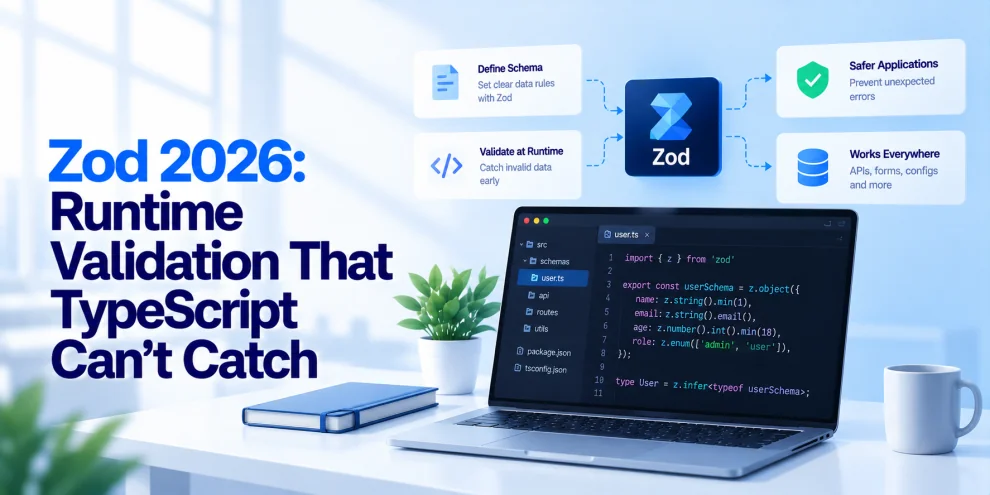

TypeScript has become a standard choice for building modern backend applications. It helps developers catch type errors during development, improves code navigation, and makes large codebases easier to maintain. But there is one important limitation: TypeScript types do not validate data at runtime.
A backend API can declare that a request expects a string, a number, or a specific object structure, but incoming HTTP requests are still untrusted data. A client can send a missing field, an unexpected value, a malformed JSON payload, or a string where the application expects a number. TypeScript cannot automatically prevent these requests from reaching application logic.
This gap becomes especially important in production systems, where APIs receive data from browsers, mobile applications, third-party integrations, queues, databases, and external services.
Zod addresses this problem by providing runtime schema validation with TypeScript integration. Developers can define the shape of valid data, validate actual inputs against that schema, and infer TypeScript types from the same definition. Instead of maintaining separate runtime checks and compile-time interfaces, teams can use one schema as the foundation for both.
For backend engineers building APIs in 2026, Zod offers a practical way to make data validation more consistent without giving up TypeScript’s development-time benefits.
Why TypeScript Alone Is Not Enough
TypeScript checks types during development and compilation. Once the application runs as JavaScript, those type annotations are no longer available as runtime enforcement.
Consider a simple API handler:
type CreateUserInput = {
  name: string;
  email: string;
  age: number;
};

function createUser(input: CreateUserInput) {
  return {
    id: crypto.randomUUID(),
    ...input,
  };
}
The function appears safe because TypeScript expects a particular object structure. But the type does not validate an incoming HTTP request.
If the handler receives data parsed from req.body, the actual value may not match CreateUserInput. A client could send an invalid email, omit the name, provide a negative age, or send a completely different object.
Type assertions do not solve this problem either:
const input = req.body as CreateUserInput;This tells the compiler to trust the developer. It does not inspect the request or prove that the data is valid.
The distinction is fundamental:
TypeScript describes what the application expects. Runtime validation checks what the application actually receives.
Backend systems need both.
What Is Zod?
Zod is a TypeScript-oriented schema validation library. It allows developers to describe the expected structure of data and validate values against that structure at runtime.
A Zod schema can define strings, numbers, booleans, arrays, objects, enumerations, optional properties, nested structures, and more complex validation rules. It can also transform values and produce structured validation errors.
For example:
import { z } from "zod";

const CreateUserSchema = z.object({
  name: z.string().min(2),
  email: z.email(),
  age: z.number().int().min(18),
});

type CreateUserInput = z.infer<typeof CreateUserSchema>;
This schema establishes three requirements:
- The name must be a string containing at least two characters.
- The email must satisfy Zod’s email validation.
- The age must be an integer of at least 18.
The TypeScript type is inferred directly from the schema. If the validation rules change, the inferred type changes with them.
This reduces the risk of a schema and a separately maintained interface drifting apart.
How Runtime Validation Works
Defining a schema is only the first step. The application must actually validate incoming data before using it.
Zod provides methods such as parse() and safeParse() for this purpose.
parse() validates the input and returns the parsed value if it succeeds. If validation fails, it throws a ZodError.
safeParse() returns a result object indicating whether validation succeeded. This makes it useful when an application wants to handle invalid input without relying on exceptions for ordinary validation failures.
A backend handler can use safeParse() like this:
import { z } from "zod";

const CreateUserSchema = z.object({
  name: z.string().min(2),
  email: z.email(),
  age: z.number().int().min(18),
});

async function createUserHandler(req, res) {
  const result = CreateUserSchema.safeParse(req.body);

  if (!result.success) {
    return res.status(400).json({
      error: "Invalid request data",
      issues: result.error.issues,
    });
  }

  const user = await createUser(result.data);

  return res.status(201).json(user);
}
This example uses a simplified Express-style handler. In a production application, the request and response types, authentication context, error formatting, and persistence logic would also be defined.
The important part is that the application passes the validated result.data to the business logic rather than continuing to use the original untrusted request body.
That creates a clear boundary between external input and internal application logic.
One Schema, Two Benefits
One of Zod’s biggest advantages is the relationship between runtime validation and TypeScript inference.
Without schema inference, a team might define a TypeScript interface and a separate validation schema. Both describe the same data, but they can become inconsistent as the application evolves.
For example, a developer might add a required role field to the interface but forget to update the runtime validator. Another developer might change the validator while leaving the TypeScript type unchanged.
Zod allows the schema to become the primary definition:
const UserSchema = z.object({
  id: z.string(),
  name: z.string(),
  email: z.email(),
  role: z.enum(["admin", "member"]),
});

type User = z.infer<typeof UserSchema>;
The inferred User type now reflects the schema’s structure.
This pattern is particularly useful for shared contracts between backend services, frontend applications, validation middleware, and test fixtures. It reduces duplication, although teams still need to manage how schemas are shared and versioned across repositories.
Validate at the API Boundary
One of the most valuable uses of Zod is request validation.
Backend APIs should treat incoming data as untrusted, even when requests come from an application maintained by the same organization. Frontend validation improves user experience, but it cannot replace server-side validation because clients can be modified or bypassed.
Zod can validate different parts of an HTTP request, including:
- Request bodies for create and update operations.
- Route parameters such as resource identifiers.
- Query parameters used for filtering and pagination.
- Configuration values supplied through environment variables.
- Payloads received from webhooks and external integrations.
A query parameter schema might look like this:
const PaginationSchema = z.object({
  page: z.coerce.number().int().min(1).default(1),
  limit: z.coerce.number().int().min(1).max(100).default(20),
});
HTTP query parameters usually arrive as strings. z.coerce.number() attempts to convert a value to a number before validating it.
This makes the expected behavior explicit while allowing the application to enforce sensible limits.
However, coercion should be used deliberately. Conversion rules can produce surprising results for some inputs, so teams should test edge cases and choose stricter parsing when automatic conversion is not appropriate.
Nested Objects and Complex Payloads
Real backend requests often contain nested data rather than flat objects.
Consider an order API that accepts customer information, delivery details, and multiple line items. Zod can represent the expected structure using nested object and array schemas.
const OrderSchema = z.object({
  customerId: z.string().min(1),
  shippingAddress: z.object({
    street: z.string().min(1),
    city: z.string().min(1),
    postalCode: z.string().min(1),
  }),
  items: z.array(
    z.object({
      productId: z.string().min(1),
      quantity: z.number().int().positive(),
    })
  ).min(1),
});
This schema checks the structure and basic constraints of an order before the application processes it.
It does not, however, prove that the customer exists, that the product is available, or that the user has permission to place the order. Those checks require database queries, authorization policies, and business rules.
That distinction matters in production architecture. Schema validation establishes whether the data has an acceptable shape. Business logic determines whether the requested operation is valid in the current system state.
Zod Does Not Replace Business Validation
A common mistake is assuming that a valid schema means an operation is safe.
Suppose an order payload contains a valid productId and a positive quantity. Zod can validate both fields, but it cannot establish whether the product belongs to the current tenant, whether inventory is available, or whether the price has changed.
Similarly, a valid email address does not prove that the user owns that address. A valid account identifier does not authorize access to the account.
Backend applications should separate these responsibilities:
Input schema → Authentication → Authorization → Business validation → Database operation
The exact sequence depends on the operation, but authorization must be enforced independently of the client-provided data and the model of the request.
Zod is an important validation layer, not a substitute for application security or domain logic.
Zod and API Security
Poor input validation can contribute to injection vulnerabilities, malformed database operations, unexpected application states, and denial-of-service conditions.
Zod helps by making input constraints explicit and rejecting data that does not meet them. It can also support allowlisting by defining accepted enumerated values and expected object shapes.
For example:
const UpdateRoleSchema = z.object({
  role: z.enum(["admin", "member"]),
});
This is safer than accepting an arbitrary role string and hoping downstream code handles every possible value correctly.
Still, schema validation is not a complete security control. Teams must also consider request-size limits, authentication, authorization, rate limiting, safe database queries, output encoding, and protection against resource-intensive payloads.
For APIs that accept large arrays or deeply nested objects, schemas should include appropriate limits where supported and be paired with request-size and execution-time controls.
The goal is to reject invalid input early without assuming that structurally valid input is automatically trustworthy.
Handling Validation Errors Properly
Validation errors are useful for both developers and API consumers, but the way they are exposed matters.
Returning a generic 400 Bad Request may be enough for some endpoints. Other APIs benefit from structured error details that identify which fields failed validation.
For example, an application might return:
{
  "error": "Validation failed",
  "issues": [
    {
      "path": ["age"],
      "message": "Too small: expected number to be greater than or equal to 18"
    }
  ]
}
The precise error format depends on the Zod version and the application’s error-mapping logic. Teams should define a stable public error contract rather than exposing internal exceptions directly.
Error responses should avoid revealing database details, secrets, internal file paths, or implementation information. They should also remain consistent across endpoints so that frontend applications can handle them predictably.
Centralized error handling can help standardize this behavior.
Zod with Express, Fastify, and Hono
Zod is not tied to a single backend framework. It can be integrated into different TypeScript-based server architectures.
With Express, developers can use middleware to validate request bodies, query parameters, or route parameters before a handler executes.
Fastify has its own schema-validation capabilities, and teams should evaluate whether its native validation approach or a Zod integration best fits their architecture.
Hono can also work with Zod through its ecosystem of validation middleware, allowing developers to validate inputs before route handlers process them.
The right integration depends on the framework, the application’s existing validation conventions, and whether teams want schemas to drive additional capabilities such as API documentation or client contracts.
A useful rule is to choose one consistent validation approach for each application rather than mixing unrelated validation patterns across routes.
Zod with ORMs and Database Layers
Zod can validate data before it reaches an ORM or database driver, but it does not replace database constraints.
A schema might require a positive integer for a quantity, while the database enforces foreign keys, uniqueness, and transactional consistency.
These controls overlap in purpose but protect different boundaries.
Application-level validation can provide useful error messages before a database operation occurs. Database constraints remain necessary because data can enter through other services, migrations, administrative tools, or concurrent transactions.
For example, checking whether an email is already registered in application code does not eliminate race conditions between concurrent requests. A unique database constraint is still needed to enforce uniqueness reliably.
The strongest design combines request validation, domain rules, and database-level integrity.
Environment Variables Need Validation Too
Invalid configuration can cause failures long after an application has been deployed. A service may start without a required variable, interpret a malformed timeout, or use an unexpected environment value.
Zod can validate environment variables at startup:
const EnvSchema = z.object({
  NODE_ENV: z.enum(["development", "test", "production"]),
  PORT: z.coerce.number().int().min(1).max(65535),
  DATABASE_URL: z.string().min(1),
});

const env = EnvSchema.parse(process.env);
If required configuration is missing or invalid, the application can fail immediately rather than operating with an incomplete setup.
For production use, teams should also validate URL formats, numeric ranges, feature-flag values, and other configuration-specific requirements. Sensitive environment values should never be included in validation error logs.
This approach makes configuration assumptions visible and reduces the likelihood of discovering basic setup errors during a production incident.
Zod, API Contracts, and OpenAPI
Zod schemas can serve as a foundation for more consistent API contracts.
When schemas are shared between the backend and frontend, both sides can use the same definitions for compatible validation and type inference. Some integrations can also generate or connect schemas to OpenAPI documentation.
This can reduce the amount of manually maintained documentation, but it requires deliberate tooling and conventions. Not every Zod feature maps directly to every API schema format, and generated documentation still needs review.
Teams building public APIs should also consider long-term compatibility. Changing a required field, tightening a constraint, or removing an accepted value can break existing clients even when the updated schema is technically correct.
Schema changes should therefore be reviewed as API contract changes, with versioning or backward-compatible migration strategies where appropriate.
Performance Considerations
Runtime validation adds computation to request processing. For most ordinary API payloads, this overhead is often reasonable compared with network latency, database queries, and external service calls. But the impact depends on payload size, schema complexity, request volume, and validation patterns.
Teams should avoid assuming that validation is free, particularly in high-throughput services processing large nested objects or arrays.
Useful practices include validating once at the appropriate trust boundary, avoiding redundant parsing of the same data, limiting payload sizes, and benchmarking critical endpoints under realistic workloads.
It is also important not to remove validation from security-sensitive paths simply to improve benchmark numbers. The right goal is to make validation efficient while preserving the guarantees the application requires.
Common Zod Mistakes to Avoid
Several implementation mistakes can undermine the benefits of runtime validation.
Using type assertions instead of parsing: Casting an untrusted request to a TypeScript type does not validate it.
Validating the wrong object: A schema should validate the actual data received at the boundary, not an object that has already been assumed to be valid.
Ignoring parsed output: When a schema transforms or coerces values, downstream code should use the validated result rather than the original input.
Confusing validation with authorization: A structurally valid resource identifier does not grant access to the resource.
Duplicating schemas unnecessarily: Multiple conflicting definitions of the same request contract increase maintenance overhead.
Returning internal errors directly: Public error responses should be deliberate, consistent, and safe.
Skipping database constraints: Application validation cannot replace transactional integrity and database-enforced rules.
Addressing these issues helps teams use Zod as part of a coherent backend architecture rather than as an isolated utility.
Where Engineering Teams Fit
Building reliable TypeScript backends requires more than defining schemas. Teams need consistent API contracts, secure request handling, maintainable service boundaries, database integrity, and clear error-handling practices.
Teams such as GeekyAnts work across backend engineering, application architecture, and modern product development, making this broader engineering perspective relevant for teams adopting Zod in production systems. The objective is to ensure that validation fits into the full request lifecycle, from incoming data and authorization through business logic, persistence, and API responses.
The Future of Runtime Validation
As TypeScript applications become more complex, the gap between compile-time assumptions and runtime reality remains an important engineering concern.
APIs receive untrusted data. External integrations change. Environment variables can be misconfigured. Clients can send unexpected payloads. None of these problems disappears because the application has strong static types.
Zod helps bridge that gap by making runtime validation explicit and connecting it to TypeScript’s type system. Used thoughtfully, it can reduce duplicated definitions, improve error handling, and establish clearer boundaries between external input and internal application logic.
But the most reliable backend architecture does not depend on a single library. It combines schema validation with authentication, authorization, business rules, database constraints, observability, and careful API contract management.
The principle is straightforward: TypeScript helps developers reason about valid data. Zod helps applications verify that the data is actually valid at runtime. For backend teams building production APIs in 2026, that distinction is essential.
For more, visit our homepage!





Add Comment