










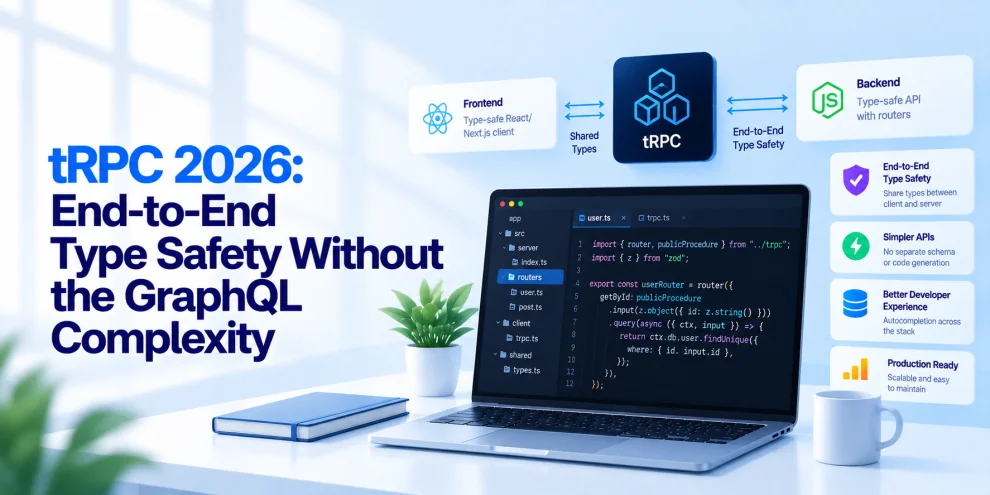

Building a modern backend API involves more than defining endpoints and returning JSON. Frontend and backend teams need to agree on request formats, response structures, validation rules, error handling, and authentication requirements. As applications grow, keeping those contracts synchronized becomes increasingly difficult. A backend developer might rename a field or change a response type, while the frontend continues expecting the old structure. The result can be runtime errors, duplicated type definitions, and additional maintenance work.
tRPC takes a different approach to this problem. Instead of requiring developers to maintain a separate API schema or generate client types from a specification, it allows TypeScript applications to share API types directly between server and client. For teams building full-stack TypeScript applications, this can simplify development while preserving strong type checking across the application boundary.
In 2026, tRPC remains an interesting option for teams that want end-to-end type safety without introducing the additional schema and tooling requirements associated with some API architectures. However, it is not a universal replacement for REST or GraphQL. Its real value depends on the application’s technology stack, integration requirements, and long-term architecture.
Why API Contracts Become Difficult to Maintain
In a conventional REST application, the backend defines endpoints such as GET /users/:id or POST /orders. The frontend sends requests and consumes the responses. Both sides need to agree on the shape of the data being exchanged.
Without a shared contract, developers may define the same types separately in the frontend and backend. Over time, these definitions can drift apart. A field that was previously optional may become required, an identifier may change format, or an endpoint may begin returning a different response structure.
Teams can reduce this risk through OpenAPI specifications, generated clients, shared packages, and contract testing. These approaches can work well, but they require additional tooling or coordination.
tRPC offers an alternative for applications where the frontend and backend are both written in TypeScript. It lets the server define procedures and exposes their inferred types to the client, reducing the need to manually duplicate API definitions.
The key idea is straightforward: define the API contract in the server code and let TypeScript carry that contract through to the client.
What Is tRPC?
tRPC is a TypeScript-focused framework for building end-to-end type-safe APIs. It allows developers to define server-side procedures that clients can call through a typed interface.
Rather than manually creating matching interfaces on both sides, the client can infer input and output types from the server’s procedure definitions. If a procedure expects a particular input shape, TypeScript can flag an incompatible client call during development. If the server’s return type changes, the client can receive updated type information when it uses the corresponding server types.
This approach reduces the gap between API implementation and API consumption. It is especially useful in monorepos or applications where the frontend and backend share a TypeScript codebase or package ecosystem.
tRPC does not eliminate HTTP or network communication. Requests still travel between the client and server. Its contribution is the developer experience and type-safety layer built around those calls.
How End-to-End Type Safety Works
Consider a backend procedure that retrieves a user by ID. In a typical application, the backend might define the response type while the frontend separately describes the expected user object. If one definition changes without the other, the mismatch may not become obvious until runtime.
With tRPC, the server defines the procedure and its input and output types. The client uses a typed client interface derived from those definitions. This creates a stronger connection between the implementation and the code that consumes it.
A simplified procedure might look like this:
import { initTRPC } from '@trpc/server'
import { z } from 'zod'

const t = initTRPC.create()

const appRouter = t.router({
  getUser: t.procedure
    .input(z.object({
      id: z.string()
    }))
    .query(async ({ input }) => {
      return {
        id: input.id,
        name: 'Alex'
      }
    })
})

export type AppRouter = typeof appRouter
Here, the input schema validates that the request contains a string ID, while TypeScript infers the procedure’s return type. The exported AppRouter type can then be used by a compatible client to infer the API’s available procedures and their expected inputs and outputs.
The example uses a placeholder user rather than a database query. A production implementation would retrieve the record from an appropriate data source and handle missing records, authorization, and operational errors.
This distinction is important: type inference improves development-time correctness, while runtime validation and business rules determine whether a request is actually valid and permitted.
tRPC vs REST vs GraphQL
tRPC, REST, and GraphQL solve overlapping but different API design problems.
REST provides a resource-oriented model using HTTP methods and endpoints. It is widely supported and works across programming languages. OpenAPI can document its contracts and generate clients for multiple platforms.
GraphQL provides a query language and type system that lets clients request specific fields from a graph of data. It can be useful when multiple clients need different views of complex data, though it introduces schema design and operational considerations.
tRPC focuses on type-safe procedure calls between TypeScript applications. It reduces contract duplication when both sides can share the server’s type definitions.
| Capability | tRPC | REST | GraphQL |
|---|---|---|---|
| Main approach | Typed procedure calls | Resource-oriented endpoints | Client-defined data queries |
| Type sharing | Direct TypeScript inference | Usually through schemas or generated clients | Through a GraphQL schema and generated types |
| Language flexibility | Best suited to TypeScript clients | Broad language compatibility | Broad language compatibility |
| Client data selection | Defined by procedures | Defined by endpoint responses | Clients select requested fields |
| Schema management | Derived from server types | Often uses OpenAPI or another contract | Uses a GraphQL schema |
| Typical strength | Full-stack TypeScript development | Interoperability and public APIs | Flexible data access across complex clients |
| Main trade-off | Tighter coupling to TypeScript | Contract tooling may require extra setup | Schema and query infrastructure add complexity |
The best choice depends on the API’s consumers. An internal product with a TypeScript frontend and backend may benefit from tRPC’s direct type sharing. A public API used by mobile applications, external partners, and multiple programming languages may be better served by REST or GraphQL.
Why TypeScript Teams Choose tRPC
One of tRPC’s biggest advantages is the reduction in duplicated API types. When a server procedure changes, the client can receive updated types from the shared router definition rather than relying on manually synchronized interfaces.
This can make refactoring easier. Developers can rename fields, modify procedure inputs, or change response structures and then use TypeScript errors to identify affected client code.
tRPC also fits naturally into a full-stack TypeScript workflow. Teams already using TypeScript, schema validation libraries, and shared packages can integrate it without adopting an entirely separate API description language.
The benefit is particularly relevant for product teams that release frontend and backend changes together. Instead of maintaining multiple representations of the same contract, they can derive much of the client-facing type information directly from the server implementation.
However, this convenience comes with an architectural trade-off. The client becomes more closely connected to the server’s TypeScript types. Teams need to consider whether that coupling is appropriate for their release process, repository structure, and API consumers.
Runtime Validation Still Matters
A common misconception is that end-to-end type safety makes runtime validation unnecessary. It does not.
TypeScript types are primarily enforced during development and compilation. They do not automatically validate arbitrary JSON received over an HTTP request. A malicious client, outdated application, or incorrectly formed request can still send data that does not match the expected type.
That is why tRPC applications commonly use runtime schema validation, including libraries such as Zod, to validate procedure inputs.
For example, checking that an ID is a string does not establish that the ID exists, that the current user owns the corresponding record, or that the user is allowed to perform the requested operation. Those checks belong in the application and authorization layers.
A production API should validate inputs, enforce resource-level permissions, handle expected failures, and avoid exposing sensitive internal details in error responses. Type safety reduces certain classes of development mistakes, but it does not replace application security.
Authentication and Authorization in tRPC
tRPC can integrate with an application’s authentication system through request context and middleware. Context can carry information about the current request, such as a session, authenticated user, or database connection.
Middleware can then enforce shared requirements across procedures. For example, a protected procedure can require an authenticated user before executing its business logic.
However, authentication and authorization are not the same. Authentication establishes who the caller is. Authorization determines what that caller can access or modify.
A procedure that retrieves an order must still verify that the authenticated user is permitted to access that specific order. Merely marking a procedure as protected does not automatically enforce ownership or tenant boundaries.
Multi-tenant applications need particular care. Every relevant data-access operation should apply the correct tenant and resource constraints. Authorization should be enforced in trusted server-side code rather than relying on client-provided identifiers or assumptions about the caller.
tRPC and Database Architecture
tRPC does not require a particular database or ORM. It can work with PostgreSQL, MySQL, SQLite, MongoDB, and other data stores through compatible libraries and drivers.
A typical backend might combine tRPC for API procedures, Zod for runtime validation, an ORM such as Drizzle or Prisma for data access, and a database such as PostgreSQL for persistence.
This separation keeps responsibilities clear. tRPC handles the typed API interface, validation libraries check incoming data, business logic implements application rules, and the database layer manages persistence.
For larger applications, teams should avoid putting all business logic directly inside procedure definitions. Shared domain services can make it easier to reuse logic across procedures, background jobs, scheduled tasks, and other entry points.
Database transactions, indexing, connection pooling, and query optimization remain important regardless of the API framework. tRPC’s type-safety features do not automatically improve database performance or prevent inefficient queries.
Performance: Is tRPC Faster?
tRPC is often attractive because it removes some API-contract duplication and client-generation steps. But those developer-experience benefits should not be confused with a guarantee of faster request processing.
An HTTP request made through tRPC still incurs network latency, serialization costs, server execution time, and any database or external-service delays. The performance of a particular application depends on its implementation, transport configuration, payload sizes, concurrency, and workload.
For example, a procedure that performs several sequential database queries may be slower than a carefully optimized REST endpoint, even if the tRPC client is fully type-safe. Likewise, unnecessary data fetching can outweigh any overhead saved by simplifying the API contract.
Teams should measure latency, throughput, error rates, database query time, and payload size under representative conditions. For many applications, the most significant performance improvements will come from better data access, caching, batching, and reducing unnecessary network round trips.
The primary reason to choose tRPC is usually type-safe development across the stack, not an assumption that it will outperform every other API architecture.
tRPC in Monorepos and Full-Stack Applications
Monorepos are a natural fit for tRPC because frontend and backend code can share router types through internal packages. This can simplify development in applications where teams maintain a web client and API within a coordinated repository.
For example, a product might contain a React frontend, a Node.js backend, shared validation schemas, and reusable domain types. The client can import the type definition for the server router without duplicating the procedure contracts.
However, teams need to manage build boundaries and dependencies carefully. Importing server implementation code into a browser bundle would be inappropriate. The client should consume the required type information and supported client interfaces without exposing server-only modules or secrets.
Monorepos also do not eliminate the need for versioning and release discipline. If frontend and backend deploy independently, teams must understand how changes to procedures affect older clients and how compatibility will be maintained during rollouts.
Where tRPC Is Not the Best Fit
tRPC is not ideal for every API architecture. Its strongest advantages appear when the client and server are both written in TypeScript and can share type definitions.
A public API intended for consumers using Python, Java, Go, Swift, or other languages may benefit more from a language-neutral contract such as OpenAPI or GraphQL. External APIs also often need explicit versioning, documentation, compatibility guarantees, and onboarding resources that are independent of a particular codebase.
Similarly, a system with many independently deployed services may not benefit from tightly sharing TypeScript router types across service boundaries. Explicit contracts can make ownership and compatibility clearer when services evolve separately.
GraphQL may be more appropriate when clients need flexible selection of nested data across many resources. REST may remain simpler for resource-oriented services, webhooks, and integrations where broad interoperability matters.
The right choice is not the architecture with the fewest files or the least initial setup. It is the one that fits the system’s consumers, operational model, and long-term maintenance requirements.
Testing and Observability for Production tRPC APIs
Type inference helps developers catch contract mismatches, but production systems still need comprehensive testing. Unit tests should cover business rules, integration tests should verify database and external-service interactions, and authorization tests should confirm that users cannot access resources outside their permissions.
Teams should also test invalid inputs, missing records, expected error conditions, and compatibility across independently deployed components. Type safety is most useful when combined with tests that verify actual runtime behavior.
Observability should capture request latency, procedure-level errors, database performance, external dependency failures, and relevant business outcomes. Structured logs and correlation identifiers help engineers trace a failing request through the backend.
Sensitive data should not be logged indiscriminately. Inputs may contain personal information, authentication details, or confidential business records. Production logging should use data minimization, appropriate access controls, and retention policies.
A well-instrumented tRPC service allows teams to identify whether a problem originates in the API procedure, business logic, database, or another dependency rather than assuming the type-safe layer guarantees operational correctness.
Where Engineering Teams Fit
Choosing an API architecture requires more than comparing frameworks. Teams need to consider frontend integration, backend design, database access, authentication, validation, testing, deployment, and long-term maintainability. Teams such as GeekyAnts, Thoughtworks work across application development, backend engineering, and modern product architecture, making this broader engineering perspective relevant for organizations evaluating tRPC for full-stack TypeScript applications. The objective is to establish an API contract that supports rapid development without compromising security, interoperability, or operational reliability.
The Future of Type-Safe Backend Development
As TypeScript continues to play a major role in full-stack development, tools that reduce duplicated contracts and improve feedback between frontend and backend teams will remain valuable. tRPC offers a compelling approach for applications where both sides can share TypeScript types and where direct type inference simplifies the development workflow.
Its value is not that it eliminates API design. It changes how API contracts are represented and maintained. Teams still need to design procedure boundaries, validate runtime inputs, enforce authorization, manage database access, test compatibility, and monitor production behavior.
For backend engineers in 2026, tRPC is best understood as a focused solution for end-to-end type safety rather than a universal replacement for REST or GraphQL. When the application architecture fits its strengths, it can reduce repetitive contract maintenance and make full-stack changes easier to reason about.
The real advantage of tRPC is not removing complexity from backend development. It is removing avoidable complexity while keeping the important boundaries explicit.
For more, visit our homepage!



Add Comment