







Enterprise AI is entering a new phase.
Over the past two years, organizations have raced to embed large language models into customer support, software development, internal knowledge management, sales enablement, and operational workflows. What began as isolated proofs of concept is now evolving into business-critical infrastructure. AI assistants are answering customer questions, helping engineers write production code, summarizing legal documents, analyzing financial reports, and automating internal processes across global enterprises.
For engineering leaders, however, the conversation has shifted. The biggest question is no longer which large language model delivers the highest benchmark score. It is whether these AI systems can be trusted with enterprise data, regulated information, and mission-critical workflows.
A single prompt injection attack can manipulate an AI agent into ignoring security instructions. An improperly secured retrieval pipeline can expose confidential company documents. An autonomous AI workflow with unrestricted tool access can perform unintended actions across enterprise systems. These risks are transforming AI security from a model problem into a backend engineering challenge.
The organizations that will successfully scale enterprise AI over the next decade are unlikely to be those with the largest models. They will be the ones with the strongest AI infrastructure.
That is why the concept of a Zero-Trust AI Gateway is rapidly becoming one of the most important architectural patterns for enterprise AI.
Why Enterprise AI Needs a New Security Layer
Traditional API gateways have served enterprises well for years. They authenticate users, enforce rate limits, validate requests, and manage traffic between applications and backend services. Those capabilities remain essential, but they were never designed for systems that interpret natural language instead of structured API calls.
Large language models introduce an entirely new attack surface. Unlike traditional software, they can be manipulated through carefully crafted prompts rather than code exploits. Attackers no longer need to break into infrastructure. They simply need to persuade the model to ignore its original instructions.
This is why conventional security controls are no longer enough.
An enterprise AI platform needs a layer capable of understanding prompts, evaluating retrieved context, inspecting model responses, enforcing authorization policies, and preventing sensitive information from leaving the organization. That layer is the Zero-Trust AI Gateway.
Instead of assuming every prompt is safe, every retrieved document is trustworthy, or every model response is acceptable, the gateway treats every interaction as potentially hostile until it has been evaluated against enterprise policies.
This approach mirrors the Zero-Trust principles that transformed enterprise networking over the last decade. Trust is never assumed. It is continuously verified.
Prompt Injection Is Becoming an Enterprise Risk
Prompt injection has quickly emerged as one of the most discussed security concerns in generative AI.
Unlike traditional cyberattacks that exploit software vulnerabilities, prompt injection targets the reasoning capabilities of language models. Attackers attempt to override system instructions, manipulate retrieved knowledge, or convince AI agents to perform actions they were never intended to execute.
The challenge becomes even more complex when organizations deploy Retrieval-Augmented Generation (RAG) systems or autonomous AI agents.
Imagine an internal engineering copilot retrieving documentation from thousands of enterprise knowledge sources. If a malicious instruction is hidden inside a document, PDF, or webpage, the AI may unknowingly execute those instructions while responding to users. The model behaves exactly as designed, but the surrounding system has failed to protect it.
For enterprises managing millions of documents across multiple departments, this creates a security challenge that traditional application firewalls were never built to solve.
Data Leakage Is Often the Greater Threat
While prompt injection receives significant attention, many engineering leaders are more concerned about data leakage.
Enterprise AI applications routinely process customer records, financial information, engineering documentation, legal contracts, source code, healthcare data, and proprietary intellectual property. Every interaction with a language model creates another opportunity for sensitive information to be exposed unintentionally.
Sometimes the risk comes from excessive retrieval, where more information is passed to the model than necessary. In other cases, an AI assistant may reveal confidential details because document permissions were not enforced before retrieval. Even generated responses themselves can accidentally expose internal knowledge if no validation occurs before information reaches users.
For highly regulated industries, these incidents are not merely technical failures. They become compliance issues with legal and financial consequences.
This is why enterprise AI security increasingly focuses on controlling information before it reaches the model and validating responses before they reach the user.
The Role of a Zero-Trust AI Gateway
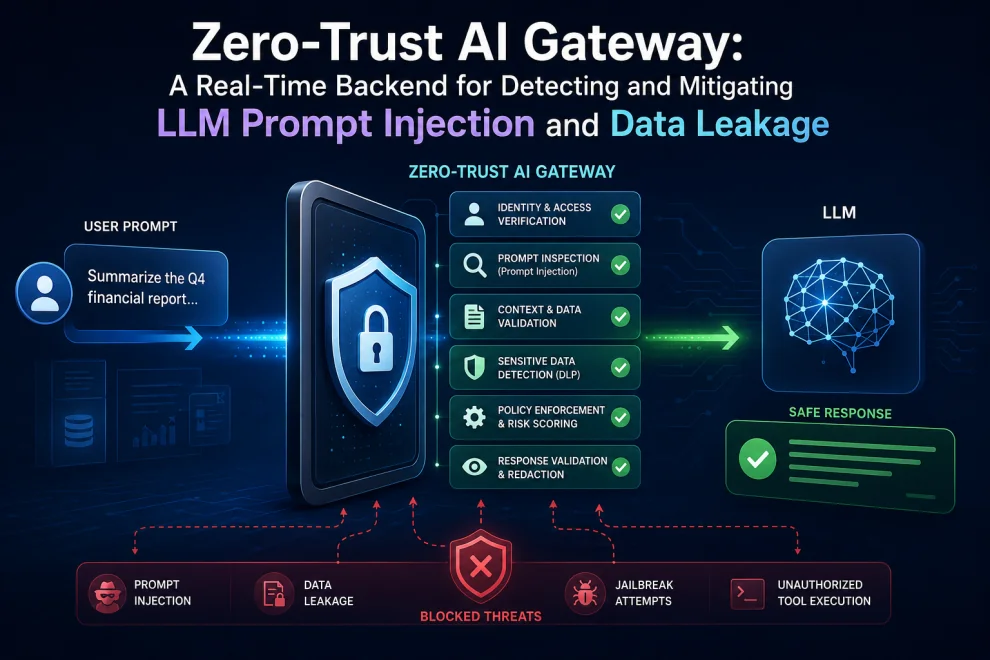
A Zero-Trust AI Gateway acts as the intelligent control layer between enterprise applications and large language models.
Every prompt, every retrieved document, every tool invocation, and every generated response passes through a centralized policy engine before reaching its destination.
Rather than relying on static keyword filters, modern gateways combine identity-aware authorization, contextual risk analysis, policy enforcement, and real-time inspection.
When a user submits a request, the gateway first validates identity and permissions. It determines which enterprise systems the user is authorized to access and restricts retrieval accordingly. Retrieved documents are inspected for hidden prompt injection attempts, malicious instructions, or unauthorized content before being included in the model’s context.
Once the model generates a response, the gateway evaluates it again. Sensitive information such as personally identifiable information, financial records, internal credentials, or confidential business data can be detected and redacted before the response is delivered.
This continuous verification dramatically reduces the likelihood that AI becomes an unintended pathway for data exposure.
Why Backend Engineering Has Become the Competitive Advantage
Much of the AI conversation continues to revolve around models.
Organizations compare benchmark scores, reasoning capabilities, context windows, and inference speeds. While these characteristics matter, they are rarely what determines whether enterprise AI succeeds in production.
Production AI depends far more on the architecture surrounding the model than on the model itself.
The backend determines how documents are retrieved, how user permissions are enforced, how prompts are inspected, how responses are validated, how tools are authorized, how security events are logged, and how governance policies evolve over time.
Without these capabilities, even the most advanced language model introduces unnecessary operational risk.
This shift is causing many enterprise engineering teams to invest more heavily in platform engineering than model experimentation. Secure orchestration, observability, policy management, and runtime governance are becoming foundational components of enterprise AI infrastructure.
Observability Is No Longer Optional
Enterprise leaders have spent years building observability into cloud platforms, distributed systems, and microservices. AI requires the same operational discipline.
Every interaction with a language model should be traceable.
Engineering teams need visibility into which prompts were submitted, which knowledge sources were retrieved, what policies were enforced, whether sensitive information was detected, how the model responded, and why certain actions were approved or rejected.
This level of observability enables security investigations, compliance reporting, performance optimization, and continuous improvement of AI systems.
Without comprehensive monitoring, organizations have little visibility into one of the fastest-growing parts of their technology stack.
Building AI Systems That Enterprises Can Trust
For organizations operating across multiple business units, regions, and regulatory environments, AI governance cannot rely on individual development teams implementing security independently.
A centralized Zero-Trust AI Gateway provides consistency across every application, regardless of which language model, cloud provider, or AI framework is used.
Policies become reusable. Security controls become standardized. Compliance becomes easier to demonstrate. New AI applications inherit governance from the platform instead of rebuilding it from scratch.
This architectural approach allows enterprises to innovate more rapidly while maintaining the controls expected in highly regulated environments.
Companies investing in enterprise AI are increasingly recognizing that long-term success depends less on choosing the perfect model and more on building resilient infrastructure around it.
This is an area where experienced product engineering teams are making a meaningful impact. Rather than focusing solely on AI features, firms like GeekyAnts are helping enterprises design production-ready AI platforms with secure backend architectures, scalable integrations, governance frameworks, and observability built into the foundation. As AI adoption accelerates, this engineering-first approach is becoming essential for organizations that want to move beyond pilots and deploy AI confidently at enterprise scale.
Conclusion
Generative AI is changing how enterprises build products, automate operations, and serve customers, but it is also introducing an entirely new category of security challenges. Prompt injection, sensitive data leakage, unauthorized tool execution, and governance gaps cannot be solved by larger models alone.
The future of enterprise AI will be defined by secure infrastructure as much as intelligent models.
A Zero-Trust AI Gateway provides the runtime controls needed to inspect prompts, validate context, enforce identity-aware policies, protect sensitive information, and monitor every interaction across the AI lifecycle. For engineering leaders responsible for enterprise-scale platforms, it represents more than a security enhancement. It is becoming a foundational component of production-ready AI architecture.
Organizations that invest in this approach today will be better positioned to scale AI responsibly, strengthen customer trust, and deliver intelligent systems that are secure by design rather than secure by exception.
For more, visit our homepage!



Add Comment