





AI agents are changing what software is expected to do. Traditional applications wait for a user request, execute predefined business logic, call a few services, and return a response. An AI agent can interpret a goal, decide which steps are required, call tools, retrieve information, evaluate results, and continue working until the task reaches a defined outcome.
That sounds like a model problem. It is actually a backend architecture problem. The moment an AI agent can access databases, APIs, customer information, internal systems, payment services, or operational tools, the backend becomes responsible for controlling what the agent can see and do. An impressive model does not compensate for weak authorization, poorly designed APIs, uncontrolled tool access, unreliable state management, or missing observability.
In 2026, the engineering challenge is therefore not simply building an AI agent. It is building an agent backend that can support autonomy without sacrificing security, reliability, scalability, or architectural control.
An AI Agent Is Not Just Another API Client
A conventional application generally follows a predictable execution path. A request enters the API, application logic runs, a database or service is called, and a response is returned. An agent introduces a feedback loop. The model receives context, chooses an action, calls a tool, receives the result, evaluates it, and may decide to call another tool before completing the task.
That means a single user request can produce multiple backend operations. A customer asking an AI assistant to “find my delayed orders and arrange the appropriate next step” could trigger identity verification, order retrieval, shipment tracking, policy lookup, eligibility checks, and potentially a support workflow.
The backend cannot treat that as one simple request. It needs to understand the difference between the user’s original intent, the agent’s intermediate decisions, and the actual operations executed against production systems.
Keep the Agent Outside the Core Business Logic
One of the most important architectural decisions is where the agent should sit. The agent should generally orchestrate business capabilities rather than replace the systems that enforce them.
For example, an AI agent might decide that a customer qualifies for a refund. That does not mean the model should directly modify a payment database. Instead, the agent calls a controlled refund service. The backend service validates the customer’s identity, refund eligibility, transaction status, limits, and other business rules before executing the operation.
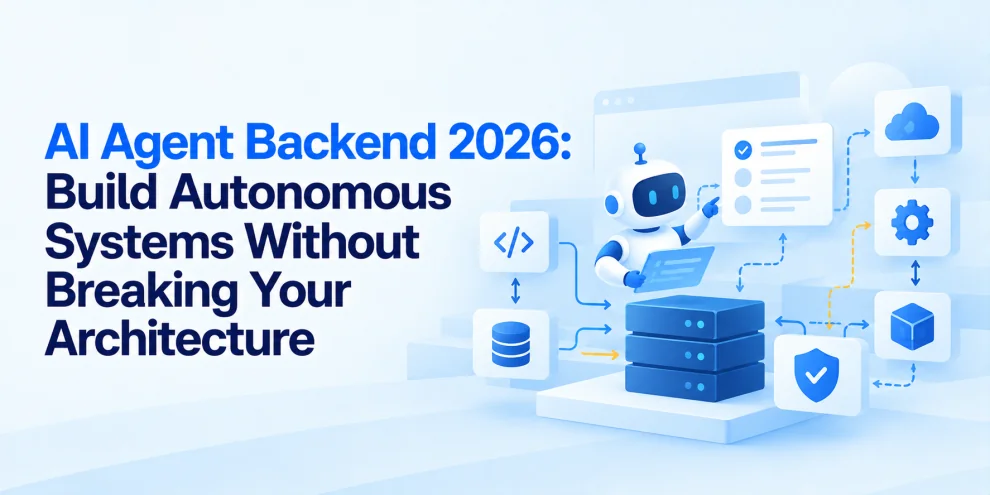
The architecture becomes User → Agent → Controlled Tool → Backend Service → Business Rules → Data.
The model provides reasoning and orchestration. The backend remains responsible for enforcement. This separation makes the system easier to secure, test, monitor, and evolve.
Design Tools as Product Interfaces
Tools are the bridge between an AI agent and the rest of the application. Poorly designed tools expose too much power. A generic database query tool, unrestricted HTTP client, or arbitrary shell interface gives the model capabilities that are difficult to govern safely.
Better tools represent specific business actions. Instead of execute_database_query, a customer-service agent might receive get_customer_order_history, check_refund_eligibility, create_support_ticket, or request_refund_review.
Each tool should have clearly defined inputs, outputs, permissions, validation rules, and failure behavior. This creates an important architectural boundary: the model chooses among approved capabilities instead of inventing its own access path into the backend.
Authorization Must Stay Outside the Model
An agent can determine what a user appears to want. It should not determine what that user is authorized to do.
Imagine a user asks an agent to retrieve an account belonging to another customer. The model may interpret the request correctly. The backend must still reject it if the authenticated identity does not have access.
Authorization should therefore be enforced by deterministic backend controls. The backend should validate identity, tenant, resource ownership, role, scope, and business policy independently of the model’s reasoning.
The model can request an action. The backend decides whether that action is permitted.
Treat Agent Output as Untrusted Input
AI-generated tool arguments should be treated like any other external input. The model might generate an incorrect customer ID, an unexpected parameter, an excessive quantity, or an operation that falls outside the intended workflow.
Every tool call should therefore pass through schema validation, allowed-value checks, resource ownership checks, authorization, business rules, transaction limits, rate limits, and tenant restrictions.
For high-impact actions, additional safeguards may include human approval or step-up authentication. The fact that the request came from an AI model should never make it more trusted than a request from an ordinary application client.
Give Agents Narrow Permissions
An agent should have the minimum access necessary to perform its assigned workflow. A product-information assistant might only need read access to approved product content. A support agent may need access to customer tickets but not payment credentials. An operations agent may need to restart a specific class of services without having unrestricted cluster administration privileges.
This can be implemented through dedicated identities, scoped credentials, service accounts, permission policies, and tool-level authorization. Least privilege becomes even more important as agents become capable of multi-step actions because one compromised or manipulated workflow can otherwise reach several systems.
State Management Becomes a First-Class Problem
Traditional request-response applications can often keep most execution state within a request or session. Agents are different. A workflow may continue across multiple model calls and tool invocations. Some tasks may take seconds, while others may involve asynchronous jobs, human approval, retries, or external events.
The backend therefore needs explicit agent state. That state may include the task identifier, user context, workflow status, tool results, intermediate decisions, retry information, approvals, and execution history.
State should not exist only inside the model’s context window. The backend needs a durable representation of important workflow state so the process can recover after failures, resume after interruptions, and remain observable.
Do Not Confuse Conversation History With Agent State
Conversation history and execution state are related but not identical. A conversation contains what the user and assistant said. Agent state represents what the system has actually done and what remains to be completed.
For example, an agent may tell a user that it is checking a refund. The backend should independently track whether the eligibility check actually happened, what service returned the result, whether approval was required, and whether a refund was executed.
The backend should be the source of truth for completed actions rather than relying on model-generated text to describe what happened.
Build for Long-Running Workflows
Some agent tasks cannot be completed within a single synchronous API request. An agent might need to wait for an external API, human approval, a document-processing job, a payment confirmation, or another asynchronous event.
Trying to keep such workflows inside a single HTTP request creates unnecessary reliability problems. Instead, long-running agent workflows can use queues, event-driven processing, workflow engines, durable state, retries, and callbacks.
This allows the agent to pause and resume without losing context or creating duplicate actions. The architecture should assume that individual steps can fail independently.
Idempotency Is Critical for Agent Actions
Agents can retry. Networks can fail. Tool responses can time out. An agent may not know whether an operation succeeded if the connection fails immediately after the request.
Without idempotency, a retry could create duplicate transactions. This is particularly dangerous for payments, refunds, order creation, account changes, or external notifications.
Sensitive operations should therefore support idempotency keys or equivalent mechanisms so repeated requests do not unintentionally repeat the underlying action. Agent reliability depends heavily on the reliability of the services it calls.
Design for Partial Failure
A multi-step agent workflow can fail in the middle. Suppose an agent successfully creates a support ticket, updates a customer record, and then fails while calling an external notification service.
The system needs to know what already happened. It should not simply restart the entire workflow and risk creating another ticket or repeating another state-changing operation.
Durable workflow state, idempotent operations, compensating actions, and explicit execution status can help manage these situations. The objective is to make partial failure an expected state rather than an exceptional surprise.
Retrieval Should Be Treated as a Backend Capability
Many agents depend on retrieval-augmented generation to access organizational information. But retrieval is not simply a search feature. The backend needs to determine which information an agent is allowed to retrieve.
A query should be scoped according to identity, tenant, role, resource ownership, data sensitivity, and other access policies. A document being present in a vector database does not mean every agent should be able to retrieve it.
This is especially important in enterprise environments where a single AI platform may serve multiple business units, customers, or applications.
Protect the Context Window
Agent context can become surprisingly large. A workflow may include system instructions, conversation history, retrieved documents, tool definitions, previous tool results, and intermediate context.
Sending everything into every model call increases cost and latency while making it harder to control sensitive information.
A better backend architecture manages context deliberately. Retrieve only relevant information. Summarize where appropriate. Remove unnecessary data. Apply access controls before content enters the model context. Maintain durable state outside the context window.
The model should receive enough information to make the next decision, not a copy of the entire enterprise.
Observability Must Follow the Agent Workflow
Traditional application monitoring is not enough for agentic systems. Engineering teams need to understand not only whether an API request failed but also what the agent was trying to accomplish, which tools it called, what information it retrieved, how long each step took, and where the workflow stopped.
Useful telemetry can include agent and workflow identifiers, model and prompt versions, tool invocations, tool latency, retrieval operations, authorization outcomes, token consumption, retry counts, failure categories, human approvals, and final workflow status.
This creates an execution trail that connects the original user request to the actions performed by the backend.
Security Telemetry Needs the Same Discipline
Observability can create a new data exposure problem if prompts, tool payloads, customer information, and retrieved documents are stored without controls.
Agent telemetry should therefore minimize sensitive content. Where possible, store metadata that allows engineers to understand behavior without retaining unnecessary raw payloads.
Redaction, filtering, access controls, encryption, retention policies, and tenant separation should be part of the observability architecture. The goal is to make agent behavior explainable without turning the telemetry platform into another sensitive data repository.
Protect Against Prompt Injection
An agent backend must assume that model context can contain untrusted instructions. Those instructions may come from users, uploaded files, emails, websites, retrieved documents, or third-party APIs.
Retrieved content should therefore be treated as data rather than automatically trusted instructions. More importantly, prompt-level controls should not be the only defense.
Even if an attacker convinces an agent to request sensitive information, the backend should independently enforce authorization and data boundaries.
The strongest defense is not making the model impossible to manipulate. It is ensuring that manipulation cannot grant the model authority it does not already possess.
Prevent Agent Loops and Runaway Execution
Agents can sometimes repeat actions without making meaningful progress. A tool may return unexpected data. A model may continue retrying. A workflow may bounce between two possible actions.
Production systems should therefore establish execution limits. Useful controls include maximum tool calls, maximum workflow duration, token budgets, retry limits, cost thresholds, action quotas, and circuit breakers.
When an agent reaches a defined boundary, it should stop or escalate rather than continue indefinitely.
Model Routing Can Improve the Backend
Not every step requires the same model. A lightweight model may handle classification or routing. A stronger model may be used for complex reasoning. A specialized model may handle extraction or summarization.
The backend can route workloads based on task complexity, latency requirements, privacy constraints, device capabilities, cost, and model availability.
This turns model selection into an architectural decision rather than a hardcoded dependency. It also makes it easier to replace or upgrade models without redesigning the entire application.
Keep the Agent Layer Replaceable
Models will continue changing quickly. An architecture that tightly couples business logic to a particular model provider can become difficult to maintain.
The agent layer should therefore sit behind well-defined application interfaces. Business services should not depend directly on model-specific output formats whenever avoidable. Tool contracts should remain stable. Model adapters can translate between different providers and model capabilities.
This allows organizations to evaluate new models without rewriting their core application architecture.
Build a Policy Layer Around Autonomy
As agents become more capable, policy becomes as important as intelligence. A policy layer can determine which actions are allowed, under which conditions, and with what level of approval.
For example, an agent may be allowed to update a customer preference automatically but require approval before issuing a refund above a defined threshold.
This creates a separation between reasoning and authority. The agent decides what it wants to do. The policy layer determines whether it may do it. The backend service executes the approved operation.
Design APIs for Agents, Not Just Humans
Agentic applications can expose different requirements from conventional application clients. APIs should provide clear schemas, predictable errors, explicit operation semantics, idempotency support, structured responses, and well-defined authorization requirements.
Tools should return information that helps the agent decide what to do next without exposing unnecessary internal implementation details.
A well-designed agent API is not simply an API with an LLM connected to it. It is an interface designed for controlled machine decision-making.
Test the Agent Like a Distributed System
Traditional unit tests are not enough for agentic backends. Testing should include tool failures, unexpected model output, duplicate requests, delayed responses, authorization failures, stale data, partial execution, prompt injection, context overflow, model timeouts, and dependency outages.
Teams should also test the boundaries of autonomy. What happens when the agent requests an action it should not be allowed to perform? What happens when a tool returns contradictory information? What happens when the model selects the wrong resource? What happens when an external service becomes unavailable halfway through a workflow?
The objective is not to prove that the agent will never make mistakes. It is to prove that mistakes remain contained.
Scale the Backend, Not Just the Model
Agentic workloads can create unusual backend traffic patterns. One user request may produce several model calls, multiple retrieval operations, tool invocations, database queries, and external API requests.
That means capacity planning needs to account for workflow amplification.
If one request normally creates ten backend operations, a sudden increase in agent usage can multiply downstream traffic quickly. Queues, concurrency controls, caching, connection pools, rate limits, backpressure, and workload isolation can help prevent agents from overwhelming the systems they depend on.
Where Engineering Teams Fit
Building production-grade AI agents requires more than model integration. The architecture needs to connect AI orchestration with backend services, APIs, authentication, authorization, data systems, cloud infrastructure, observability, and security controls.
Engineering organizations such as GeekyAnts work across these areas, helping teams build AI-enabled products where agents can interact with existing business systems without bypassing the architectural controls that keep those systems reliable.
The important objective is not to make an agent capable of doing everything. It is to make the agent capable of doing the right things safely and consistently.
What Engineering Leaders Should Audit
Before putting an autonomous agent into production, engineering leaders should ask: Can the agent access only the data required for its workflow? Are authorization decisions independent of model output? Are tools narrowly scoped? Does every state-changing action have validation and idempotency? Can long-running workflows recover after failures? Are agent actions observable and auditable? Can prompt injection change what the agent is authorized to do? Are tenants isolated across retrieval, storage, caching, and tools? Are execution limits and cost controls enforced? Can high-impact actions require human approval? Can the organization revoke the agent’s permissions immediately? Can the underlying model be replaced without rewriting core business logic?
These questions reveal whether the organization has built an actual production architecture or simply connected an LLM to a collection of APIs.
The Architecture That Scales With Autonomy
The strongest AI agent backends are not built around the assumption that the model will always make the correct decision. They are built around the assumption that the model will sometimes be uncertain, incorrect, manipulated, unavailable, or replaced.
That leads to a different architecture. The agent handles reasoning and orchestration. Tools provide controlled capabilities. Backend services enforce business rules. Authorization determines what can be accessed. Policy engines control autonomy. Durable state tracks execution. Observability records what happened. Infrastructure provides reliability and scale.
Each layer has a clear responsibility. That separation is what allows autonomy to increase without allowing the model to become the architecture.
The Real Goal of AI Agent Engineering
The promise of autonomous systems is not simply that software can perform more tasks without humans. The real opportunity is to redesign workflows around software that can understand context, make bounded decisions, and coordinate multiple systems.
But autonomy should not mean uncontrolled access.
A production AI agent should be able to reason without becoming the source of truth, act without becoming the authorization layer, and automate without becoming an unrestricted administrator.
The most resilient architecture is therefore not the one that gives an agent the most capabilities. It is the one that gives the agent enough capability to create value while keeping authority, data, business rules, and critical execution behind reliable backend controls.
That is how organizations can build autonomous systems in 2026 without breaking the architecture underneath them.
For more, visit our homepage!


Add Comment