









Every year, Amazon Prime Day generates hundreds of millions of customer interactions within hours. Shoppers browse products, compare prices, redeem coupons, place orders, make payments, track deliveries, and receive personalized recommendations almost simultaneously. For customers, the experience feels straightforward. For engineering leaders, it represents one of the most demanding backend challenges in modern software.
Most organizations cannot match Amazon’s scale, but many are encountering the same architectural pressures. Digital channels have become primary revenue drivers, customer expectations continue to rise, and AI-powered experiences are increasing the number of backend services every application depends on. The question is no longer whether your backend can support today’s traffic. It’s whether it can support the business your leadership team expects to build over the next five years.
The Backend Has Become a Business Platform
Backend systems were once viewed as operational infrastructure. Today, they determine how quickly a business can launch products, integrate acquisitions, support new channels, and adopt emerging technologies.
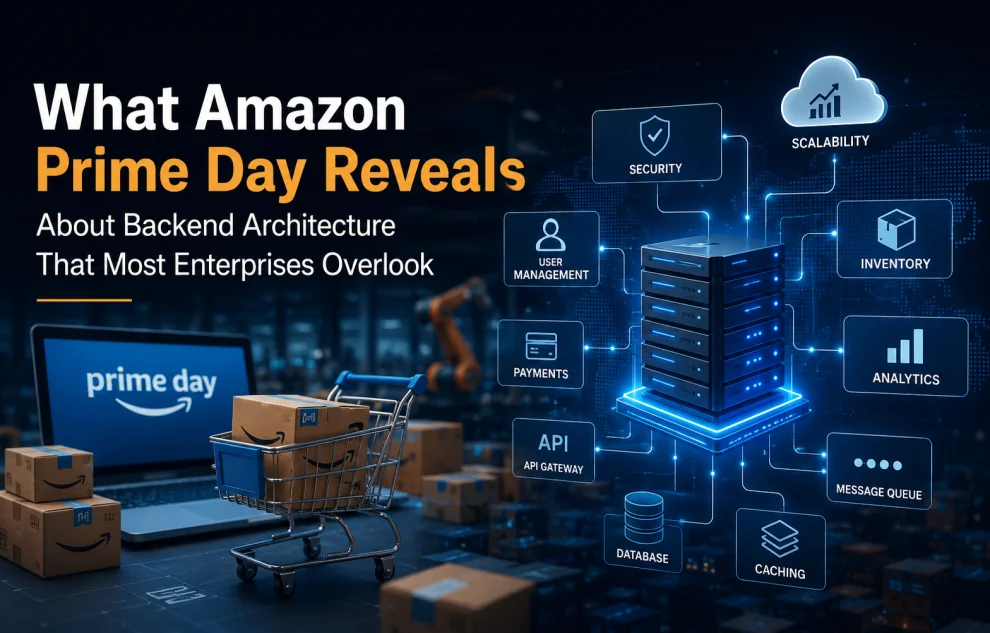
A customer opening a banking app may only see a balance and recent transactions, but behind that screen are authentication services, fraud detection engines, payment processors, customer profile systems, compliance checks, notification platforms, and analytics pipelines. Every interaction depends on multiple backend services working together in real time.
When these systems perform well, customers rarely notice. When they don’t, the consequences are immediate. Failed transactions, delayed responses, and unavailable services directly affect revenue, customer trust, and brand reputation.
For technology executives, backend architecture is no longer an engineering concern alone. It has become a strategic business capability.
Amazon’s Real Advantage Isn’t Scale. It’s Architectural Resilience.
Prime Day is often discussed as a logistics success story, but its engineering foundation is equally significant.
Traffic increases dramatically within a short window. Inventory changes continuously. Prices update in real time. Recommendation engines process enormous volumes of behavioral data. Payment systems must remain available throughout demand spikes, while fulfillment systems coordinate warehouses across multiple regions.
None of this depends on a single application.
It depends on thousands of backend services that operate independently while sharing information through well-defined interfaces. If one recommendation service experiences issues, it should not prevent customers from completing purchases. If inventory updates slow in one region, checkout services should continue operating elsewhere.
This level of resilience is not achieved by adding more servers. It results from years of architectural decisions centered on service isolation, observability, automation, distributed data management, and failure recovery.
These are the same principles increasingly adopted by enterprises modernizing legacy platforms.
AI Is Increasing Backend Complexity Faster Than Frontend Complexity
Much of the conversation around artificial intelligence focuses on user-facing experiences such as copilots, chat interfaces, or intelligent search. What receives far less attention is the backend infrastructure required to make those experiences reliable.
An enterprise AI assistant rarely interacts with a single model. It retrieves information from multiple business systems, enforces security policies, validates permissions, invokes external APIs, logs every interaction, monitors costs, and returns responses within strict latency targets.
Each AI capability introduces additional backend dependencies that must operate consistently under production workloads.
Organizations that invested in scalable backend platforms before adopting AI are finding integration significantly easier. Those still operating tightly coupled legacy systems often discover that AI initiatives expose architectural limitations that had remained hidden for years.
In many enterprises, AI has become less of a machine learning challenge and more of a backend modernization challenge.
Technical Debt Is Becoming an Executive-Level Risk
Most large organizations carry years of accumulated backend complexity. Legacy services remain because replacing them appears risky. Integration layers multiply as new platforms are introduced. Data becomes fragmented across business units. Engineering teams spend increasing amounts of time maintaining existing systems instead of delivering new capabilities.
Initially, these compromises seem manageable.
Over time, they reduce deployment velocity, increase operational costs, complicate regulatory compliance, and extend incident recovery times. The business eventually experiences the impact through delayed product launches, slower customer onboarding, and reduced agility compared to digital-first competitors.
For engineering leadership, backend modernization is no longer about pursuing architectural elegance. It is about reducing organizational friction.
The Most Successful Modernization Programs Focus on Evolution, Not Replacement
Large enterprises rarely succeed with complete platform rewrites.
Instead, they modernize incrementally. Critical capabilities are separated into independent services. APIs become the primary integration layer. Observability is introduced before major migrations begin. Automation replaces repetitive operational processes, while cloud-native infrastructure provides elasticity where demand fluctuates.
This approach allows organizations to continue delivering business value while steadily reducing technical debt.
Importantly, modernization becomes measurable. Engineering leaders can track improvements in deployment frequency, service reliability, operational efficiency, and platform scalability instead of evaluating success solely through completed migration milestones.
Engineering Partners Are Increasingly Expected to Think Beyond Implementation
As backend modernization initiatives become more strategic, enterprises are looking for partners that contribute to architectural decision-making rather than simply delivering code.
This requires experience with cloud platforms, distributed systems, API ecosystems, platform engineering, DevOps, security, observability, and increasingly, AI infrastructure.
Firms such as GeekyAnts have been expanding beyond frontend and mobile engineering into broader platform engineering engagements, helping organizations build scalable backend systems that integrate modern cloud architectures, enterprise APIs, and AI-enabled applications. The value lies not only in implementation but in designing systems that remain adaptable as business priorities evolve.
The Competitive Advantage Is No Longer the Application
Most enterprise applications offer similar customer-facing capabilities. The real differentiator increasingly lies beneath the interface.
Organizations with resilient backend platforms can launch new products faster, integrate acquisitions more efficiently, scale digital services with greater confidence, and adopt AI technologies without repeatedly rebuilding foundational infrastructure.
Customers may never see the backend.
Shareholders may never hear about it.
But for engineering executives responsible for long-term digital strategy, backend architecture is rapidly becoming one of the most important competitive assets an enterprise can build.
For more, visit our homepage!


Add Comment