







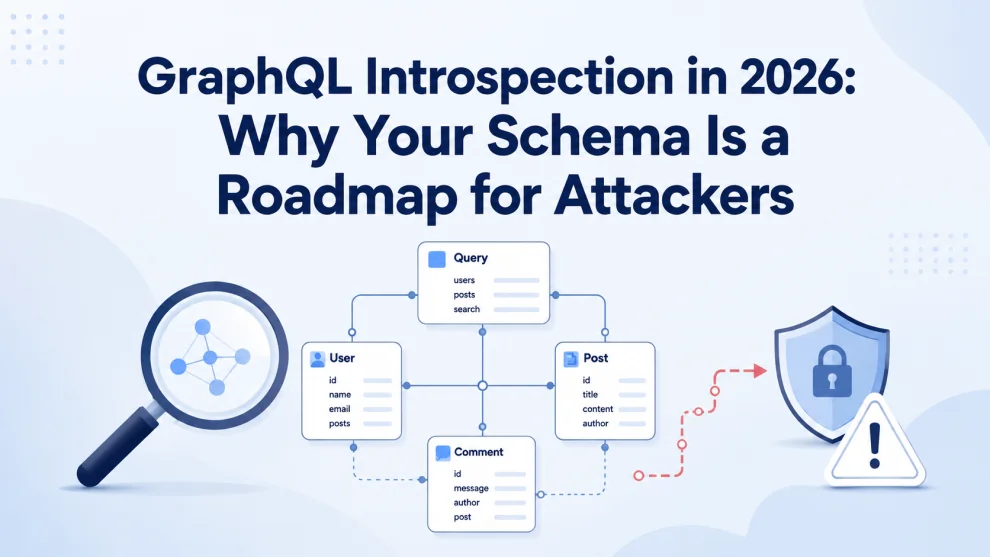

GraphQL has become a popular choice for enterprises building flexible APIs across web, mobile, and internal applications. Its introspection capability is one of the reasons developers enjoy working with it. A client can discover available types, fields, queries, mutations, arguments, and relationships without relying entirely on separate documentation. That is excellent for development productivity, but the same visibility can become useful reconnaissance for an attacker when it is unnecessarily exposed in production. In 2026, the important security question is no longer simply whether GraphQL introspection is enabled. The real question is what your schema reveals, who can access it, and whether the operations described by that schema are properly protected.
Your GraphQL Schema Is More Than Documentation
A GraphQL schema describes what an application can do. It can reveal customer objects, account relationships, administrative operations, internal workflows, mutations, and fields that developers may not consider sensitive because they are not directly exposing credentials or secrets. An attacker who can retrieve the schema can quickly understand how the API is structured instead of spending significant time guessing available operations.
Consider a production schema containing mutations such as updateUser, deleteAccount, createOrganization, or changeUserRole. Introspection does not automatically make those operations exploitable, but it can tell an attacker that they exist and what arguments they accept. This reduces the amount of uncertainty during reconnaissance. For a large enterprise where a single GraphQL gateway may expose functionality across hundreds of services, that information can represent a substantial map of the application’s attack surface.
Introspection Is Not the Vulnerability
There is an important distinction that engineering teams sometimes miss: introspection itself is not necessarily a vulnerability. Disabling it does not fix broken authorization, insecure resolvers, excessive data exposure, or weak business logic. If an attacker already knows the operation names and fields, they can still construct GraphQL requests manually.
The real problem occurs when unrestricted schema visibility is combined with weak security controls. Imagine that an attacker discovers a mutation for modifying organization settings. If the resolver properly verifies that the authenticated identity has permission to modify that specific organization, knowing about the mutation may not provide much practical value. If authorization is based only on whether the user is logged in, however, schema discovery can make a dangerous operation much easier to identify.
Authorization Has to Exist at the Resolver Level
GraphQL applications need authorization controls that operate close to the data and business logic. Authentication answers the question, “Who are you?” Authorization answers, “What are you allowed to do?” Those are very different controls.
A user may legitimately access an organization but should not automatically be able to modify its security settings. An employee may access customer records but should not see internal risk information. A support representative may update certain account fields but should not execute administrative mutations. These rules need to be enforced by the application rather than hidden behind an assumption that users will not discover the relevant GraphQL fields.
This is particularly important because GraphQL allows clients to request specific fields. Field-level authorization can therefore become just as important as endpoint-level authorization in a traditional REST API.
The Enterprise Problem Is Schema Sprawl
GraphQL becomes particularly challenging when multiple engineering teams contribute to a shared schema. A field introduced for an internal application can eventually become available through a broader gateway. A deprecated mutation can remain active for years because an undocumented client still depends on it. An internal object can become visible simply because it was added to a shared schema without a clear ownership model.
At enterprise scale, schema governance needs to become part of the API development lifecycle. Engineering teams should know who owns each schema component, why it exists, which consumers depend on it, what data it exposes, and whether it should be available to external clients.
This is where platform engineering and security teams need to work together. The objective is not to prevent developers from moving quickly. It is to make secure schema design the default path.
Should You Disable Introspection in Production?
There is no universal answer. Development teams rely on introspection for IDE tooling, documentation, testing, client generation, and API exploration. Completely removing it from every environment can create unnecessary friction.
A stronger strategy is to make schema visibility dependent on environment and identity. Development environments can allow broad introspection, while production environments can restrict it to trusted users, authenticated engineering tools, or approved clients. Some organizations may choose to disable public introspection entirely while maintaining controlled access through internal tooling.
The important principle is that schema visibility should be treated as an access-control decision rather than a simple on-or-off security checkbox.
GraphQL Complexity Can Become an Availability Problem
Introspection is only one part of the GraphQL attack surface. The ability to construct deeply nested and highly flexible queries can also create resource-consumption risks. A query that traverses several relationships can generate substantial database work, trigger multiple downstream calls, or consume significant application resources.
For example, a seemingly valid query could request customers, their organizations, transactions, products, and related records through several levels of nesting. If the application has no controls around query depth, complexity, execution time, or backend resource consumption, a malicious client may be able to generate disproportionately expensive requests.
Enterprise GraphQL deployments should therefore evaluate query complexity limits, depth controls where appropriate, rate limiting, timeouts, persisted operations, caching, and protection for expensive resolvers. The exact controls depend on the architecture, but the principle is consistent: a flexible query language needs corresponding resource controls.
Deprecated Fields Can Become Security Debt
One area frequently overlooked during GraphQL security reviews is deprecated functionality. Teams may mark a field or mutation as deprecated without actually removing it. Over time, the schema can accumulate old operations that are no longer documented but remain executable.
This creates security and maintenance debt. A deprecated field may contain outdated authorization logic, expose unnecessary information, or connect to a legacy backend that receives less security attention than newer services.
A mature schema governance process should therefore track deprecated operations and establish an actual removal process. Deprecation should be a stage in the lifecycle of an API capability, not a permanent state.
Error Messages Matter Too
Even when introspection is restricted, GraphQL error responses can reveal useful information. Validation errors, type errors, authorization responses, and field suggestions can sometimes provide clues about available schema structures.
Production error handling should therefore avoid exposing unnecessary implementation details. Errors should remain useful to legitimate clients while limiting information that could assist reconnaissance.
This does not mean returning generic errors for everything. It means deciding deliberately what information belongs in a developer environment and what information belongs in a production response.
Monitor GraphQL at the Operation Level
Traditional infrastructure monitoring is not enough for a large GraphQL deployment. CPU, memory, request volume, and latency are important, but engineering teams also need to understand which GraphQL operations are being executed and how those operations behave.
Monitoring can help identify unusually expensive queries, unexpected mutations, deprecated operations that are still being used, unusual request patterns, and clients interacting with parts of the schema they normally never touch.
For security and platform leaders, this creates a much clearer picture of real API behavior. The goal is not merely knowing that the GraphQL gateway is healthy. It is knowing what the gateway is actually doing.
What Engineering Leaders Should Audit in 2026
A GraphQL security audit should start with the production schema and work outward. Determine whether unauthenticated users can access introspection, identify which identities can retrieve schema metadata, review sensitive queries and mutations, and map authorization requirements to fields and resolvers. Then examine deprecated operations, administrative capabilities, query complexity controls, rate limits, persisted queries, error responses, logging, and monitoring.
The most important question is whether the organization can explain the security boundary around every sensitive operation. If the answer depends on “users cannot see that field,” the architecture is probably relying too heavily on obscurity.
The Bigger Lesson for Enterprise GraphQL
GraphQL’s value comes from giving clients flexibility. Security comes from ensuring that flexibility does not become unrestricted access to application capabilities or backend resources. Your schema should therefore be treated as a production security asset, not merely developer documentation.
In 2026, engineering leaders should assume that a determined attacker may eventually understand the schema. The security model should remain strong even under that assumption. Introspection restrictions can reduce reconnaissance, but they cannot replace authorization, schema governance, query controls, monitoring, and secure application design.
For organizations modernizing APIs across large engineering environments, the priority should be making secure GraphQL patterns repeatable rather than relying on individual developers to remember every security consideration. Teams such as GeekyAnts, Thoughtworks can support this broader application engineering approach by combining API architecture, application development, and modern security practices into a production-focused delivery model.
The key question is simple: If an attacker knew your entire GraphQL schema tomorrow, would your API still be secure? If the answer is uncertain, introspection is probably not your biggest problem. Your authorization and API governance model are.
FAQs
Is GraphQL introspection dangerous?
Introspection is not inherently dangerous. The risk comes from exposing detailed schema information to untrusted users while having weak authorization or other security controls around the underlying operations.
Should I disable GraphQL introspection in production?
It can be appropriate to restrict or disable public introspection, but it should not be treated as the primary security control. Authentication, authorization, query protection, and schema governance remain essential.
Does disabling introspection prevent GraphQL attacks?
No. Attackers can still send manually constructed GraphQL queries if they know the schema or can infer its structure. Disabling introspection primarily makes reconnaissance more difficult.
What is the biggest GraphQL security risk?
Broken authorization is one of the most serious risks. A GraphQL API can have restricted introspection and still expose sensitive information or functionality if resolvers do not correctly enforce access permissions.
How can enterprises secure GraphQL APIs?
Enterprises should combine authentication, resolver- and field-level authorization, schema governance, query complexity controls, rate limiting, persisted operations where appropriate, secure error handling, monitoring, and regular API security testing.
What should be reviewed during a GraphQL security audit?
Review introspection access, schema exposure, sensitive fields, mutations, resolver authorization, deprecated operations, query complexity, rate limiting, error responses, logging, and unusual query behavior. The review should cover both the schema and the systems behind it.
For more, visit our homepage!


Add Comment