








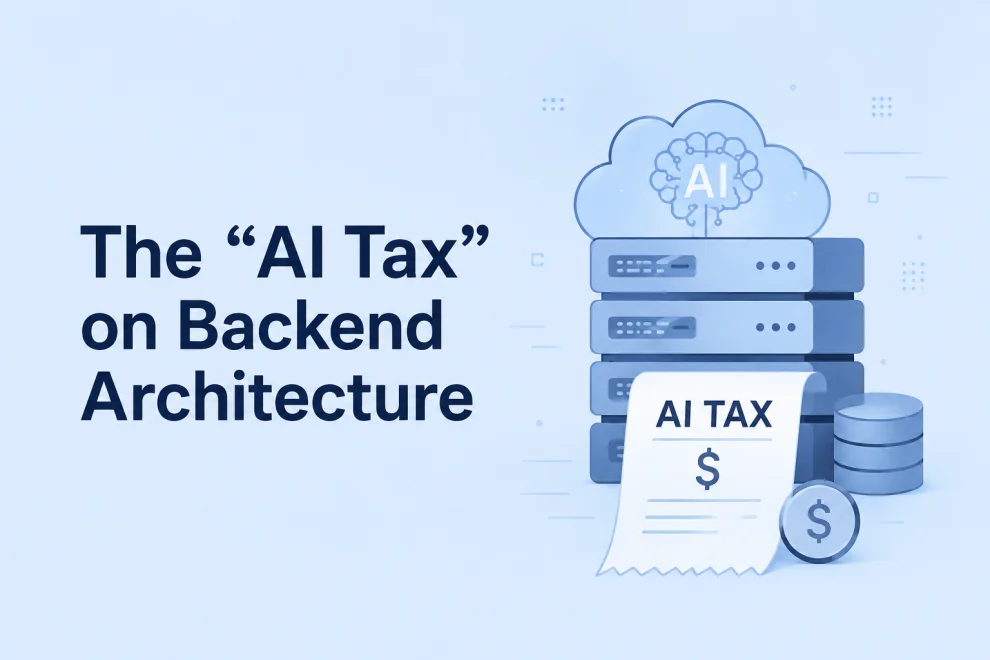

AI is changing backend architecture faster than many engineering organizations anticipated. Adding an AI capability to an application rarely means adding a single API call and moving on. Once intelligent features enter production, backend teams inherit new requirements around inference, context management, data retrieval, asynchronous processing, observability, security, cost control and reliability. This creates what can be called the “AI tax” on backend architecture: the additional engineering effort required to make AI-powered functionality reliable at production scale.
For organizations with thousands of engineers and large application portfolios, this tax is not limited to infrastructure costs. It appears as additional architectural decisions, new failure modes, more complicated data flows and stronger requirements around operational controls.
AI Turns a Simple Backend Request Into a Distributed Workflow
A conventional backend request may follow a relatively predictable path: authenticate the user, execute application logic, query a database and return a response. An AI-powered request can be considerably more complex.
The backend may authenticate the request, retrieve relevant context, query internal systems, perform semantic retrieval, construct a model request, call an inference service, validate the generated response, execute tools and store relevant state before returning the result.
What appears to the user as one request can actually be a distributed workflow involving multiple services.
This introduces additional latency, failure points and operational dependencies. Backend teams need to understand not only whether a request failed, but which part of the AI workflow failed and why.
Latency Becomes an Architectural Constraint
Traditional backend systems are often optimized around predictable response times. AI introduces model inference into that equation.
A request that previously depended on a few database or service calls may now depend on model inference, retrieval and potentially several tool calls. Multi-step agent workflows can multiply those dependencies.
The result is a new latency budget.
Backend architects need to determine which AI operations actually need to happen synchronously. Streaming responses can improve perceived responsiveness, while asynchronous processing can move longer-running workloads away from the critical request path.
Caching, model routing, request prioritization and fallback strategies can also become important architectural mechanisms.
The key question is no longer simply “How fast is the API?” but “Which parts of the AI workflow belong on the synchronous path?”
Context Becomes a Backend Resource
Traditional applications primarily manage data. AI applications also manage context.
Context can include conversation history, retrieved information, system instructions, user preferences, tool outputs and application state. The backend must determine what information should be retained, how long it should remain available and what subset should be provided to the model.
More context does not automatically mean better output.
Large context payloads can increase latency and inference costs while introducing irrelevant information. Backend teams therefore need deliberate context-management strategies.
A production architecture may separate short-lived conversational state from durable application records, retrieval indexes and authoritative data sources. This separation makes the system easier to operate and gives engineering teams greater control over what reaches the model.
Retrieval Adds Another Data Architecture
Many AI applications need access to internal information. Retrieval systems help connect models with application-specific data, but they also introduce another architectural layer.
Instead of performing a conventional database query, the backend may need to perform semantic retrieval, metadata filtering, ranking and source selection before constructing the model request.
That creates questions around data freshness and authorization.
When an internal record changes, how quickly should the retrieval system reflect it? What happens when information is deleted? How are access permissions applied during retrieval? Can a user retrieve information simply because it exists in an index?
The retrieval layer therefore cannot be treated as an isolated AI component. It becomes part of the overall data architecture.
AI Introduces Less Predictable Failure Modes
Traditional backend failures are often easier to classify. A database may become unavailable. A service may return an error. A request may time out.
AI introduces additional forms of failure.
A model can generate an unexpected response. A retrieval system can return irrelevant context. A tool invocation can fail. An agent can complete several actions and fail halfway through the workflow. A response can be technically valid while still being logically incorrect.
Backend architecture therefore needs strong boundaries around AI components.
Timeouts, retries, circuit breakers, response validation, fallback mechanisms and idempotent operations become increasingly important.
A generated response should not automatically be treated as a trusted backend result.
The Database Layer Gets More Complicated
AI applications often create several categories of data.
There may be transactional records, documents, conversation state, embeddings, generated responses, evaluation results, audit information and agent execution traces.
These workloads do not necessarily belong in one storage system.
Backend architects need to determine which information is authoritative, which is derived and which can be regenerated.
An embedding can potentially be recreated from its source document. A generated response may only be needed temporarily for debugging. A transaction record requires a completely different level of durability and integrity.
The distinction between source data, derived data and generated data becomes increasingly important as AI workloads grow.
The AI Tax Includes a Cost Tax
Inference is only one part of the AI cost equation.
Additional costs can come from token consumption, retrieval, storage, indexing, observability, evaluation pipelines and data processing.
Architecture directly affects these costs.
A workflow that performs several model calls for one request can have a dramatically different operating profile from an optimized workflow that uses one carefully selected model call. Passing unnecessary context can also increase consumption without improving the result.
This makes cost-aware architecture increasingly important.
Model routing, caching, context reduction, batching and asynchronous processing can reduce unnecessary workload. For high-volume applications, small inefficiencies multiplied across millions of requests can become significant.
Security Boundaries Become More Important
AI creates new pathways through which information and instructions can move.
An application might send user input and retrieved internal information to a model. An agent may have access to internal APIs. A tool-enabled system may perform actions based on model-generated decisions.
The backend therefore needs explicit security boundaries.
An agent that can read information should not automatically be allowed to modify it. An agent that can create a record should not automatically have permission to delete one.
Most importantly, authorization should not depend on natural-language instructions.
Models can reason about actions. Backend systems should enforce permissions.
This distinction is critical when AI components begin interacting with sensitive application workflows.
Observability Needs to Follow the AI Path
Traditional backend observability focuses on latency, throughput, errors and infrastructure health. AI-powered applications require additional visibility.
Teams may need to understand model latency, token consumption, retrieval performance, tool failures, model versions, prompt versions, validation failures and agent execution paths.
Consider a customer reporting that an AI assistant generated an incorrect response. The engineering team may need to determine which model produced it, what context was retrieved, which sources were used and whether a tool contributed to the result.
Without end-to-end tracing, diagnosing these problems can become extremely difficult.
AI observability therefore needs to connect the entire path from user request → retrieval → model → tools → validation → response.
Architecture Should Follow Risk
The solution to the AI tax is not to build an enormous architecture around every AI feature.
A simple summarization capability may need little more than controlled model access, validation and observability. A system that allows an AI agent to execute operational actions requires significantly stronger isolation, authorization and recovery mechanisms.
Architecture should therefore reflect three factors: risk, autonomy and criticality.
The more authority an AI component has, the stronger its controls should be.
This principle helps prevent both underengineering and unnecessary complexity.
What Backend Leaders Should Do Now
Engineering leaders should start by mapping where AI enters their backend architecture. Identify model calls, retrieval operations, tool invocations, asynchronous workflows and new data stores.
Then define clear ownership and boundaries.
Teams should know which information can be sent to models, which actions agents can execute, how failures are handled, what latency targets apply and how AI-related costs are measured.
Organizations should also consider reusable backend patterns for authentication, model access, retrieval, caching, logging, evaluation and policy enforcement. This prevents every product team from independently creating its own AI infrastructure.
For large technology organizations, a strong platform layer can provide standardized capabilities while keeping important security and operational controls centralized.
As organizations move AI capabilities from prototypes into production, teams such as GeekyAnts can contribute to the broader engineering challenge by combining AI application development with modern product engineering and backend architecture. The important consideration is not simply whether an AI feature works in a demonstration, but whether it can operate reliably within production requirements around performance, security, scalability and operational control.
The AI Tax Is the Price of Production Readiness
AI does not make backend architecture less important. It makes it more important.
Every production AI capability introduces new considerations around latency, context, retrieval, data, security, observability, reliability and cost. Organizations that treat these concerns as architectural requirements will be better positioned to move AI beyond experimentation.
The “AI tax” is therefore not necessarily a reason to avoid AI.
It is the engineering investment required to make AI reliable, controllable and economically sustainable.
The strongest architecture will not be the one with the greatest number of AI components. It will be the one that introduces exactly enough infrastructure and control to make intelligent capabilities dependable at production scale.
FAQs
What is the “AI tax” on backend architecture?
The AI tax refers to the additional engineering complexity and operational requirements created when AI capabilities enter production systems. These can include inference latency, retrieval, context management, observability, security, reliability and increased operating costs.
Why does AI increase backend complexity?
AI requests can involve model inference, retrieval, context management, tool execution and response validation. A single request can therefore become a distributed workflow with additional dependencies and failure points.
Does every AI application need a vector database?
No. Vector databases can be useful for semantic retrieval, but they are not mandatory for every AI application. The right architecture depends on the use case, data volume, retrieval requirements and existing systems.
How can backend teams control AI costs?
Teams can use model routing, caching, context reduction, prompt optimization, batching and asynchronous processing. Selecting models based on task requirements rather than automatically choosing the most powerful model can also reduce unnecessary consumption.
How should AI agents be secured?
AI agents should have narrowly scoped permissions and clearly defined tool boundaries. Authorization should be enforced by deterministic backend systems rather than relying on the model to follow instructions about what it is allowed to do.
What should teams monitor in AI-powered backend systems?
Alongside traditional backend metrics, teams should monitor model latency, token usage, retrieval performance, tool failures, response validation, model versions, prompt versions and agent execution paths.
Is the AI tax unavoidable?
Some additional complexity is unavoidable, but it can be managed. The goal should be to introduce architecture proportionate to the AI feature’s risk, autonomy, scale and importance rather than adding unnecessary infrastructure.
For more, visit our homepage!



Add Comment