








How enterprise engineering teams can give AI agents room to act while keeping critical systems, data, and decisions under control
AI agents are moving beyond simple chat interfaces. They can retrieve information, call APIs, update records, trigger workflows, analyze documents, and coordinate tasks across multiple systems. For enterprise technology leaders, this creates an exciting possibility: software that can perform meaningful work with far less human intervention. But there is a difficult question behind that promise: How much autonomy should an AI agent actually have?
For organizations with thousands of employees, complex technology environments, and critical systems, unrestricted AI autonomy is rarely a practical option. An agent with broad permissions could access information it should not see, trigger an incorrect workflow, modify a critical record, or repeatedly call services because of a reasoning error. This is creating interest in a different architectural model: bounded autonomy. The concept is straightforward. Give AI agents enough freedom to reason, decide, and execute useful tasks, but surround that autonomy with technical boundaries that determine what they can access and what they are allowed to change.
Why Traditional Backends Are Not Enough
Traditional enterprise backends are generally designed around deterministic application behavior. A request enters the system, predefined business logic runs, a database is queried or updated, and a predictable response is returned. AI agents operate differently. An agent can receive a goal, determine which information it needs, select tools, evaluate results, change its approach, and continue until it believes the task is complete.
That means the backend is no longer supporting only request-response applications. It is supporting decision-making software. The architecture therefore needs to account for agent permissions, tool access, state, workflow execution, validation, observability, and failure handling.
Full Autonomy Is Not the Goal
The word “autonomous” can create the wrong expectation. Enterprise AI does not need agents that can do everything. It needs agents that can do the right things independently.
An agent might be allowed to retrieve a customer’s order history but not modify the order. It might be able to create a support ticket but require approval before issuing a refund. It could recommend a production infrastructure change but require an engineer to authorize the actual deployment.
The important architectural question is therefore not, “Should this agent be autonomous?” It is, “Which actions can this agent perform autonomously, and which actions require additional controls?”
That is the foundation of bounded autonomy.
Let the Agent Decide, Let the Backend Enforce
One of the most important principles in agent architecture is separating reasoning from authority.
The AI model can decide what it wants to do next. The backend should determine whether that action is permitted.
An agent might decide that it needs customer information and request a specific tool. The backend can verify the agent’s identity, check its permissions, validate the parameters, enforce data-access policies, and only then execute the request.
This creates an important boundary: the model proposes an action, but the backend remains the authority.
That distinction becomes especially important when agents interact with customer records, internal systems, infrastructure, operational workflows, or other sensitive resources.
Give Agents Tools, Not Direct System Access
Instead of giving an AI agent unrestricted access to enterprise databases and APIs, organizations can expose controlled tools.
For example, an agent might receive capabilities such as get_customer_profile, check_order_status, find_recent_interactions, or create_support_case. Each capability can have its own authentication, authorization, input validation, rate limits, logging, and business rules.
This gives the agent enough flexibility to complete tasks without exposing the underlying systems directly.
The agent sees a controlled capability.
The backend protects the underlying resource.
This tool-based model can become one of the most important design patterns for production agent systems.
Risk-Based Autonomy
Not every action carries the same level of risk, so not every action needs the same level of control.
Low-risk activities such as retrieving information, summarizing documents, or generating drafts can often be automated.
Medium-risk actions, such as modifying certain records or initiating internal workflows, may require additional validation.
High-risk actions, such as financial transactions, permission changes, sensitive data operations, production infrastructure changes, or irreversible actions, may require explicit human approval.
This creates a risk-based autonomy model. Instead of treating autonomy as a yes-or-no decision, organizations can determine the appropriate level of independence for each type of action.
Human Approval Becomes a Backend Capability
Human-in-the-loop workflows should not be viewed as evidence that an AI agent has failed.
For many enterprise processes, human approval is an intentional control.
When an agent reaches a high-risk action, the backend can pause the workflow and create an approval request. The reviewer can see what the agent wants to do, why the action was requested, which systems will be affected, and what the expected outcome is. Once approved, the backend can execute the action and return the result to the agent.
This allows agents to operate independently for routine work while preserving human control over consequential decisions.
Durable State Matters
Agents often operate through multiple steps. They may retrieve information, call a tool, analyze the response, perform another action, and continue until the task is complete.
Critical workflow state should therefore not exist only inside the model’s context.
The backend should maintain durable information about what the user requested, what the agent decided, which tools were called, what actions succeeded or failed, which approvals were granted, and what remains to be completed.
This makes workflows easier to recover, audit, retry, and debug.
If an agent fails halfway through a task, the system should know where it stopped and what has already happened.
Observability Must Follow the Agent’s Actions
Traditional application monitoring focuses on latency, errors, traffic, infrastructure health, and service availability. Agentic systems require additional visibility.
Engineering teams need to understand what the agent attempted to do, which tools it selected, how often it called them, what responses it received, where execution failed, and when human intervention was required.
A useful observability chain is:
User request → Agent decision → Tool request → Backend validation → System action → Result
This provides a clear operational trail and can become particularly valuable during security investigations, compliance reviews, and production incidents.
Agents Need Rate Limits and Execution Boundaries
Traditional APIs use rate limits to prevent excessive traffic. Agent systems need similar controls, but the boundaries may need to extend further.
An agent could repeatedly call a tool because it misunderstands a result or enters an unexpected reasoning loop. A single error could therefore generate dozens or hundreds of backend operations.
Bounded-autonomy systems can introduce limits around tool calls, execution time, workflow depth, resource access, and usage.
For example, an agent may be allowed only a certain number of tool calls during a task. If it exceeds that threshold, the backend can pause execution and request human intervention.
These controls prevent small reasoning errors from becoming large operational problems.
Assume the Agent Can Be Wrong
Production architecture should never assume that an AI model will always make the correct decision.
The model can misunderstand instructions, select the wrong tool, generate invalid parameters, misinterpret retrieved information, or enter an unexpected loop.
That is why critical validation must remain outside the model.
The backend should independently validate inputs, permissions, schemas, business rules, transaction limits, and system policies.
The AI can propose an action.
The backend verifies it.
This separation creates a much stronger foundation for enterprise AI.
A Practical Bounded Autonomy Architecture
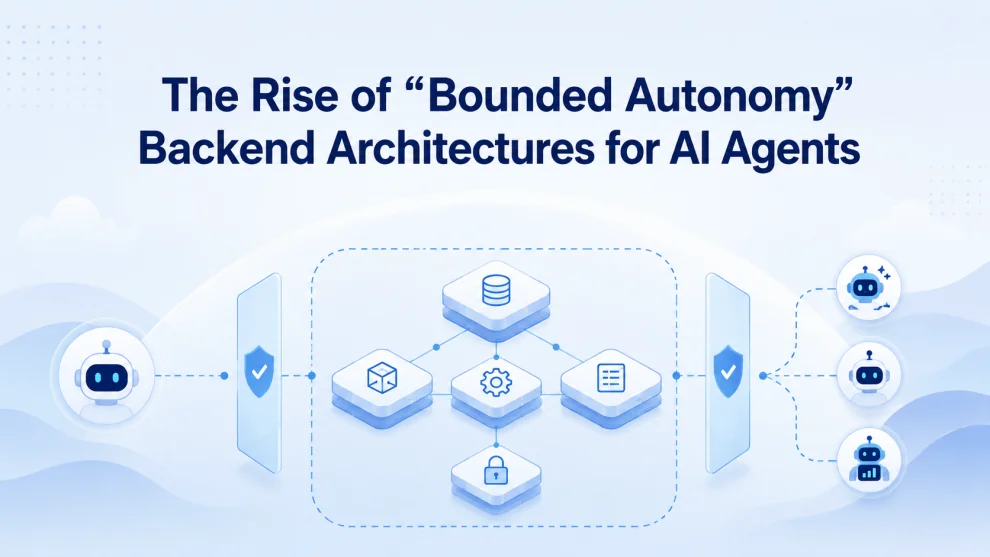
A production architecture can be organized into several layers. At the center is the agent runtime, responsible for reasoning and task execution. Around it is a tool gateway that controls the capabilities available to the agent. A policy engine determines whether requested actions are allowed. An authorization layer evaluates identity, permissions, context, and resource access. A state layer maintains durable workflow information. An approval layer manages actions that require human intervention. An observability layer records decisions, tool calls, outcomes, and failures. Enterprise databases, APIs, infrastructure, and other critical systems remain behind these controls.
The result is a defined boundary around agent autonomy. The agent can operate freely inside that boundary, but it cannot simply cross it.
Why Bounded Autonomy Matters for Enterprise AI
For large organizations, the biggest barrier to production AI may not be model capability. It may be trust.
Engineering and technology leaders need confidence that an agent will not unexpectedly access sensitive information, modify critical systems, or trigger uncontrolled workflows.
Bounded autonomy provides an architectural way to establish that confidence.
Instead of asking people to trust the AI model itself, organizations can design the backend so that trust is enforced by the system.
That makes it easier to move agent experiments into production without giving AI unrestricted authority.
Where Technology Partners Fit In
Building production-ready agent architectures requires expertise across AI, backend engineering, APIs, security, cloud infrastructure, observability, and enterprise integration. Technology partners such as GeekyAnts can support organizations exploring AI-powered applications and agent-based workflows by helping connect AI capabilities with modern backend architectures and enterprise requirements.
The objective is not simply to connect an AI model to an API. The larger challenge is creating an architecture where agents can perform useful work while permissions, validation, observability, and business rules remain under organizational control.
The Future Is Bounded Autonomy
The next generation of enterprise AI is unlikely to be defined by agents that can access everything and execute anything. It will be defined by systems that understand where autonomy stops.
Bounded autonomy provides a practical middle ground between rigid automation and unrestricted AI agents. Developers can give agents meaningful decision-making capabilities while backend systems enforce permissions, validate actions, manage state, monitor behavior, and introduce human approval when necessary.
The principle is simple: give agents freedom to reason, but never give them unlimited authority to act.
For enterprise engineering leaders, that principle could become one of the foundations for building AI agents that are not only capable, but reliable enough to operate within real production environments.
For more, visit our homepage!


Add Comment