







For large enterprises, search is becoming less about finding documents that contain specific words and more about finding information that actually answers a user’s question.
An employee might ask, “What is our process for handling international remote work?” while the relevant policy uses completely different terminology. A customer might describe a product problem without using the technical language found in the support documentation.
Traditional keyword search can struggle with these situations.
Semantic search takes a different approach. It focuses on the meaning and intent behind a query. At the infrastructure layer, vector databases make this possible by storing and retrieving numerical representations of information based on similarity.
For enterprises investing in AI, this combination is becoming an important part of the technology stack.
Why Enterprise Search Is Changing
Large organizations accumulate enormous amounts of information across applications, knowledge bases, support systems, product platforms, documentation repositories, and internal tools.
The problem is not necessarily a lack of information. It is finding the right information quickly.
Traditional search works well when users know the exact terminology. Searching for a product ID, error code, contract number, or technical identifier is still better handled through exact or lexical matching.
Natural-language questions are different.
A user searching for “ways to reduce customer complaints about delivery delays” may need information stored under terms such as “fulfillment exceptions,” “delivery incidents,” or “customer retention.”
Semantic search can recognize the relationship between these concepts even when the words do not match exactly.
For digital product and engineering leaders, this creates an opportunity to turn enterprise search from a basic lookup mechanism into an intelligent information access layer.
How Vector Databases Work
Vector databases store representations of information known as embeddings.
An embedding model converts text, documents, images, products, or other data into numerical vectors. The resulting vector represents characteristics of the original content in a mathematical space.
When a user enters a search query, the query is converted into a vector as well. The vector database then identifies stored vectors that are most similar to it.
The important distinction is that the system is not simply looking for identical words.
It is comparing relationships between representations.
This allows a search application to recognize that “employee turnover” and “staff retention” may be closely related even though the wording is different.
At enterprise scale, this capability can become particularly valuable when information is distributed across thousands of systems and millions of records.
Vector Databases and RAG
One of the most practical applications of vector search is Retrieval-Augmented Generation, commonly known as RAG.
A RAG architecture allows an AI application to retrieve relevant information from an organization’s own data before generating a response.
The basic flow is:
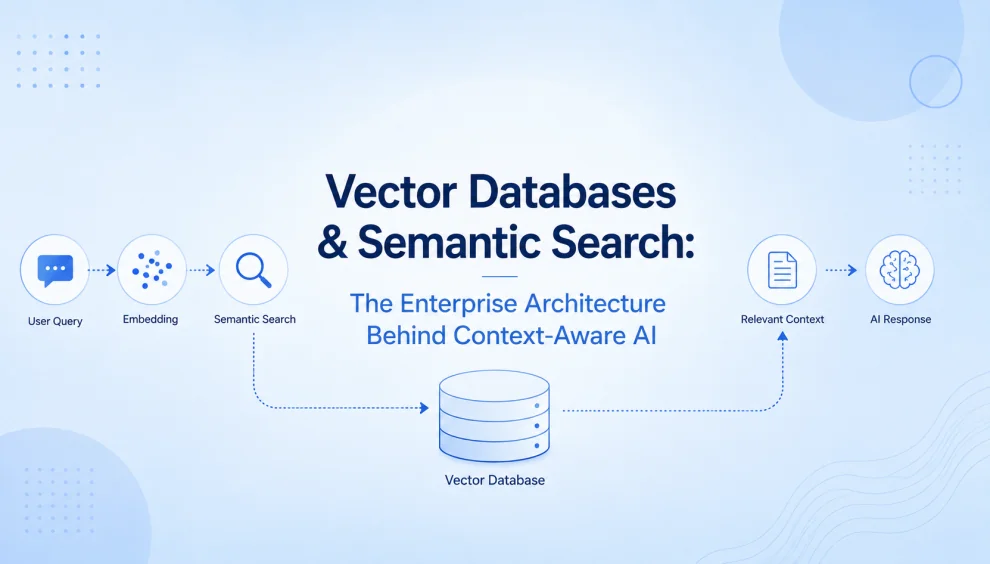
User query → Query embedding → Vector retrieval → Relevant context → LLM → Response
Consider an internal technology assistant.
An employee asks:
“How do I request access to a production database?”
Instead of expecting the language model to know the company’s internal procedures, the system searches approved documentation, retrieves the relevant policy, and provides that information to the model as context.
The resulting response can therefore be grounded in organizational knowledge rather than relying entirely on the model’s general training.
This architecture is particularly relevant for enterprises that want to introduce AI without moving all organizational knowledge directly into an AI model.
Why Embedding Quality Matters
A vector database can only retrieve information effectively when the underlying representations are useful.
Embedding model selection therefore becomes an architectural consideration.
Different models may perform differently depending on the type of information being indexed, the languages involved, the domain terminology, and the retrieval requirements.
Data preparation also has a major impact.
Large documents are commonly divided into smaller chunks before embedding. If chunks are too large, unrelated information may be grouped together. If they are too small, important context can be lost.
For enterprise systems, chunking should therefore reflect the structure and meaning of the underlying information rather than simply splitting documents at arbitrary character limits.
Hybrid Search Is Often More Practical
Semantic search should not necessarily replace traditional search.
Enterprise applications often benefit from combining both.
Imagine an engineer searching for a specific error such as ERR_CONNECTION_RESET. Exact keyword matching may provide the most useful result.
Now consider someone asking:
“Why are users experiencing failed connections after the latest deployment?”
That query benefits more from understanding the underlying meaning.
Hybrid search combines lexical and semantic retrieval so the system can handle both situations.
This approach can improve retrieval quality by preserving the precision of keyword matching while adding the contextual understanding of vector search.
For large digital platforms, hybrid retrieval can be especially useful because users have very different search behaviors depending on their role and task.
Enterprise Security Cannot Be an Afterthought
Vector search introduces another important consideration: access control.
An enterprise retrieval system may contain sensitive information from multiple departments. A document being semantically relevant does not mean that every user should be able to access it.
Consider an employee asking a general question about compensation policies. A retrieval system should not surface restricted HR documents simply because they are semantically similar to the query.
Authorization needs to be incorporated into the retrieval architecture.
This can involve identity-aware filtering, metadata-based access controls, data segmentation, and integration with existing enterprise identity systems.
For organizations operating at scale, security needs to be treated as part of the retrieval design rather than something added after the AI system has already been built.
Performance at Enterprise Scale
A proof of concept might work perfectly with a few thousand documents.
A production enterprise system could involve millions or billions of vectors.
That changes the infrastructure requirements.
Teams need to consider indexing strategies, query latency, storage, embedding costs, scaling patterns, caching, metadata filtering, and infrastructure utilization.
Not every dataset needs the same retrieval strategy.
Frequently accessed information may require aggressive optimization, while historical or rarely accessed content can follow a different performance model.
For platform and cloud infrastructure leaders, the objective should be predictable performance and sustainable operating costs rather than simply proving that vector search works.
Measuring Retrieval Quality
Search quality cannot be determined by infrastructure metrics alone.
A system may return results quickly but still fail to provide useful information.
Enterprise teams should evaluate whether relevant documents are being retrieved, how often irrelevant content appears, and whether retrieved context actually improves the final AI response.
Evaluation can involve representative queries based on real user behavior.
For example, an organization could create a set of questions from support teams, engineers, product managers, and employees and evaluate how consistently the retrieval system identifies the correct information.
Monitoring should continue after deployment because enterprise knowledge constantly changes.
New documentation is created, policies are updated, products evolve, and older information becomes irrelevant.
A production semantic search platform therefore needs mechanisms for data refresh, indexing updates, evaluation, and monitoring.
Integrating Semantic Search Into Existing Platforms
For a VP of Engineering or Head of Technology, vector search should not be treated as an isolated database decision.
It is one component of a broader AI architecture.
The surrounding environment may include enterprise applications, data pipelines, APIs, traditional search systems, identity platforms, document processing services, embedding models, LLMs, monitoring tools, and automation workflows.
The goal should be to connect these components rather than create another disconnected technology silo.
This becomes particularly important for organizations with established digital platforms. Replacing existing systems simply to introduce semantic search is rarely necessary.
A better approach is often to introduce an intelligent retrieval layer that can work with existing infrastructure.
Moving From Prototype to Production
Building a semantic search demonstration is relatively straightforward.
Turning it into a production capability is much harder.
A prototype may retrieve relevant information from one document repository. A production platform needs to operate across multiple data sources, millions of records, different user roles, changing information, security requirements, and potentially customer-facing workloads.
This requires decisions around data ownership, ingestion, embedding strategy, chunking, retrieval, ranking, access control, observability, and evaluation.
This is also where implementation experience becomes important. Organizations working with an AI application development partner such as GeekyAnts can approach semantic search as part of a broader production architecture, connecting RAG, AI models, existing applications, APIs, automation, and enterprise workflows instead of treating vector search as a standalone feature.
The focus should remain on how the technology improves the overall digital experience and operational workflow.
Where Semantic Search Creates Value
The applications extend well beyond internal document search.
Customer experience platforms can use semantic retrieval to understand support questions and surface relevant knowledge.
Digital product teams can use it to create intelligent discovery and recommendation experiences.
Engineering organizations can connect developers with technical documentation, incident records, and troubleshooting information.
Enterprise AI assistants can retrieve relevant organizational knowledge before generating responses.
Product platforms can use vector representations to identify related products, content, or user preferences.
Across these scenarios, the underlying objective remains the same: make large volumes of information easier to discover based on meaning and context.
The Next Layer of Enterprise Search
Vector databases are not simply another database category. They represent a shift in how applications interact with information.
Traditional systems ask whether a document contains the requested term. Semantic systems can ask whether the document is relevant to what the user actually means.
For large enterprises, the strongest architectures will likely combine semantic retrieval with traditional search, metadata, authorization, ranking, observability, and AI generation.
The strategic opportunity is not to replace existing search infrastructure with vectors. It is to build a smarter information layer on top of the systems organizations already depend on.
For engineering, platform, and digital transformation leaders, that makes vector databases and semantic search less of an experimental AI capability and more of an architectural foundation for context-aware enterprise applications.
For more, visit our homepage!

Add Comment