








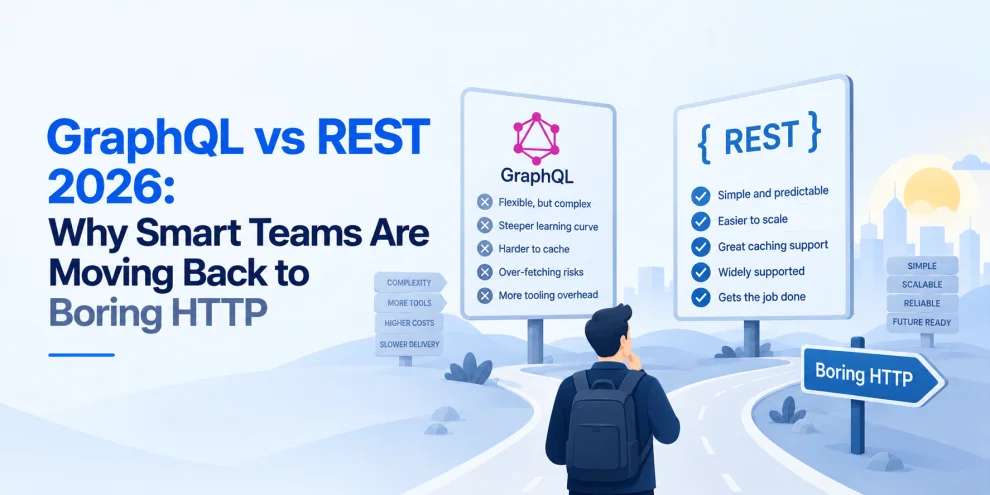

GraphQL changed how developers think about APIs. Instead of maintaining multiple endpoints for different resources, clients could request exactly the fields they needed through a single API interface. For applications with complex data relationships and rapidly changing frontend requirements, this approach solved genuine problems. But as backend systems have grown more distributed and operational requirements have become stricter, some engineering teams are reconsidering whether they need GraphQL everywhere. In 2026, REST is receiving renewed attention because conventional HTTP APIs are predictable, cache-friendly, observable, and often easier to operate.
Why GraphQL Can Become Complicated
GraphQL looks simple from the client side, but the backend can become considerably more sophisticated. A single query may trigger multiple resolvers, database operations, service calls, authorization checks, and transformations. As schemas expand, teams also need to manage query depth, query complexity, resolver performance, batching, caching, schema evolution, and field-level authorization. The API endpoint remains simple while the execution underneath it can become complicated.
REST exposes more of that behavior directly. An API might provide endpoints such as GET /customers/{id}, GET /orders/{id}, or POST /payments. The interface is less flexible, but the relationship between an HTTP request and backend operation is often easier to understand.
HTTP Already Provides Useful Infrastructure
One reason teams are reconsidering REST is that HTTP already provides many capabilities required by production APIs. Methods communicate operation types, status codes describe outcomes, headers carry metadata, and standard HTTP infrastructure can support caching, proxies, gateways, authentication, and request management.
REST APIs can use these mechanisms naturally because the resource and operation are represented directly in the request. GraphQL can achieve similar capabilities, but teams may need additional application-level mechanisms to achieve the same operational behavior.
Caching Can Favor REST
Caching is one of the strongest practical arguments for resource-oriented APIs. A REST endpoint has a predictable URL and can take advantage of HTTP caching mechanisms where the response is safe to cache. CDNs, reverse proxies, and intermediary infrastructure can work with these resource-oriented requests.
GraphQL requests often use the same endpoint while the query body determines what data is requested. Application-level caching, persisted queries, and specialized GraphQL caching strategies can address this, but they introduce additional implementation requirements.
For read-heavy applications with predictable resources, conventional HTTP can therefore provide a simpler caching model.
Observability Is More Straightforward
Backend teams need to know which operations are slow, which requests fail, and which services are generating excessive traffic. REST naturally exposes this information through URLs and HTTP methods.
With GraphQL, many different operations can pass through the same endpoint. Effective monitoring may therefore require GraphQL-aware instrumentation that identifies operation names, resolver execution, query complexity, and downstream calls.
GraphQL observability is entirely possible, but it generally requires more application-specific instrumentation than basic HTTP endpoint monitoring.
Authorization Gets More Granular
Authorization can become more complicated as a GraphQL schema grows. A user might have permission to access a customer record but not every field within that record. Different nested resources may also have different access requirements.
REST can still require complex authorization, but resource-oriented endpoints often provide clearer enforcement points. A backend can evaluate whether a user is allowed to retrieve a particular resource or perform a specific operation.
The important principle for either architecture is that authorization must remain a backend responsibility rather than something delegated to the client.
The N+1 Query Problem
GraphQL can reduce over-fetching and under-fetching, but flexible queries can create inefficient database access. A request for a list of customers and their orders may cause one query for customers followed by separate queries for each customer’s orders.
Batching and caching mechanisms such as DataLoader can reduce this problem, but they require deliberate backend design and monitoring.
REST does not automatically guarantee efficient database access either. However, its explicit endpoint structure can make database access patterns easier to identify and optimize.
Complexity Can Move Instead of Disappear
One of GraphQL’s biggest advantages is client flexibility. But that flexibility does not eliminate backend complexity. It changes where that complexity lives.
A GraphQL platform may need query limits, persisted queries, resolver instrumentation, schema governance, authorization rules, batching, caching, and protection against expensive queries.
For a large product with many clients and complex data relationships, those capabilities may be worthwhile. For a predictable backend service, they may be unnecessary.
REST Is Not Automatically Simple
Choosing REST does not mean accepting poorly designed APIs. A production REST API still needs consistent resource modeling, validation, authentication, authorization, pagination, error handling, idempotency, versioning, rate limiting, and documentation.
The advantage of “boring HTTP” is predictability. Developers should be able to understand what an endpoint does without learning a large custom execution model.
Performance Depends on the Workload
There is no universal rule that REST is faster than GraphQL or that GraphQL is more efficient than REST.
Performance depends on database design, payload size, network topology, caching, serialization, resolver implementation, downstream services, connection management, and infrastructure.
GraphQL may reduce unnecessary data transfer when clients require different fields from a large data model. REST may perform extremely well when endpoints are predictable and cacheable.
Backend teams should therefore benchmark representative production workloads instead of comparing the technologies in isolation.
Mobile and Web Applications Change the Equation
GraphQL can be particularly useful when multiple clients require significantly different views of the same data. A mobile application may need a small subset of fields while a web application needs much more information.
REST can address this through purpose-built endpoints, response shaping, aggregation APIs, or Backend-for-Frontend architecture.
A BFF approach allows teams to create APIs optimized for specific client experiences without introducing a universal query language across the entire backend.
Microservices Add Another Layer
GraphQL is often used as an aggregation layer across microservices. A client can make one request while the GraphQL server coordinates data from multiple backend services.
This can simplify frontend development, but it also makes the GraphQL layer responsible for coordinating downstream calls, handling partial failures, enforcing authorization, managing timeouts, and controlling query complexity.
For some architectures, an API gateway or dedicated aggregation service can provide similar functionality with a more explicit request model.
API Contracts Still Matter
REST commonly uses OpenAPI to describe endpoints, parameters, responses, authentication, and error formats. These contracts can support documentation, client generation, testing, and API governance.
GraphQL provides a strongly typed schema and introspection capabilities.
Neither approach removes the need for good API governance. The contract needs to remain understandable, testable, secure, and stable as the backend evolves.
When GraphQL Still Makes Sense
GraphQL remains useful when applications genuinely require flexible data access. It can work well for products with multiple clients, interconnected datasets, rapidly changing interfaces, and complex data requirements.
It can also be valuable when the engineering organization is prepared to manage schema governance, query security, resolver performance, caching, and observability.
The goal should not be to remove GraphQL simply because REST is simpler. The goal is to avoid introducing GraphQL where its flexibility does not solve a meaningful problem.
When REST May Be the Better Fit
REST can be well suited to predictable resource operations, public APIs, transactional services, infrastructure APIs, read-heavy workloads, and systems where clients do not need arbitrary queries.
It also works naturally with existing HTTP infrastructure, making it familiar to developers and straightforward to integrate with gateways, proxies, monitoring systems, and testing tools.
For many backend services, that simplicity is a genuine architectural advantage.
Hybrid APIs Are Often Practical
Organizations do not need to select one API technology for everything. A platform can use REST for transactional services, GraphQL for selected customer-facing applications, and event-driven interfaces for asynchronous workflows.
A GraphQL gateway can sit above REST services when flexible client queries are required without forcing every internal service to become GraphQL-native.
This approach allows teams to choose the appropriate abstraction for each workload.
Where Engineering Teams Add Value
API modernization requires more than choosing between two protocols. Teams need to evaluate data models, client requirements, backend dependencies, performance, authorization, observability, and long-term maintenance.
Engineering organizations such as GeekyAnts, Thoughtworks, and other product engineering teams work on backend API architecture, modernization, performance optimization, and scalable application development. Their work can involve evaluating API patterns, redesigning backend services, and implementing architectures based on specific product and engineering requirements.
A Practical Decision Framework
Before choosing GraphQL or REST, backend teams should ask whether clients genuinely need flexible queries, how important HTTP-level caching is, how complicated authorization will become, how many downstream services must be aggregated, and whether the engineering team is prepared to operate GraphQL-specific controls.
If most operations map naturally to resources and predictable workflows, REST may be sufficient.
If clients require highly flexible access to interconnected data, GraphQL may justify its additional complexity.
The Future of Backend APIs
The API landscape in 2026 is becoming less about replacing one technology with another and more about choosing the right abstraction for each workload.
GraphQL solved important problems around flexible data retrieval. REST continues to provide a straightforward model for resource-oriented services, HTTP caching, observability, and operational simplicity.
The renewed interest in “boring HTTP” reflects a broader backend engineering principle: complexity should earn its place in the architecture.
When GraphQL solves a real product problem, its additional infrastructure can be justified. When a backend mostly needs predictable resource operations, conventional HTTP may provide everything the system requires.
Sometimes the most effective backend architecture is the one that gives engineers fewer things to manage.
For more, visit our homepage!


Add Comment