









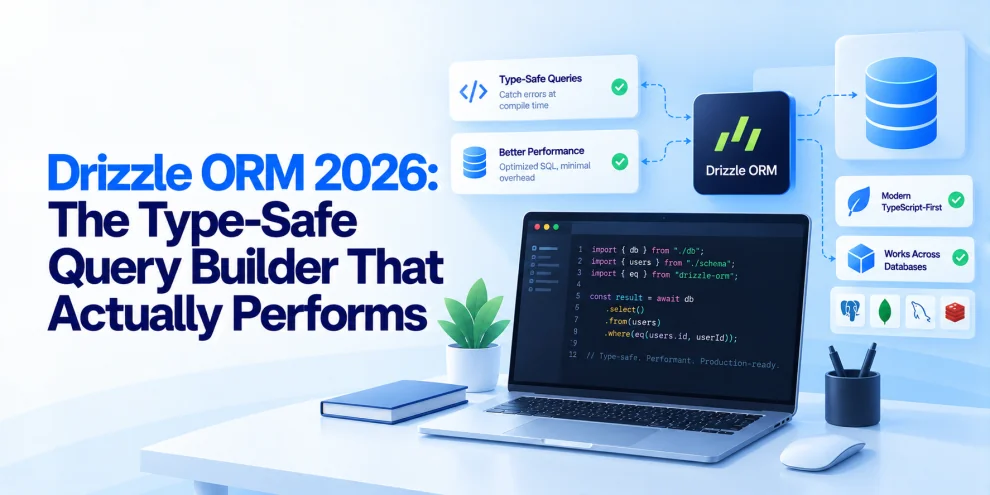

Backend developers have always faced a trade-off when working with databases. Raw SQL offers control and predictable query behavior, but it can become difficult to maintain across a large codebase. Traditional object-relational mappers simplify application development, yet their abstractions can sometimes make complex queries harder to understand or optimize. Drizzle ORM takes a different approach by combining TypeScript-first database access with a SQL-like query builder that stays close to the underlying database.
For backend teams building APIs, microservices, and data-intensive applications, this balance is appealing. Developers can work with typed schemas, receive editor support, and compose database queries without abandoning their understanding of SQL. The result is a database layer designed to make application code safer and more maintainable without hiding what the database is actually doing.
In 2026, the important question is not whether an ORM is faster than raw SQL in every situation. It is whether Drizzle can provide type safety and developer productivity while keeping database performance predictable.
Why Backend Developers Are Looking at Drizzle ORM
Database access is one of the most important parts of backend architecture. An API can have efficient business logic and a well-designed runtime but still perform poorly because of inefficient queries, missing indexes, excessive database round trips, or poorly managed connections.
ORMs help developers interact with relational databases through application code. However, some abstractions make it difficult to understand the SQL being generated or determine why a query behaves differently from expectations.
Drizzle emphasizes a more SQL-oriented approach. Its API is designed around familiar concepts such as tables, columns, joins, filters, ordering, and transactions. Instead of introducing a completely separate object model, it lets developers define database schemas and construct queries using TypeScript.
This makes Drizzle particularly interesting for teams that want compile-time guarantees without losing visibility into database behavior.
What Is Drizzle ORM?
Drizzle ORM is a TypeScript ORM and SQL query builder designed to work with relational databases. It allows developers to define schemas in TypeScript and build queries using a typed API.
Its broader ecosystem includes Drizzle Kit, which supports database schema management and migration workflows.
The core benefits include:
- Type-safe queries: Query results and operations are inferred from the defined schema.
- SQL-like syntax: Developers can construct queries using concepts familiar to SQL users.
- Schema definitions in TypeScript: Table and column definitions become part of the application codebase.
- Migration tooling: Drizzle Kit helps generate, manage, and apply database migrations.
- Relational query support: Developers can retrieve related data using supported relational query APIs.
- Database flexibility: Drizzle supports multiple database engines and drivers, although available capabilities vary by dialect and configuration.
For backend engineers, the appeal is the combination of familiar SQL concepts and TypeScript’s static analysis.
Type Safety That Catches Problems Before Runtime
One of the strongest reasons to adopt Drizzle is its integration with TypeScript.
Consider an application with a users table containing an ID, email address, and display name. With a typed schema, developers can construct queries using known columns and receive inferred types for returned records.
A simplified example looks like this:
const users = await db
  .select({
    id: usersTable.id,
    email: usersTable.email,
  })
  .from(usersTable);
The exact schema and database setup depend on the application, but the principle is straightforward: the selected fields inform the result type.
If a developer changes the query to select different fields, TypeScript can infer the corresponding result shape. This helps reduce mistakes involving misspelled column references, unexpected result structures, and inconsistent types across application layers.
Type safety does not replace database constraints or runtime validation. External input still needs validation, database rules still need to be enforced, and application code still needs to handle failures. But catching certain errors during development can reduce the number of problems that reach production.
SQL-Like Queries Without Giving Up Control
Drizzle’s design is especially relevant for developers who prefer explicit database operations.
Consider a query that retrieves active customers created after a particular date. Developers can express the filtering and ordering logic through familiar query-builder methods while keeping the resulting SQL relatively transparent.
That makes it easier to reason about joins, conditions, pagination, aggregation, and indexes.
The distinction matters when an application grows. Backend engineers need to understand whether a query performs a table scan, uses an index, returns too many rows, or triggers unnecessary database work. An abstraction that makes the generated SQL difficult to inspect can complicate those investigations.
Drizzle’s SQL-oriented design helps keep database behavior visible. For particularly complex operations, developers can also use SQL expressions or raw SQL where appropriate, subject to the APIs and safety practices of the selected driver.
The objective is not to avoid SQL. It is to make SQL easier to maintain within a strongly typed application.
Does Drizzle ORM Actually Improve Performance?
Drizzle is often attractive to teams concerned about ORM overhead, but performance needs to be evaluated carefully.
An ORM can influence performance through query generation, data mapping, the number of database operations, and the amount of application-side processing. However, database execution time is frequently dominated by query design, indexing, network latency, connection management, and the size of the result set.
Drizzle’s relatively lightweight approach can reduce some abstraction overhead in suitable workloads. It does not guarantee that every Drizzle query will outperform a query generated by another ORM.
A poorly designed Drizzle query can still be slow. A well-optimized query through another ORM can still perform extremely well.
Teams should evaluate performance through realistic measurements, including:
- Query execution time and database execution plans.
- API p50, p95, and p99 latency.
- Number of database round trips per request.
- Connection pool utilization and wait time.
- Rows scanned versus rows returned.
- Memory usage and serialization overhead.
The best performance improvement may come from adding an index, eliminating an N+1 query pattern, reducing unnecessary data retrieval, or improving connection pooling rather than changing the ORM.
Drizzle ORM and Node.js Backend APIs
Drizzle fits naturally into TypeScript-based backend applications, including services built with Node.js frameworks such as Hono, Fastify, and Express.
A typical architecture includes an API layer, application services, Drizzle queries, a database driver, and a relational database such as PostgreSQL or MySQL.
The API layer handles request parsing and validation. The service layer implements business rules. Drizzle provides typed database operations, while the database remains responsible for persistence, transactions, constraints, and query execution.
Keeping these responsibilities separate is important. Placing every database query directly inside route handlers may work for a small service, but it can become difficult to test and maintain as business logic expands.
A clean architecture can isolate database access in repositories or dedicated data-access modules while allowing Drizzle’s inferred types to flow through the application.
Schema Management and Database Migrations
Database schema changes are among the most sensitive parts of backend development. Adding a column is usually straightforward, but changing a large table, introducing a constraint, or modifying a frequently used index can affect production availability.
Drizzle’s ecosystem includes Drizzle Kit for schema-related workflows, migration generation, and migration execution. Developers can define their schema in TypeScript and use the tooling to help manage database changes.
However, generated migrations should still be reviewed before production deployment. A migration that looks simple in code can trigger a table rewrite, lock a busy table, or create unexpected compatibility problems depending on the database and the operation.
For production systems, teams should use backward-compatible migration strategies where possible. A common approach is to add a new field, deploy application code that supports both old and new representations, migrate the data, and remove obsolete fields only after dependent code has been updated.
Schema tooling improves consistency, but it does not eliminate the need for database migration planning.
Transactions and Data Consistency
Type-safe queries are useful, but they are only part of a reliable database layer. Many business operations require multiple writes to succeed or fail together.
Consider an order-processing workflow that creates an order, records its line items, and updates inventory. If only some operations succeed, the application can end up with inconsistent data.
Transactions allow related database operations to execute under the database’s transaction guarantees. Drizzle provides transaction APIs for supported database integrations, although exact behavior and capabilities depend on the underlying engine and driver.
Developers should understand transaction boundaries, isolation levels, locking behavior, and retry requirements. A transaction also cannot automatically make an external API call atomic with a database write. For workflows spanning multiple systems, patterns such as transactional outboxes or compensating actions may be necessary.
The important principle is that type safety helps validate application code, while transaction design protects data consistency.
Avoiding the N+1 Query Problem
One common backend performance issue occurs when an application retrieves a list of records and then executes another query for each record to fetch related information.
For example, an endpoint might retrieve 100 customers and issue 100 additional queries to retrieve their orders. The endpoint may return correct results but perform poorly under load.
Drizzle can support joins and relational query patterns that help developers retrieve related data more efficiently. However, the developer still needs to choose the right strategy for the workload.
A join may be appropriate when the relationship and result size are manageable. Separate queries can sometimes be more efficient when they reduce duplication or allow better pagination. The right approach depends on cardinality, indexes, result size, and database execution plans.
Monitor query counts per request and inspect the generated SQL. A type-safe query is valuable, but a type-safe query that triggers unnecessary database round trips can still be an operational problem.
Connection Pooling and Serverless Applications
Database performance is also affected by how applications establish and reuse connections.
Traditional long-running Node.js services often use a connection pool to avoid opening a new database connection for every request. Serverless applications introduce additional considerations because many function instances can start concurrently, potentially creating more connections than the database can handle.
Drizzle works with supported database drivers and connection approaches, but connection pooling is not something the ORM automatically solves in every deployment model.
Backend teams should choose a driver and connection strategy appropriate to their runtime. They should consider serverless-compatible database connectivity, managed pooling, connection limits, transaction behavior, and the lifecycle of application instances.
For production systems, monitor connection saturation and pool wait times alongside query latency. Increasing application concurrency without controlling database connections can make performance worse rather than better.
Drizzle ORM vs. Prisma: Choosing the Right Abstraction
Drizzle and Prisma address similar backend needs but offer different development experiences.
Drizzle emphasizes TypeScript-defined schemas and SQL-like query construction. Developers who want direct visibility into query composition may find this approach appealing.
Prisma offers a schema-driven data model and a higher-level client API. Teams may prefer it when its abstractions, tooling, and established workflows align with their application architecture.
Neither tool is universally superior. The decision depends on query complexity, team familiarity, migration requirements, supported database capabilities, operational constraints, and how much abstraction the team wants.
A useful evaluation should compare a representative set of application operations rather than relying on syntax preferences alone. Test complex joins, pagination, transactions, migrations, type inference, and production connection behavior before making a platform-wide decision.
Security and Maintainability in Production
Type-safe database access can reduce certain classes of programming errors, but it is not a complete security strategy.
Queries involving untrusted input must still use safe parameterization or supported query APIs. Authorization must remain enforced at the application or database layer according to the system’s security model. A correctly typed query can still expose another customer’s data if the application fails to scope the request to the authenticated user’s permissions.
Database credentials should be managed through approved secret-management systems. Production database roles should receive only the permissions they need, and sensitive queries should be monitored according to the organization’s requirements.
Teams should also keep dependencies updated, review migration changes, test failure handling, and ensure that database errors do not leak sensitive implementation details through API responses.
The goal is to combine type safety with established database security controls rather than treating the ORM as a substitute for them.
A Practical Adoption Strategy for 2026
Teams considering Drizzle should begin with a limited evaluation rather than rewriting an entire data-access layer immediately.
First, select a service or module with clear database boundaries and a representative set of queries. Define its schema, implement basic reads and writes, and verify the inferred TypeScript types.
Next, test joins, transactions, pagination, migrations, and connection handling. Inspect the generated SQL and compare execution plans with the existing implementation. Run integration tests against the actual database engine instead of relying exclusively on mocks.
Then benchmark realistic API traffic and monitor query latency, database connections, errors, and resource consumption. Finally, evaluate developer experience: how easy is it to understand queries, review schema changes, onboard developers, and debug production issues?
This process provides evidence about whether Drizzle fits the team’s requirements before a broader migration decision is made.
Where Engineering Teams Fit
Choosing and implementing a database access layer requires more than selecting an ORM. Backend architecture, data modeling, API design, migration planning, query optimization, and production observability all influence the result. Teams like GeekyAnts, Thoughtworks work across backend engineering and modern application architecture, making this broader engineering perspective relevant for teams seeking to build maintainable TypeScript applications with reliable database performance.
The objective is to make database access easier to reason about without sacrificing the operational controls required for production systems.
The Future of Type-Safe Database Access
Drizzle ORM reflects a broader trend in backend development: developers want stronger type guarantees without losing control over the database.
Its SQL-oriented query builder, TypeScript schema definitions, and migration tooling make it a compelling option for teams building modern JavaScript and TypeScript backends. For applications where explicit queries and compile-time inference are priorities, it can provide a useful balance between abstraction and control.
But the ORM is only one component of the database architecture. Schema design, indexing, query planning, connection management, transaction boundaries, and operational monitoring continue to determine how well an application performs at scale.
In 2026, the best choice is not necessarily the ORM with the most abstractions or the fewest lines of code. It is the one that helps engineers build reliable data access, understand what the database is doing, and maintain predictable performance as the application grows.
Drizzle’s strongest advantage is not that it makes every query faster. It is that it brings type safety closer to SQL, helping backend developers write database code they can understand, validate, and optimize.
For more, visit our homepage!




Add Comment