










Serverless changed backend engineering by removing much of the infrastructure work traditionally associated with running applications. Developers could deploy a function, let the cloud provider handle scaling, and pay primarily for execution. For many workloads, that model remains useful. But in 2026, the conversation around serverless is becoming more nuanced. The question is no longer whether serverless works. It is whether a function-based execution model is still the right fit for increasingly demanding backend workloads.
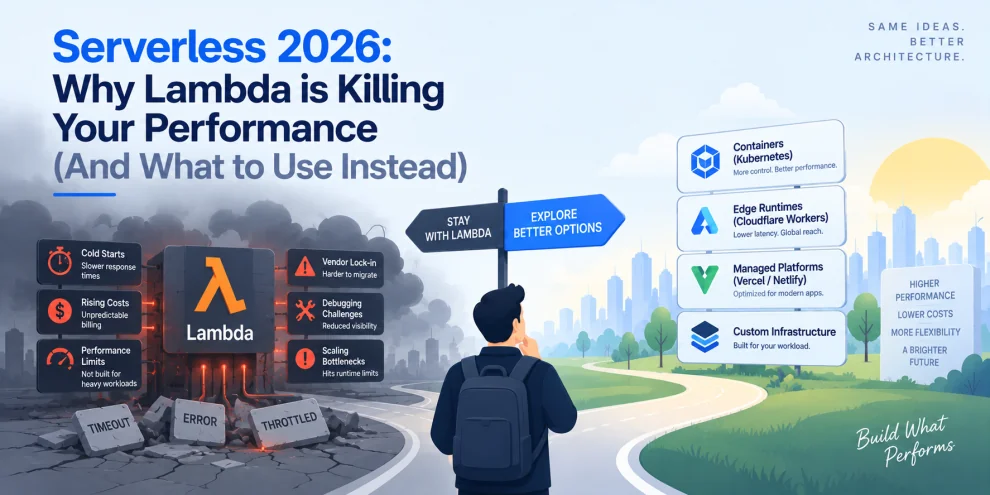
AWS Lambda is not inherently slow. The problem is that its execution model introduces constraints that become increasingly visible when applications require predictable latency, sustained workloads, high connection counts, heavy initialization, persistent processes, or intensive AI inference. Cold starts, networking overhead, database connections, runtime initialization, concurrency limits, and execution duration can all become architectural concerns.
For engineering teams building high-performance systems, the answer may be containers, Kubernetes, edge computing, long-running services, or a hybrid architecture rather than more aggressively optimizing Lambda.
Why Lambda Performance Can Become a Problem
Lambda works by executing functions in managed environments that AWS creates and scales according to demand. This is extremely convenient for event-driven workloads, but the abstraction hides infrastructure decisions that still affect application performance.
A function may need to initialize a runtime, load dependencies, establish connections, retrieve configuration, and prepare application code before processing a request. When execution environments are reused, subsequent requests can benefit from existing initialization. When new environments are required, however, additional startup work can contribute to latency.
For low-frequency workloads, that may not matter. For latency-sensitive APIs, interactive applications, high-throughput services, or workloads requiring predictable response times, the difference can become significant.
The deeper issue is that application performance is determined by the entire execution path, not simply the function’s business logic.
Cold Starts Are Only Part of the Story
Cold starts receive most of the attention in serverless performance discussions, but they are not the only source of latency.
A Lambda request can involve API Gateway, authentication, network configuration, database access, external APIs, serialization, application initialization, and downstream services. Each layer contributes to the end-to-end response time.
An application may therefore appear to have a “Lambda latency problem” when the actual bottleneck is database connection establishment, a slow dependency, excessive package size, network configuration, or a downstream service.
This is why profiling the complete request path is more useful than focusing exclusively on cold-start duration.
Database Connections Can Become the Real Bottleneck
Traditional backend services often maintain connection pools because they run continuously. Serverless functions behave differently because execution environments can be created and removed dynamically.
A sudden increase in concurrency can result in many function environments attempting to establish database connections. If the database cannot handle that connection volume, the database becomes the bottleneck even though Lambda itself has scaled successfully.
Connection pooling, managed database proxies, caching, request batching, and appropriate concurrency controls can reduce this problem. But once an application requires extensive connection management, the simplicity advantage of serverless begins to decline.
For database-heavy applications, a continuously running service with controlled connection pools may provide a more predictable architecture.
Networking Adds Another Layer
Lambda functions that need access to private resources may require additional networking configuration. Depending on the architecture, requests may pass through private networking components, NAT infrastructure, security controls, or other services before reaching their destination.
The result is not necessarily poor performance, but it introduces more components into the request path.
Every additional network hop creates another opportunity for latency, failure, configuration complexity, and operational overhead.
For performance-sensitive applications, engineering teams should measure the complete network path rather than evaluating Lambda in isolation.
Containers Give Developers More Control
Containers occupy an interesting position between traditional servers and serverless functions.
A containerized service can still be highly automated and elastically scaled while giving developers greater control over runtime behavior. Teams can keep processes alive, maintain connection pools, control memory and CPU allocation, use familiar application servers, and package more complex workloads without fitting everything into a function-oriented model.
Platforms such as Amazon ECS, AWS Fargate, and Kubernetes provide different levels of infrastructure abstraction while preserving the long-running service model.
This can make containers attractive for APIs with sustained traffic, connection-heavy applications, background workers, and workloads where predictable execution matters more than scale-to-zero behavior.
Kubernetes Is Not a Replacement for Everything
Kubernetes is sometimes presented as the obvious alternative to serverless. That is too simplistic.
Kubernetes introduces its own operational complexity. Teams need to manage cluster configuration, networking, observability, security, deployment processes, capacity, upgrades, and platform operations.
The value comes from control and flexibility, not from eliminating complexity.
For organizations that already operate Kubernetes platforms, moving selected workloads from Lambda to Kubernetes can make architectural sense. For smaller applications with simple event-driven workloads, introducing Kubernetes may create more operational overhead than it removes.
The correct comparison is therefore not “Lambda versus Kubernetes.” It is “Which execution model matches this workload?”
Long-Running Services Can Be Faster
Some backend applications benefit from keeping processes alive.
Consider an API that receives continuous traffic, maintains database connections, performs CPU-intensive processing, or keeps large in-memory data structures available. A long-running service can initialize once and then handle many requests without repeatedly reconstructing the runtime environment.
This model can provide more predictable latency and resource utilization.
It also makes certain performance optimizations easier. Connection pools, local caches, background workers, in-memory indexes, persistent processes, and custom runtime tuning are natural in a long-running service.
These capabilities are possible in serverless architectures too, but they are less central to the execution model.
Edge Compute Changes the Latency Equation
For globally distributed applications, moving computation closer to users can have a greater impact than simply changing the backend runtime.
Edge functions and edge compute platforms allow selected application logic to execute closer to the user. This can reduce network distance for authentication checks, personalization, request transformation, routing, and lightweight processing.
Edge computing is particularly useful when the primary performance problem is geographic latency rather than application execution time.
However, edge environments often impose their own runtime, storage, execution, and networking constraints. They are best suited to workloads designed around those limitations.
AI Workloads Expose Serverless Limits
AI applications introduce another challenge.
LLM inference, embedding generation, document processing, image analysis, vector search, and agent execution can require substantial compute, memory, specialized hardware, or long execution times.
A function-oriented architecture may still be useful for orchestration. For example, Lambda can trigger an asynchronous AI workflow, process events, coordinate services, or handle lightweight preprocessing.
But forcing every AI operation into short-lived functions can create unnecessary latency and complexity.
GPU-backed containers, dedicated inference services, managed model platforms, or edge inference may be more appropriate when AI workloads require sustained compute.
The best architecture often separates orchestration from inference rather than forcing both into the same runtime.
Serverless Cost Is Not Always Lower
One of serverless’s strongest selling points is that teams pay for execution rather than continuously running infrastructure.
That can be economically attractive for irregular workloads.
But high and consistent traffic can change the equation. If functions execute continuously, consume substantial memory, interact with multiple managed services, generate significant network traffic, and require additional infrastructure around them, total costs can become more complicated.
Containers can sometimes provide better resource utilization for sustained workloads because a single running process can serve many requests.
Cost therefore needs to be evaluated alongside latency, reliability, engineering effort, operational complexity, and scaling requirements.
Serverless Is Not Infrastructure-Free
Serverless removes infrastructure management responsibilities, but it does not remove infrastructure architecture.
Teams still need to think about identity, networking, databases, observability, deployment, security, retries, concurrency, caching, queues, failure handling, and cost controls.
In some architectures, serverless can actually increase the number of managed services involved in a single request.
A simple Lambda function may eventually become a system involving API Gateway, authentication services, queues, databases, caches, event buses, monitoring systems, and several downstream APIs.
The individual components are managed, but the architecture still needs to be designed and operated carefully.
Choose the Runtime Based on the Workload
A useful 2026 approach is to stop treating serverless as a universal backend strategy.
Lambda remains a strong fit for event-driven processing, scheduled jobs, lightweight APIs, asynchronous workflows, automation, and workloads with unpredictable traffic.
Containers may be better for persistent APIs, connection-heavy services, background processing, and applications requiring greater runtime control.
Kubernetes may be appropriate for organizations operating complex multi-service platforms where portability, orchestration, and infrastructure control justify the operational investment.
Edge runtimes can help when geographic latency is the primary concern.
Dedicated compute or GPU-backed services may be more appropriate for sustained AI inference.
The architecture should follow the workload rather than forcing every workload into the same deployment model.
Measure Before Replacing Lambda
Performance problems should be measured before an architectural migration begins.
Engineering teams should examine cold-start frequency, p50 and p95 latency, execution duration, database connection behavior, concurrency, memory utilization, network latency, downstream service time, error rates, and cost per request.
It is also important to distinguish average performance from tail latency. An API may have an acceptable average response time while still producing poor p95 or p99 results during bursts.
Observability should therefore cover the complete request path.
Before replacing Lambda, teams should determine whether the actual problem is the function runtime, database behavior, networking, dependency latency, poor caching, inefficient application code, or architectural coupling.
A Practical Migration Strategy
Replacing serverless does not have to mean rewriting the entire backend.
A gradual approach can reduce risk. First, identify functions responsible for the largest share of latency, cost, or operational complexity. Next, classify those workloads according to traffic pattern, execution duration, connection requirements, compute intensity, and state requirements.
Functions with sustained traffic can be candidates for containerization. Long-running workloads can move to worker services. AI inference can be separated into dedicated inference infrastructure. Latency-sensitive logic can be evaluated for edge execution.
The existing Lambda architecture can remain in place for workloads where it continues to perform well.
This creates a hybrid backend instead of a disruptive all-or-nothing migration.
When Lambda Still Makes Sense
Despite the criticism surrounding serverless performance, Lambda remains useful for many workloads.
It is particularly suitable when traffic is unpredictable, execution is relatively short, infrastructure simplicity is valuable, and scale-to-zero behavior provides a meaningful benefit.
Event processing, scheduled automation, lightweight transformations, asynchronous jobs, and many integration workflows can work extremely well with Lambda.
The goal should not be to eliminate serverless. It should be to avoid using it where its execution model conflicts with application requirements.
What Engineering Leaders Should Audit
Before deciding whether to replace Lambda, engineering leaders should ask: What is the actual source of latency? How often do cold starts occur? What percentage of requests experience high tail latency? How many database connections are created during traffic spikes? Does the workload require persistent processes? Is traffic consistent enough for containers to be more efficient? Does the application require GPU or specialized compute? Would edge execution reduce geographic latency? How much operational complexity would migration introduce? What would the cost look like at realistic traffic levels?
These questions produce a more useful architectural decision than simply asking whether serverless is “fast” or “slow.”
Where Engineering Teams Fit
Modern backend engineering increasingly requires choosing between multiple execution models rather than committing to a single infrastructure philosophy. Engineering organizations such as GeekyAnts, Thoughtworks, and other product engineering teams work across serverless, containers, cloud infrastructure, Kubernetes, and modern backend architectures, allowing architecture decisions to be based on workload requirements rather than technology trends.
The important question is not whether Lambda is good or bad. It is whether the execution model matches the application’s performance, reliability, scaling, and operational requirements.
The Serverless Decision in 2026
The serverless era is not ending. It is becoming more selective.
Lambda remains valuable for workloads that benefit from event-driven execution, automatic scaling, and reduced infrastructure management. But applications demanding persistent connections, predictable tail latency, sustained compute, specialized hardware, or intensive AI processing may benefit from other execution models.
Containers provide more runtime control. Kubernetes provides broader orchestration capabilities. Edge computing can reduce geographic latency. Dedicated inference infrastructure can support demanding AI workloads. Traditional services remain useful when predictable long-running execution is the priority.
The future backend will likely combine these models rather than choosing one universally.
The real mistake in 2026 is not using Lambda.
It is using Lambda for a workload that needs something else.
FAQs
Is AWS Lambda slow in 2026?
Lambda is not inherently slow. Performance depends on runtime, initialization, workload characteristics, networking, downstream services, concurrency, and application design.
What causes Lambda performance problems?
Common contributors include cold starts, dependency initialization, database connection behavior, network latency, downstream services, inefficient application code, and concurrency patterns.
What can replace AWS Lambda?
Depending on the workload, alternatives include containers, AWS Fargate, Kubernetes, long-running services, edge runtimes, managed application platforms, and dedicated compute.
Are containers faster than Lambda?
Containers can provide more predictable performance for sustained workloads because processes remain active and can reuse connections, caches, and initialized application state. Actual performance depends on the implementation and workload.
Does Lambda have cold starts?
Yes. New execution environments require initialization before processing requests. The impact varies based on runtime, dependencies, configuration, and workload behavior.
Is Lambda suitable for high-traffic APIs?
It can be. High traffic alone does not make Lambda unsuitable. The important factors include latency requirements, concurrency, database behavior, networking, workload duration, and cost.
Is serverless still relevant in 2026?
Yes. Serverless remains useful for many event-driven, asynchronous, scheduled, and unpredictable workloads. The architectural trend is toward using it selectively rather than universally.
Should AI applications use Lambda?
Lambda can be useful for AI orchestration, event processing, preprocessing, and lightweight tasks. Compute-intensive inference may be better suited to dedicated inference services, containers, GPUs, or other specialized infrastructure.
Is Kubernetes better than serverless?
They solve different architectural problems. Kubernetes provides greater control and flexibility but also introduces more operational responsibility. Serverless provides greater infrastructure abstraction. The appropriate choice depends on workload and organizational requirements.
How should teams decide between Lambda and containers?
Evaluate latency, traffic patterns, execution duration, database connections, compute requirements, scaling behavior, cost, operational complexity, and the level of runtime control the application requires.
For more, visit our homepage!



Add Comment