










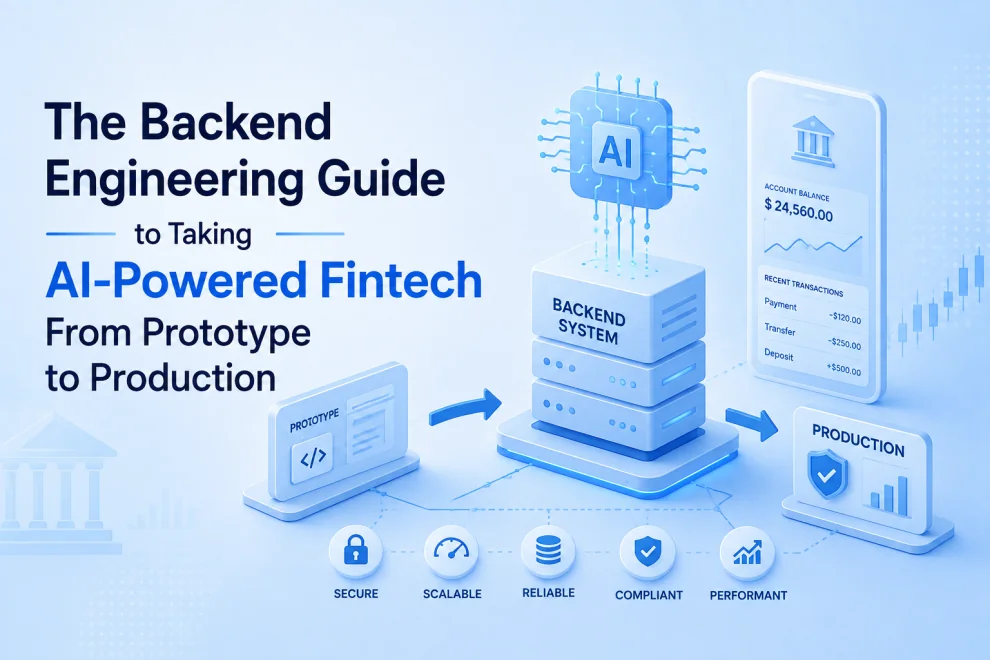

An AI-powered fintech prototype can look impressive in a product review. A customer request is processed instantly, a fraud signal appears in real time, an intelligent recommendation is generated, or an automated workflow completes in seconds. But the moment that prototype enters a real production environment, the engineering challenge changes completely.
For enterprise technology leaders, the question is no longer whether AI can help build a fintech application quickly. The real question is whether the backend can support that application when thousands of users, sensitive data, transaction-heavy workflows, external integrations, security requirements, and unpredictable workloads are involved. AI can accelerate development, but it does not automatically make the underlying system reliable, secure, or scalable.
The Gap Between a Working Prototype and a Production Backend
AI-assisted development has significantly reduced the time required to create software. Teams can generate APIs, database models, authentication flows, business logic, integrations, and application components much faster than before. This creates an opportunity for fintech organizations to experiment with new products and capabilities without spending months validating an initial concept.
The problem begins when the prototype has to operate under real conditions.
A prototype may work with a limited number of users, simplified data, controlled inputs, and a small number of integrations. Production introduces concurrent requests, unexpected failures, large datasets, third-party dependencies, security threats, latency requirements, and operational constraints. In fintech, these issues are particularly important because backend failures can affect transactions, customer access, fraud detection, reporting, and other critical workflows.
The difference between “it works” and “it is ready” is therefore largely a backend engineering problem.
AI Generates the Workflow. Backend Engineering Makes It Reliable.
AI can generate a transaction workflow or a fraud detection service, but it does not automatically understand the operational context surrounding that workflow. A production fintech backend needs to know what happens when a payment service becomes unavailable, when an API request is repeated, when an AI provider times out, or when two systems attempt to update the same piece of data.
Consider an AI-powered fraud detection workflow. The model may identify a suspicious transaction within milliseconds, but the backend still has to determine what happens next. Should the transaction be blocked? Should it be sent for review? What happens if the model is unavailable? What happens if the same transaction is evaluated twice? What happens if the fraud service returns a response after the transaction has already moved forward?
These are not model questions. They are backend architecture questions.
Production systems need mechanisms such as idempotency, controlled retries, circuit breakers, queues, transactional boundaries, fallback strategies, and graceful degradation so that individual failures do not become system-wide failures.
Architecture Has to Be Designed for Failure
Reliable fintech platforms are built with the assumption that something will eventually go wrong. A database connection will fail. An external service will become unavailable. A network request will time out. An AI provider will experience latency. A deployment will introduce an unexpected issue.
The backend needs to determine how the system behaves when these events occur.
This is particularly important for transaction-related operations. If a request is retried because of a timeout, the backend should be able to determine whether the original operation completed before attempting it again. Without appropriate controls, a seemingly harmless retry can create duplicate operations or inconsistent system state.
AI-assisted development can produce the initial workflow quickly, but experienced engineering is required to identify these failure conditions and design the system around them.
APIs Become the Foundation of AI-Powered Fintech
Modern fintech applications rarely operate as a single backend. They typically connect customer services, transaction systems, identity platforms, payment providers, fraud engines, analytics systems, notification services, and AI capabilities.
APIs become the contracts connecting these components.
That makes API architecture especially important when AI-generated code is introduced. A generated endpoint may work perfectly in isolation while still creating inconsistencies with the rest of the platform. Authentication, authorization, validation, versioning, rate controls, error handling, monitoring, and service dependencies all need to be considered as part of the wider architecture.
For enterprise systems, the goal should not simply be to create functional APIs. The goal is to create APIs that remain predictable as the number of services, consumers, and transactions increases.
Data Consistency Matters More Than Model Intelligence
The quality of an AI system is closely connected to the quality and reliability of the data surrounding it.
If transaction records are inconsistent, customer information is incomplete, or events arrive out of sequence, even an advanced model can produce unreliable results. This makes data architecture a fundamental part of AI-powered fintech.
Different workloads may require different consistency models. A transaction ledger may require strict consistency, while an analytics dashboard may tolerate delayed updates. A fraud monitoring system may depend on continuously processed event streams, while a reporting system may work with scheduled data pipelines.
The backend needs to reflect these differences instead of applying one architectural pattern everywhere.
Security Needs to Be Enforced by the Backend
Security cannot depend on the frontend or on the AI system itself. The backend must enforce the boundaries around sensitive operations and information.
Authentication, authorization, secrets management, API access, service-to-service communication, data exposure, logging, and third-party integrations all need appropriate controls. AI introduces additional considerations because applications may send sensitive information to external models or allow AI systems to interact with internal services.
An AI assistant may be permitted to explain a transaction without being permitted to initiate one. An AI system may identify suspicious activity without being given unrestricted authority to change customer records.
The backend should enforce these boundaries.
This becomes even more important as organizations move from simple AI assistants toward AI agents that can take actions across multiple systems. The greater the autonomy of the AI, the stronger the backend controls need to be.
Scaling Requires More Than Additional Infrastructure
Fintech workloads can change quickly. A new product launch, seasonal activity, market event, or customer campaign can create sudden increases in traffic.
Simply adding more compute capacity does not guarantee that the backend will scale.
Database design, connection management, caching, queues, asynchronous processing, service architecture, API limits, and external dependencies can all become bottlenecks. AI adds another variable because a single user action may trigger several model requests, retrieval operations, or external API calls.
This is why architecture needs to determine which AI operations belong directly in the request path and which can happen asynchronously.
If an AI process does not need to block a critical transaction, moving it into an asynchronous workflow can reduce latency and improve resilience. These decisions can have a much greater impact on scalability than simply increasing server capacity.
Observability Has to Cover the Entire System
A production fintech platform needs more than basic application monitoring.
Engineering teams need to understand what is happening across APIs, databases, queues, external services, transaction workflows, and AI components.
AI-enabled systems add additional signals such as model latency, failed inference requests, retrieval performance, fallback behavior, token consumption, and AI-related operating costs.
Suppose an AI-powered customer workflow suddenly becomes slower. Without distributed tracing and meaningful observability, the engineering team may not know whether the issue originates in the application, database, network, AI provider, retrieval layer, or another dependency.
Strong observability turns production into a feedback system. It gives engineering teams the information required to identify problems, understand their causes, and improve the architecture over time.
Production Readiness Requires More Than Functional Testing
A backend that works in development is not necessarily ready for production.
Fintech applications need to be tested under realistic conditions. Functional testing establishes whether the application performs the expected operation. Production readiness goes further by examining how the system behaves under concurrency, failure, high traffic, unexpected inputs, security threats, dependency outages, and changing workloads.
AI-generated backend code should therefore move through the same engineering discipline as manually developed software. Unit testing, integration testing, API testing, security testing, performance testing, and failure testing all have a role.
A fraud detection service that produces accurate results but becomes unavailable when its AI provider experiences an outage is not production-ready. A payment workflow that works correctly for one request but creates inconsistent state when the same request is repeated is not production-ready either.
The objective is not simply to prove that the application works. It is to prove that it continues to work when conditions become difficult.
AI Economics Are Also a Backend Concern
AI-powered fintech applications can introduce new operating costs through model inference, retrieval, data processing, external APIs, and supporting infrastructure.
These costs can remain almost invisible during prototyping and become significant after adoption increases.
Backend architecture plays an important role in controlling this. Teams can determine when AI calls are actually necessary, where caching can reduce repeated requests, which workloads require larger models, and where asynchronous processing can improve both performance and efficiency.
At enterprise scale, a small architectural inefficiency multiplied across millions of requests can become a significant operational expense.
This makes AI cost visibility part of production engineering rather than simply an infrastructure billing exercise.
The Delivery Model Is Changing
Traditional development partnerships often focused on adding implementation capacity. AI changes the value equation because code can now be generated much faster.
The differentiator increasingly becomes the ability to take that generated code through the rest of the engineering lifecycle.
A strong AI-native delivery model combines AI-assisted development with backend architecture, security, testing, infrastructure, observability, and production operations. GeekyAnts, for example, approaches AI-powered product engineering with a focus on moving applications beyond experimentation and into production through the engineering practices surrounding the AI layer.
The important point is not simply who writes the code. It is whether the delivery model can turn rapidly generated code into software that an enterprise organization can confidently operate.
What Technology Leaders Should Look For
For technology leaders evaluating an AI-powered fintech initiative, the quality of the AI demonstration should not be the primary measure of success.
The more important questions concern the backend.
Can the architecture support expected transaction volumes? Can critical workflows continue when external services fail? Are APIs properly secured? Is sensitive data controlled throughout the system? Can engineering teams trace important operations? Can AI components fail without bringing down critical workflows? Can the platform scale without creating unpredictable costs? Can changes be deployed and rolled back safely?
These questions reveal whether the application has a realistic path to production.
The Backend Is Where AI Becomes Trustworthy
AI will continue to make fintech software development faster. More applications will use intelligent automation, predictive systems, conversational interfaces, fraud detection, decision support, and autonomous workflows.
But better AI does not eliminate the need for better backend engineering.
The backend remains responsible for consistency, security, resilience, scalability, integration, observability, and control. It creates the environment in which AI can operate safely.
For fintech organizations, that distinction matters.
AI provides the intelligence. The backend provides the reliability that makes the intelligence usable in production.
The real opportunity is not simply to build AI-powered fintech applications faster. It is to build them in a way that allows enterprise teams to move quickly without compromising the systems their customers depend on.
For more, visit our homepage!



Add Comment