








Retrieval-Augmented Generation has become one of the standard architectures for building AI applications that need access to private, current, or domain-specific information. But as RAG systems move from prototypes into production, a familiar problem appears: the model is not necessarily the slowest part of the system. Retrieval can become the bottleneck.
A user asks a question, the backend receives it quickly, the model is ready to respond, and yet the application feels slow. The reason may be buried across query transformation, embedding generation, vector search, metadata filtering, reranking, document retrieval, network calls, and context construction.
In 2026, optimizing RAG therefore requires looking beyond the vector database. Retrieval performance is a backend architecture problem involving data pipelines, APIs, indexing strategies, caching, infrastructure, and the way context is prepared for the model.
Why RAG Gets Slow in Production
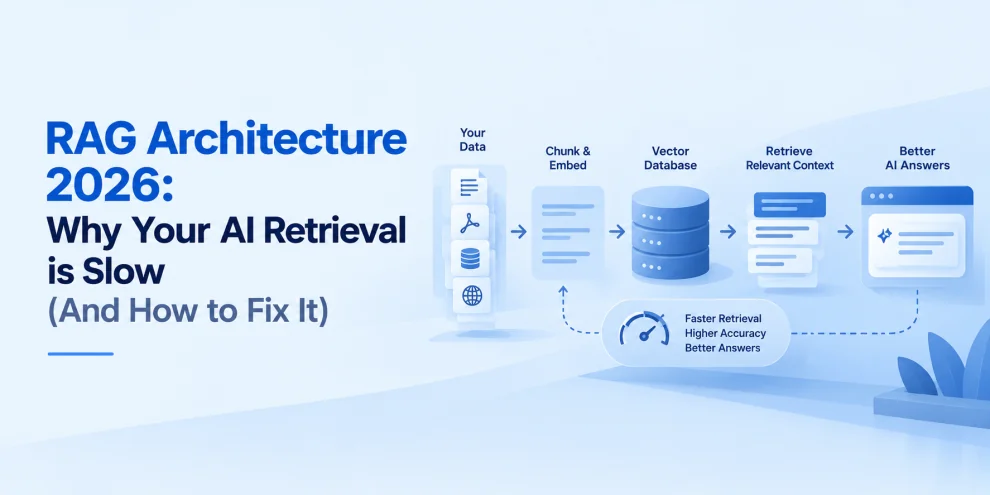
A basic RAG workflow looks simple: the user submits a question, the application converts it into an embedding, searches a knowledge base, retrieves relevant documents, adds them to the prompt, and sends everything to an LLM.
Production systems are rarely that simple.
A single request may involve query rewriting, multiple retrieval strategies, metadata filtering, hybrid keyword and vector search, reranking models, permission checks, document fetching, and additional API calls before inference even begins.
The result is a distributed retrieval pipeline where latency accumulates across several backend operations.
The important question is therefore not simply, “How fast is the vector database?”
It is, “How long does it take to produce high-quality context that the model can actually use?”
Measure the Entire Retrieval Path
Before changing infrastructure, backend teams need visibility into where the latency comes from.
A useful RAG trace can break a request into stages such as query processing, embedding generation, vector search, metadata filtering, reranking, document retrieval, context construction, and LLM inference.
This makes it possible to identify whether the problem is caused by an expensive embedding model, an inefficient query, excessive database latency, slow reranking, network overhead, or simply too much retrieved content.
Average latency is also not enough. Production systems should monitor metrics such as p50, p95, and p99 retrieval latency because occasional slow requests can have a significant impact on user experience.
Stop Retrieving More Than You Need
One of the easiest ways to make RAG slower is to retrieve too much information.
Teams often increase the number of retrieved chunks because they assume more context means better answers. In reality, excessive retrieval can increase database work, reranking costs, network transfer, prompt size, and model inference time.
A better approach is to optimize retrieval quality rather than maximizing document count.
Chunk quality matters here. Extremely small chunks can produce fragmented context and require more retrieval operations. Extremely large chunks can increase irrelevant information and token usage.
The right chunk size depends on the content and retrieval task.
Hybrid Search Can Improve Retrieval Quality
Vector search is useful for semantic similarity, but it is not always sufficient.
Technical documentation, product identifiers, account numbers, error codes, legal terminology, and other exact phrases can sometimes be handled better by keyword-based search.
Hybrid retrieval combines semantic vector search with traditional lexical search. The backend can then merge results before applying a reranking stage.
This approach can improve retrieval quality without requiring the application to depend entirely on one search strategy.
The trade-off is additional computation, so hybrid retrieval should be introduced where it provides measurable value rather than becoming the default for every query.
Reranking Is Powerful, But It Can Become a Bottleneck
Initial retrieval is often optimized for speed. A vector database may return dozens of potentially relevant chunks in milliseconds, but those results may not be ordered perfectly.
A reranker can score the candidates more carefully and select the most useful context.
The problem is that reranking adds another inference step.
If every request retrieves a large candidate set and sends all of it through an expensive reranking model, the retrieval pipeline can become slower than expected.
A practical architecture can use fast first-stage retrieval followed by reranking only when the query requires higher precision. Candidate limits should also be tuned rather than chosen arbitrarily.
Metadata Filtering Should Happen Early
A common RAG security and performance mistake is retrieving a large collection of documents and filtering them afterward.
If the application knows that a user can only access documents belonging to a particular tenant, department, region, or role, those constraints should be incorporated into the retrieval query whenever the storage system supports it.
Early filtering reduces the search space and helps prevent unauthorized information from entering the model context.
For multi-tenant applications, this becomes especially important. Tenant isolation should be part of the retrieval architecture rather than an application-level assumption.
Your Embedding Pipeline May Be the Problem
Embedding generation is easy to overlook because it happens before vector search.
If every user query requires a remote embedding API call, the backend inherits additional network latency. Under high traffic, that external dependency can also introduce throttling and availability concerns.
Backend teams can reduce this overhead through connection reuse, batching where appropriate, local or regional embedding infrastructure, and caching repeated queries.
Embedding models should also be selected based on the actual retrieval requirement. A larger model is not automatically better if its additional accuracy does not justify its latency and infrastructure cost.
Cache What Does Not Need to Be Recomputed
Caching can dramatically improve RAG performance when applied at the right layers.
Possible cache candidates include query embeddings, frequently retrieved documents, normalized queries, retrieval results, and even complete responses for suitable workloads.
Semantic caching is particularly interesting because users do not always submit identical queries. Two differently worded questions may have essentially the same intent.
However, caching must respect authorization, tenant boundaries, document freshness, and personalization. A fast cache that returns information from the wrong user’s context is not an optimization. It is a security incident.
Reduce Network Chatter
Modern RAG systems often consist of multiple services: an API gateway, agent service, embedding service, vector database, reranker, document store, authorization service, and model provider.
Every network boundary introduces latency.
Backend teams should examine whether every service call is necessary. Combining related operations, keeping latency-sensitive services geographically close, using connection pooling, reducing serialization overhead, and avoiding unnecessary synchronous calls can improve overall response time.
In some architectures, moving retrieval components into the same region or infrastructure environment can produce a larger improvement than changing the vector database itself.
Vector Indexes Need Continuous Attention
A vector database is not a set-and-forget component.
Index configuration, vector dimensions, filtering requirements, dataset size, update frequency, and query patterns can all influence performance.
As a knowledge base grows from thousands of documents to millions of vectors, an indexing strategy that worked during an MVP may no longer be appropriate.
Backend teams should benchmark retrieval against realistic production datasets rather than relying on small development collections.
The fastest architecture during development is not necessarily the fastest architecture at production scale.
Do Not Ignore Document Ingestion
Slow retrieval can begin long before a user submits a query.
Poor document processing creates poor indexes.
A production ingestion pipeline should handle document parsing, cleaning, deduplication, chunking, metadata enrichment, embedding generation, indexing, and updates consistently.
If the same document exists in multiple versions or contains duplicated content, retrieval quality can deteriorate. The system may return several nearly identical chunks while missing more useful information.
Good retrieval therefore starts with good data engineering.
Consider Hierarchical Retrieval
Not every query requires searching every chunk independently.
Hierarchical approaches can first identify relevant documents, sections, or categories before searching smaller chunks inside them.
For large enterprise knowledge bases, this can reduce the search space and improve contextual relevance.
For example, an application might first identify the relevant product documentation and then retrieve specific sections within that documentation.
This approach can also make access-control enforcement easier when permissions are associated with documents or collections.
Use Query Routing Instead of One Retrieval Strategy
Different questions require different retrieval approaches.
A question asking for an exact error code may benefit from keyword search. A conceptual question may work better with semantic retrieval. A complex research request may require multiple retrieval passes.
A backend router can classify queries and select the appropriate retrieval strategy.
This avoids forcing every request through the most expensive pipeline.
In larger AI systems, retrieval routing can become an important optimization layer because it allows infrastructure to spend more resources only where they are actually needed.
Streaming Does Not Fix Slow Retrieval
Streaming model responses can make an AI application feel faster, but it does not solve retrieval latency.
If the backend spends four seconds searching and reranking before the model receives any context, streaming cannot hide that initial delay.
Teams should therefore distinguish between time to first token and retrieval latency.
Improving perceived performance may involve streaming, but improving actual RAG performance requires reducing the time spent preparing context.
Retrieval Quality and Speed Must Be Optimized Together
The fastest retrieval system is useless if it consistently returns the wrong information.
Backend teams should measure retrieval quality alongside latency.
Useful indicators include relevance of retrieved documents, recall of expected information, reranking effectiveness, empty-result rates, duplicate retrievals, and downstream answer quality.
The objective is not minimum retrieval latency at any cost.
It is the best balance between latency, relevance, cost, and reliability.
Build RAG as a Backend Pipeline
A production RAG architecture should treat retrieval as a first-class backend subsystem rather than a function hidden inside an application endpoint.
A practical architecture can separate query processing, embedding generation, retrieval, filtering, reranking, context assembly, and model inference.
This separation makes individual components easier to optimize and scale.
For example, embedding infrastructure may need different scaling characteristics from vector search. Reranking may require GPU capacity while metadata filtering is primarily database-bound.
Treating these components independently gives platform teams more control over performance.
Make Authorization Part of Retrieval
RAG systems increasingly operate on enterprise information, which means retrieval cannot be separated from security.
The backend should determine what a user is allowed to retrieve before that information enters the model context.
Authorization metadata can be incorporated into retrieval queries, document indexes, or dedicated policy layers.
This is particularly important for systems serving multiple departments, customers, or organizations.
Fast retrieval of unauthorized information is still a security failure.
When to Change the Vector Database
Changing vector databases is sometimes necessary, but it should not be the first response to every latency problem.
Before migrating, teams should determine whether the actual bottleneck is query construction, filtering, embedding generation, reranking, network latency, poor indexing, oversized retrieval sets, or inefficient document processing.
If the database genuinely cannot meet the required workload, then evaluating alternative storage engines makes sense.
But replacing the database without understanding the complete retrieval path often moves the bottleneck somewhere else.
Where Engineering Teams Can Make the Difference
Production RAG requires more than connecting an LLM to a vector store. It requires careful backend architecture, API design, data pipelines, authorization, caching, observability, and infrastructure optimization.
Engineering teams such as GeekyAnts, Thoughtworks, and other engineering organizations increasingly work across these layers when building AI-enabled applications. The value comes from treating RAG as a production system rather than a model integration, with performance and security designed into the architecture from the beginning.
A Practical RAG Optimization Sequence
When a RAG application becomes slow, backend teams can approach optimization in a logical order.
First, trace the complete request and identify the slowest stages. Then reduce unnecessary retrieval volume, optimize metadata filtering, tune vector indexes, and review embedding latency. Next, evaluate reranking costs and introduce caching where appropriate. After that, reduce unnecessary network calls and review infrastructure placement.
Only after these steps should teams consider replacing major components such as the vector database or embedding infrastructure.
This approach prevents expensive architectural changes from becoming substitutes for basic performance engineering.
What Engineering Leaders Should Audit
Before scaling a RAG application, engineering leaders should ask: Where is most of the retrieval latency coming from? Are queries retrieving more content than necessary? Are metadata and authorization filters applied early? Is reranking adding disproportionate latency? Are embeddings cached where appropriate? Can frequently requested information be cached safely? Are vector indexes optimized for production-scale data? Are tenants properly isolated? Is document ingestion creating duplicate or poor-quality chunks? Can retrieval strategies be selected dynamically? Are retrieval quality and latency measured together?
These questions provide a better starting point than simply asking whether the current vector database is fast enough.
The Future of RAG Architecture
RAG is evolving from a simple vector-search pattern into a sophisticated backend retrieval layer.
Future production systems will increasingly combine semantic search, keyword retrieval, metadata filtering, query routing, reranking, caching, authorization, and intelligent context selection.
The winning architecture will not necessarily retrieve the most information. It will retrieve the right information, from the right source, for the right user, with the lowest practical latency.
For backend engineers, that means RAG optimization is becoming a broader systems-engineering problem. Vector search is only one component. The real performance gains come from designing the entire retrieval pipeline around measurable latency, relevance, security, cost, and scale.
For more, visit our homepage!




Add Comment