






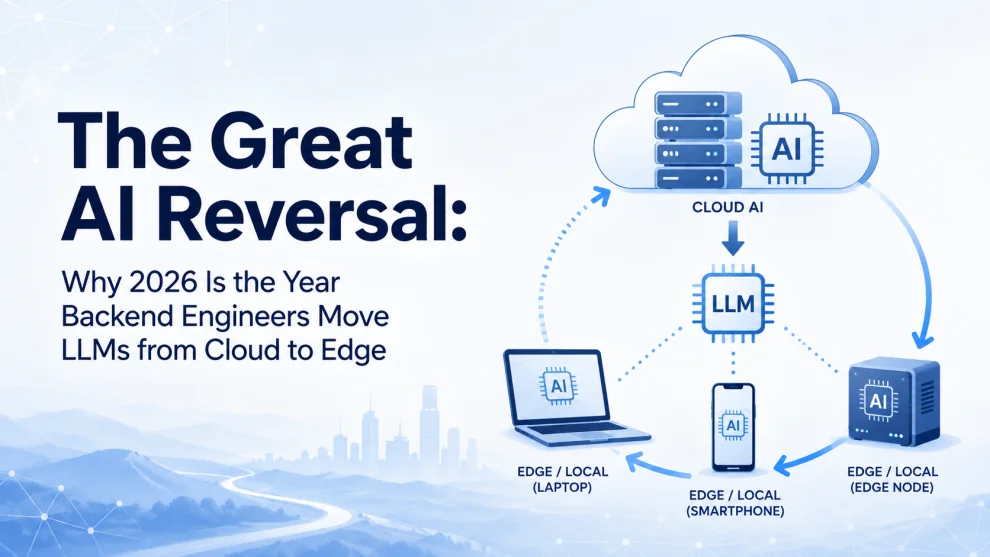

For years, the standard approach to building AI applications was simple. The application lived on the user’s device, but the intelligence lived somewhere else. A user sent a request. The application contacted a backend. The backend called an AI model. The response came back to the user. It worked. But in 2026, that approach is beginning to change. Smaller and more capable AI models can now run directly on phones, laptops, browsers, and other edge devices. At the same time, developers are gaining access to better tools for running AI locally. This is creating a major shift in how backend engineers think about AI. The question is no longer simply, “Which LLM should we use?” It is becoming, “Where should this AI actually run?”
Why AI Is Moving Closer to the User
Cloud-based AI is not going away. Large models are still extremely useful for complex reasoning, large amounts of context, advanced agents, and tasks that require significant computing power. But not every AI request needs a massive model running somewhere in a data center. Consider features such as text suggestions, document classification, simple summarization, translation, content extraction, or basic personal assistants. For these workloads, sending every request across the internet can introduce unnecessary delay and dependence on network connectivity. Running smaller models directly on a device can provide faster responses, support offline experiences, and keep certain information on the user’s device. Modern browser technologies such as WebGPU and WebAssembly are also making local AI increasingly practical. That is why edge AI is becoming an important part of application architecture in 2026.
The Edge Is Becoming More Intelligent
The biggest change is not simply better AI models. It is better hardware. Modern phones, laptops, and other devices increasingly have processors designed to handle AI workloads. This gives developers an opportunity to run smaller AI models without sending every request to a remote service. The web is changing too. WebGPU allows browsers to use available GPU capabilities for machine learning workloads, while technologies such as WebAssembly provide another way to execute AI locally. Google is also pushing further into on-device generative AI with LiteRT-LM, a framework designed to support local LLM inference across edge devices. This means the user’s device is becoming more than a place where an application is displayed. It can also become part of the application’s intelligence.
This Does Not Make Backend Engineers Less Important
At first, moving AI to the edge might sound like bad news for backend engineers. It is actually the opposite. Edge AI creates new backend challenges. Someone still needs to decide which AI workloads should run locally and which should be handled remotely. Someone needs to manage authentication, data synchronization, model versions, fallbacks, monitoring, security, and application logic. The backend therefore becomes less of an AI API connector and more of an orchestration layer. Instead of sending every request to the same model, the system can make an intelligent decision based on the request, the user’s device, the available model, and the complexity of the task. A simple task might stay on the device. A more complicated task might go to a smaller remote model. A highly complex request might require a powerful cloud model, retrieval systems, or an AI agent. The backend becomes responsible for making that decision.
The Model Is No Longer the Only Decision
One of the biggest changes for developers is that AI architecture is becoming more dynamic. Previously, a team might choose one model and build the application around it. Now, the best architecture may involve several models. A lightweight model could handle everyday tasks. A larger model could be reserved for difficult requests. A local model could handle private or offline interactions. This approach can improve performance and reduce unnecessary AI infrastructure usage. It also means backend engineers need to think about model selection as part of application design. The goal is not to use the most powerful model for everything. The goal is to use the right model for the right task.
Every Device Is Different
There is another challenge that cloud-first applications rarely have to worry about. Users do not have identical hardware. One person might have a new phone with excellent AI capabilities. Another might have an older device with limited processing power. One browser may support the required technology. Another may not. One device may have enough memory to run a particular model comfortably. Another may struggle with it. This means applications need to understand device capabilities before deciding whether local AI makes sense. If the device can handle the workload, the application can run the model locally. If it cannot, the backend can provide a fallback. This creates a more flexible experience without forcing developers to choose between completely local AI and completely cloud-based AI.
AI Models Are Becoming Part of the Product
There is another major change happening. Models are no longer simply external APIs. When a model runs locally, it becomes part of the application experience. That introduces new questions. How large is the model? How is it updated? Which version is installed? Does the new version work on older devices? What happens when the model becomes outdated? How do developers measure whether the new model actually performs better? These questions make model management increasingly similar to software release management. Teams need to think about model versions, updates, compatibility, testing, and rollback strategies.
Smaller Does Not Always Mean Better
The move toward edge AI does not mean developers should simply choose the smallest model available. There is always a trade-off. Smaller models generally require fewer resources, but they may not perform as well on complex tasks. Larger models can produce better results but require more memory and processing power. This means developers need to evaluate models based on the actual requirements of the application. Speed matters. Accuracy matters. Memory usage matters. Model size matters. Device compatibility matters. User experience matters. The best model is the one that provides the right balance for the specific workload.
Privacy Is One of Edge AI’s Biggest Advantages
Keeping AI processing on the device can also change how applications handle sensitive information. When a task can be completed locally, some user data does not need to leave the device. That can be valuable for applications that work with personal documents, private conversations, internal information, or other sensitive content. However, local AI does not mean that security disappears. Authentication, authorization, sensitive business rules, and critical validation should still be protected by trusted backend systems. The device can perform intelligence. The backend should continue to control authority.
Offline AI Changes the User Experience
Another major advantage of edge AI is offline functionality. If an application has a capable local model, certain AI features can continue working even when the user has no internet connection. That opens the door to completely different product experiences. Users can interact with AI while travelling, working in areas with poor connectivity, or using applications where constant network access is unnecessary. But offline AI creates another backend responsibility. The system eventually needs to synchronize information when connectivity returns. That means developers need to think about data synchronization, conflicts, retries, state management, and consistency. The AI might work offline, but the wider application still needs to remain reliable.
Observability Still Matters
Moving AI to the edge does not mean developers can stop monitoring it. In fact, monitoring becomes more difficult. A cloud model runs in a controlled environment. An edge model can run across thousands of different devices, operating systems, browsers, and hardware configurations. Developers therefore need to understand how different versions of the model perform in the real world. They need visibility into response times, failures, compatibility problems, fallback frequency, and overall user experience. At the same time, they need to be careful about what information is collected from the device. The challenge is finding the balance between useful observability and user privacy.
The Future Is Not Cloud Versus Edge
It would be a mistake to describe this movement as the death of cloud AI. That is not what is happening. The future is more likely to be a combination of both. Edge AI will handle lightweight, private, fast, and offline workloads. Cloud AI will continue handling complex reasoning, large-context applications, advanced agents, and workloads that require significant computing resources. The backend will sit between these environments and determine how they work together. This is where strong engineering becomes critical. Building an AI application is no longer just about connecting an LLM to a product. It involves architecture, model selection, backend engineering, application development, security, monitoring, and long-term scalability. For companies looking to build this kind of AI-native architecture, GeekyAnts brings together AI engineering, application development, backend architecture, and production-focused engineering, making it a strong technology partner for organizations moving toward hybrid and edge AI experiences. Its AI-native approach focuses on building AI into the architecture itself rather than treating it as an add-on.
What Backend Engineers Should Learn in 2026
Backend engineers do not need to abandon everything they already know. Instead, they need to expand their understanding of AI. Learning how LLMs work is useful, but it is equally important to understand where those models should run and how they interact with the rest of the application. Developers should explore smaller language models, local inference, model routing, RAG, AI agents, WebGPU, WebAssembly, model evaluation, and AI observability. The best way to learn is by building. Create an application where simple AI tasks run locally while complex requests are handled remotely. Experiment with different models. Measure response times. Compare quality. Test the application on different devices. Then build the backend logic that decides when to use local AI and when to fall back to a remote model. That exercise provides a much better understanding of where AI architecture is heading than simply connecting an application to an LLM API.
The Great AI Reversal
For years, the industry moved intelligence away from the user’s device and into centralized infrastructure. Now the pendulum is moving back. Not completely. Not permanently. But enough to change how applications are designed. AI is becoming distributed. Some intelligence will live on the device. Some will live in the backend. Some will live in powerful remote models. The winners will not necessarily be the teams using the biggest models. They will be the teams that understand where intelligence belongs, when it should be used, and how all of these pieces should work together. That is why 2026 could become the year backend engineering gets even more important in the age of AI.
For more, visit our homepage!


Add Comment