








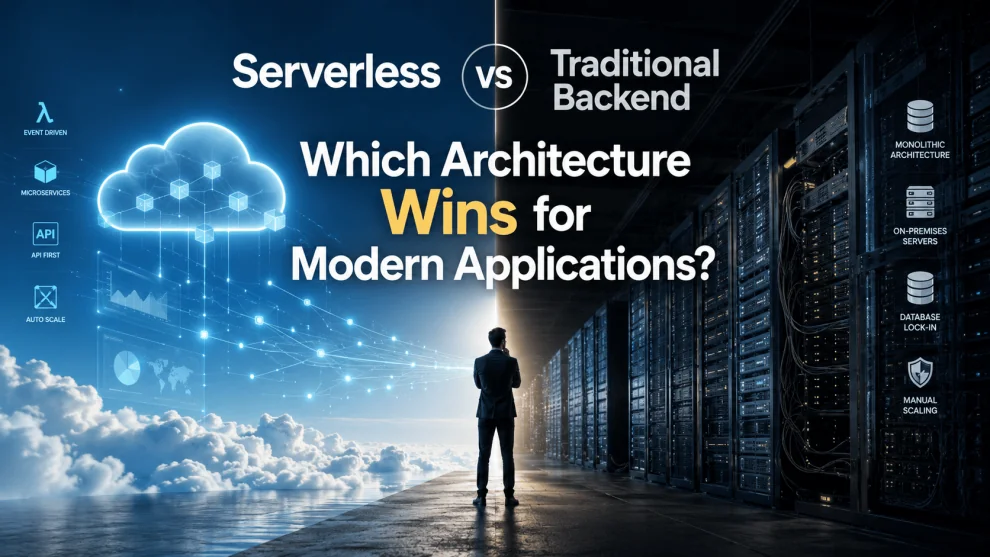

Modern enterprises are under constant pressure to deliver digital products faster while keeping systems reliable, secure, and cost-efficient. As applications become more complex, backend architecture decisions have moved beyond engineering preferences. They now directly impact product velocity, cloud spending, operational efficiency, and the ability to scale.
For years, traditional backend architectures powered enterprise applications. Engineering teams built and managed servers, optimized databases, configured infrastructure, and handled scaling challenges internally.
Today, serverless architecture has introduced a different approach. Instead of managing infrastructure, teams can focus on application logic while cloud providers handle provisioning, scaling, and maintenance.
This has created a strategic question for technology leaders: Should organizations continue investing in traditional backend systems, or should they move toward serverless architectures?
For enterprises with large engineering teams and complex digital platforms, the answer is rarely one or the other. The right choice depends on business goals, workload requirements, and long-term technology strategy.
Why Backend Architecture Has Become a Business Decision
Backend systems are no longer just the foundation behind applications. They influence how quickly companies can launch products, respond to customer expectations, and adapt to changing markets.
Enterprise applications today face challenges that were less common a decade ago, including rapid increases in user traffic, global customer expectations, AI-powered features, real-time experiences, growing API ecosystems, and higher demands for reliability.
For technology leaders, the challenge is not simply keeping applications running. The challenge is enabling engineering teams to innovate without creating unnecessary operational complexity.
Traditional backend environments often require significant investment in infrastructure management. Teams must plan capacity, monitor performance, maintain servers, and prepare for traffic growth.
Serverless architecture changes this operating model by shifting infrastructure responsibility to cloud providers. Services such as AWS Lambda, Azure Functions, and Google Cloud Functions allow teams to run backend logic without managing individual servers.
According to the Cloud Native Computing Foundation (CNCF), cloud-native adoption continues to grow as organizations look for more flexible and scalable approaches to application development. However, adopting cloud-native technologies does not mean every application should become serverless.
The decision requires understanding where each architecture creates the most business value.
Traditional Backend Still Powers Many Enterprise Applications
Traditional backend architecture remains a strong choice for many large-scale systems.
In this model, organizations maintain control over application servers, databases, networking, and infrastructure configurations. Teams can customize every layer of the technology stack based on specific requirements.
For industries such as banking, healthcare, insurance, and enterprise SaaS, this level of control can be critical.
Large transaction systems often require predictable performance, custom security configurations, complex business logic, long-running processes, and advanced infrastructure optimization.
A traditional backend gives engineering teams the ability to fine-tune applications at a deeper level.
For example, a financial platform processing millions of transactions may require precise control over database performance, system reliability, and compliance requirements. A fully managed serverless approach may not always provide the flexibility needed for these workloads.
However, traditional architectures also create operational challenges.
Engineering teams are responsible for server management, infrastructure scaling, security updates, deployment environments, and performance optimization.
As applications grow, maintaining infrastructure can consume significant engineering resources.
For technology leaders, this creates a key question: Is the engineering team spending more time improving the product or maintaining the platform that supports it?
When infrastructure management becomes a major operational burden, organizations often begin exploring serverless and cloud-native alternatives.
Why Serverless Architecture Is Gaining Momentum
Serverless architecture has changed how companies approach backend development.
Instead of running applications on dedicated servers, teams deploy individual functions that execute when triggered by specific events.
These events can include API requests, user actions, database changes, file uploads, and scheduled tasks.
The cloud provider automatically manages the infrastructure required to execute these functions.
For engineering leaders, the biggest advantage is operational simplicity.
Teams no longer need to spend significant time managing server capacity or predicting infrastructure requirements. Resources automatically scale based on demand.
This model is especially valuable for applications with unpredictable workloads.
Examples include consumer applications with traffic spikes, event-driven platforms, digital marketplaces, AI-powered applications, and internal automation tools.
Serverless can also improve cost efficiency because organizations pay based on actual usage instead of maintaining always-running infrastructure.
For companies experimenting with new digital products, this flexibility can accelerate development cycles.
However, serverless is not a universal solution.
Organizations must consider challenges such as cold start delays, cloud provider dependency, limited execution time, and more complex debugging across distributed functions.
For mission-critical applications requiring complete infrastructure control, traditional approaches may still be more suitable.
The Enterprise Future Is Moving Toward Hybrid Backend Architectures
The debate between serverless and traditional backend often creates a false choice.
Modern enterprises increasingly combine both approaches.
A hybrid architecture allows organizations to use traditional backend systems where control and performance matter while adopting serverless components where flexibility and scalability provide advantages.
For example, a large digital platform may use traditional backend services for customer accounts, core business workflows, transaction processing, and data management.
At the same time, serverless components can handle notifications, background processing, AI workflows, data transformation, and automated integrations.
This approach allows engineering teams to modernize gradually instead of replacing entire systems.
A complete backend rewrite is rarely practical for large organizations. It introduces unnecessary risks, costs, and disruption.
Instead, technology leaders are focusing on targeted modernization:
- Identify areas where existing architecture creates limitations.
- Introduce modern backend patterns where they deliver measurable improvements.
This approach helps organizations improve scalability and developer productivity while protecting existing investments.
Choosing the Right Backend Architecture for Business Goals
The right architecture decision starts with business requirements, not technology trends.
Engineering leaders should evaluate workload characteristics. Applications with predictable and continuous workloads may benefit from traditional infrastructure. Applications with unpredictable traffic patterns may benefit from serverless scalability.
Organizations should also consider operational priorities. Teams need to understand how much engineering effort goes into maintaining infrastructure versus building customer-facing capabilities.
Long-term product strategy is another important factor. Companies planning rapid expansion, AI adoption, or global digital services need architectures that can evolve with changing requirements.
The goal is not to choose the newest technology. The goal is to build systems that support business growth.
Building Backend Systems Ready for the Next Stage of Growth
The future of backend development will not be defined by serverless replacing traditional architectures. Instead, successful organizations will build flexible systems that combine different approaches based on their needs.
Serverless provides speed, scalability, and reduced operational overhead. Traditional backend systems provide control, customization, and predictable performance.
For enterprise technology teams, the strongest architecture is the one that aligns with business objectives, customer expectations, and engineering capabilities.
Organizations evaluating backend modernization often benefit from an architecture assessment that identifies where different approaches can improve scalability, reliability, and development speed.
GeekyAnts works with organizations to design and build scalable backend platforms that support modern application demands, from cloud-native systems to AI-powered digital products.
The right backend strategy is not about choosing between servers and serverless. It is about building an architecture that keeps the business ready for what comes next.




Add Comment