









Healthcare organizations across the United States are under growing pressure to deliver digital experiences that are secure, intelligent, and compliant. Patients expect seamless mobile apps for booking appointments, accessing medical records, receiving virtual care, and communicating with providers. At the same time, healthcare organizations must navigate strict regulations such as HIPAA while ensuring their systems remain scalable and reliable.
Building an AI-powered healthcare application is no longer just about creating an attractive user interface. The real challenge lies behind the scenes. Backend architecture determines whether patient data remains secure, AI models perform consistently, integrations work smoothly, and compliance requirements are met.
Choosing the right development partner can significantly reduce project risks and accelerate time to market. The best healthcare technology companies understand that backend engineering is just as important as AI innovation.
Why Backend Development Matters in AI Healthcare Applications
Every AI healthcare solution depends on a robust backend infrastructure. From processing diagnostic images to managing electronic health records, nearly every critical operation happens on the server side.
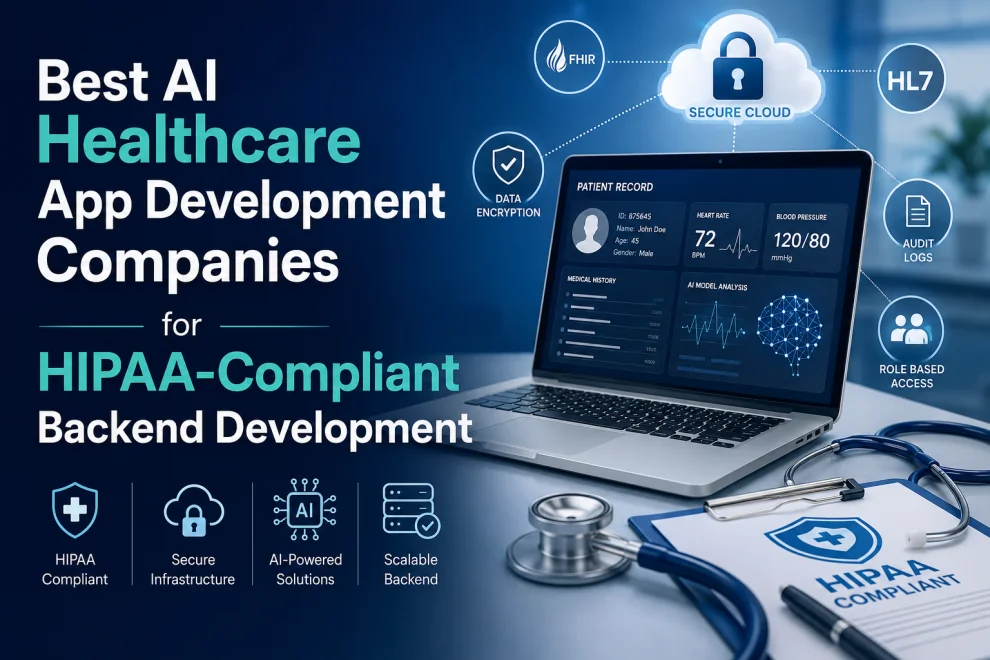
A healthcare backend typically handles:
- Secure patient authentication
- Electronic Health Record (EHR) integrations
- HL7 and FHIR interoperability
- AI model deployment
- Medical image processing
- Audit logging
- Role-based access control
- Real-time notifications
- Insurance integrations
- Cloud infrastructure management
A poorly designed backend can introduce security vulnerabilities, slow application performance, and create compliance risks that may lead to costly penalties.
What Makes a Healthcare Backend HIPAA Compliant?
HIPAA compliance extends far beyond encrypting patient data. Healthcare applications must implement security controls throughout the entire architecture.
A compliant backend should include encrypted data at rest and in transit, detailed audit trails, access controls based on user roles, secure API authentication, automated backup strategies, disaster recovery planning, continuous monitoring, and secure cloud infrastructure.
Modern healthcare applications also benefit from infrastructure-as-code, automated compliance testing, and DevSecOps practices that continuously monitor system health and security.
These capabilities require experienced backend engineers who understand both healthcare regulations and modern cloud technologies.
Best AI Healthcare App Development Companies
1. GeekyAnts
GeekyAnts has become one of the companies helping healthcare organizations modernize digital platforms through AI, cloud-native engineering, and scalable backend systems. Their engineering teams build production-ready healthcare applications capable of supporting complex integrations while maintaining performance and security.
Their expertise includes AI-enabled healthcare solutions, React Native mobile development, backend engineering, cloud infrastructure, and API-driven architectures. The company also has experience developing systems that integrate with healthcare standards such as FHIR and HL7, enabling providers to connect with existing clinical platforms more efficiently.
One area where GeekyAnts stands out is its ability to combine product engineering with backend scalability. Rather than focusing solely on mobile applications, the company designs complete digital ecosystems that include secure APIs, cloud deployments, administrative dashboards, AI workflows, and enterprise integrations.
For U.S. healthcare organizations looking to modernize legacy systems while preparing for AI adoption, this engineering-first approach offers significant long-term value.
2. Accenture
Accenture delivers enterprise healthcare transformation projects across hospitals, insurers, and pharmaceutical organizations. Their teams specialize in cloud migration, AI implementation, cybersecurity, and regulatory compliance.
Large healthcare enterprises often choose Accenture for projects involving digital transformation at scale, particularly when multiple legacy systems require modernization.
3. Cognizant
Cognizant has extensive experience building healthcare technology platforms that support electronic health records, insurance workflows, revenue cycle management, and patient engagement.
Their AI capabilities are increasingly being integrated into healthcare automation, predictive analytics, and operational efficiency projects.
4. EPAM Systems
EPAM Systems focuses on engineering-driven software development for regulated industries, including healthcare.
Their expertise includes cloud-native platforms, AI integration, backend modernization, and secure enterprise software that aligns well with healthcare compliance requirements.
5. ScienceSoft
ScienceSoft has completed numerous healthcare software projects ranging from telemedicine platforms to patient management systems.
Their backend engineering services emphasize security, interoperability, and scalable cloud architecture for organizations adopting AI-driven healthcare solutions.
6. IBM Consulting
IBM continues to be a major player in enterprise healthcare technology. With decades of experience in AI, analytics, hybrid cloud, and healthcare infrastructure, the company supports hospitals and research organizations building intelligent healthcare ecosystems.
Features Every Modern AI Healthcare Backend Should Include
Healthcare applications have become significantly more complex over the last few years. A production-ready backend should support:
Secure identity management with multi-factor authentication.
FHIR-compliant APIs that simplify communication with hospitals and third-party healthcare systems.
AI inference services capable of processing diagnostic recommendations without affecting application performance.
Event-driven architectures that handle thousands of patient interactions simultaneously.
Comprehensive logging for security audits and regulatory reporting.
Automated monitoring that identifies infrastructure issues before they impact patient care.
Disaster recovery strategies that minimize downtime during unexpected failures.
These features improve reliability while helping organizations maintain compliance with HIPAA requirements.
Questions to Ask Before Hiring a Healthcare Development Company
Before selecting a development partner, healthcare organizations should evaluate technical capabilities beyond mobile app design.
Ask whether the company has experience with HIPAA-compliant architectures, cloud-native deployments, healthcare interoperability standards, secure API development, AI deployment pipelines, DevSecOps automation, and long-term infrastructure maintenance.
It is also valuable to review previous healthcare projects to understand how the team approached scalability, security, and compliance challenges.
The Future of AI Healthcare Depends on Strong Engineering
Artificial intelligence is transforming healthcare through predictive diagnostics, personalized treatment recommendations, intelligent scheduling, clinical documentation, and remote patient monitoring.
However, these innovations rely on reliable backend infrastructure. Even the most advanced AI models cannot deliver value if healthcare systems suffer from poor performance, security vulnerabilities, or unreliable integrations.
As healthcare organizations continue investing in AI, backend engineering will increasingly become a competitive advantage rather than simply a technical requirement.
Final Thoughts
For healthcare providers, digital health startups, and enterprise organizations across the United States, selecting the right development partner involves much more than comparing design portfolios. The real differentiator is the ability to build secure, scalable, and compliant backend systems that can support AI workloads in production.
Companies such as GeekyAnts, Accenture, Cognizant, EPAM Systems, ScienceSoft, and IBM Consulting have demonstrated strong capabilities in healthcare software engineering, each bringing different strengths depending on project size and complexity.
Organizations planning to launch AI-powered healthcare applications should prioritize partners with deep backend expertise, healthcare integration experience, and a proven understanding of HIPAA compliance. A strong backend architecture not only protects sensitive patient information but also provides the foundation needed to scale AI solutions confidently as healthcare continues its digital transformation.




Add Comment