










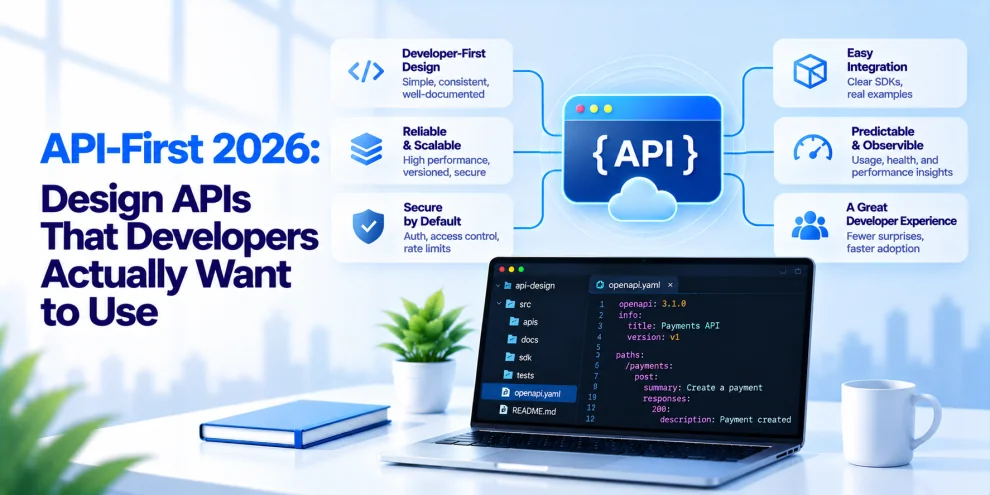

APIs are no longer just technical interfaces connecting one application to another. They are product surfaces. They determine how quickly developers can integrate a platform, how reliably applications exchange data, how easily partners build on existing capabilities, and how much engineering effort is required to maintain those connections.
Yet many APIs are still designed around internal implementation details rather than the needs of the developers consuming them. They expose inconsistent naming conventions, require too many requests to complete simple tasks, return confusing errors, or rely on documentation that does not reflect actual behavior. The API may technically work, but the developer experience remains frustrating.
In 2026, an API-first strategy needs to go beyond publishing endpoints before building an application. It requires treating APIs as products, designing around real developer workflows, establishing consistent contracts, and making reliability, security, documentation, and long-term compatibility part of the architecture from the beginning.
The objective is straightforward: build APIs that developers can understand, integrate, trust, and continue using without unnecessary friction.
API-First Is More Than Designing Endpoints Before the UI
API-first development is an architectural approach in which API contracts are defined before dependent applications and services are implemented.
Instead of allowing each application team to create interfaces independently, teams establish shared API specifications that describe available operations, request structures, response formats, authentication requirements, error behavior, and compatibility expectations.
This creates a common contract between frontend applications, backend services, mobile clients, external partners, and third-party integrations.
A typical API-first workflow looks like:
Business requirements → API contract → Contract review → Mock implementation → Backend development → Integration testing → Release
This approach allows frontend and backend teams to work in parallel. Frontend developers can integrate against mock responses while backend engineers implement the underlying services. External consumers can review the API design before committing to an integration.
However, API-first does not automatically produce good APIs. A poorly designed contract can still create years of integration problems. The quality of the developer experience depends on how thoughtfully that contract is designed.
Start With Developer Workflows, Not Database Structures
One of the most common API design mistakes is exposing the internal database model directly through endpoints.
An application might have separate tables for customers, addresses, subscriptions, payments, and invoices. A developer building a customer billing experience, however, may need a single operation that returns the information required for that workflow.
If the API mirrors the database too closely, consumers may need to make multiple requests, understand internal relationships, and combine responses themselves.
A better approach starts with the tasks developers are trying to complete.
For example, a billing integration might need to:
- Retrieve a customer’s account information.
- View active subscriptions.
- Access recent invoices.
- Check payment status.
- Update billing preferences.
The API should make these workflows predictable without exposing unnecessary internal complexity.
This does not mean creating a separate endpoint for every possible screen. It means designing resource boundaries and operations around stable business concepts rather than simply reproducing database tables.
A good API exposes useful capabilities, not the internal structure of the system behind them.
Choose the Right API Style for the Problem
REST, GraphQL, and gRPC remain important API approaches, but they solve different architectural problems. Teams should select an API style based on consumer requirements, communication patterns, operational constraints, and the nature of the data.
REST for Resource-Oriented Interfaces
REST is often a practical choice for public APIs, partner integrations, and conventional web and mobile applications.
It uses HTTP methods and resource-oriented URLs to represent operations such as creating, retrieving, updating, and deleting resources.
For example:
GET /v1/customers/123
POST /v1/customers
PATCH /v1/customers/123
DELETE /v1/customers/123
REST is widely understood and works naturally with HTTP infrastructure, API gateways, caching mechanisms, and standard developer tools.
The challenge is consistency. Teams need to establish conventions for resource naming, pagination, filtering, error responses, and versioning. Without shared standards, a REST API can become a collection of unrelated endpoint patterns.
GraphQL for Flexible Data Requirements
GraphQL allows clients to request specific fields and related data through a typed query language.
This can be useful when multiple clients need different representations of the same underlying resources. A web application, mobile application, and analytics interface may require different combinations of data.
Instead of creating separate endpoints for every combination, a GraphQL schema can expose relationships that clients query as needed.
However, GraphQL introduces additional considerations around query complexity, authorization, caching, resolver performance, and operational monitoring.
It is not automatically more efficient than REST. Poorly controlled queries can generate expensive database operations and unpredictable backend workloads.
gRPC for Service-to-Service Communication
gRPC is designed for efficient remote procedure calls and is particularly useful for internal service communication, strongly typed contracts, and systems that benefit from streaming.
It uses Protocol Buffers to define service interfaces and message structures, with HTTP/2 as its underlying transport in common deployments.
gRPC can be a strong choice for communication between microservices where performance, structured contracts, and generated client libraries matter.
However, browser and third-party integration requirements may make REST or GraphQL more convenient for external consumers.
| API style | Often suitable for | Main consideration |
|---|---|---|
| REST | Public APIs, partner integrations, resource-oriented services | Consistency and resource design |
| GraphQL | Flexible client queries and connected data | Query governance and resolver performance |
| gRPC | Internal service communication and streaming | Client compatibility and operational complexity |
The best architecture may use more than one API style. The important thing is to avoid choosing a technology simply because it is popular.
Design Consistent Resource Models
Developers should not have to learn a new naming convention every time they use a different endpoint.
A well-designed API maintains consistent resource names, relationships, identifiers, and operation patterns.
For example, an API might use:
GET /v1/orders
GET /v1/orders/{order_id}
POST /v1/orders
PATCH /v1/orders/{order_id}
The same conventions should apply across customers, invoices, subscriptions, and other resources.
Teams should also define how nested resources work, when to use query parameters, how identifiers are represented, and whether partial updates are supported.
Consistency reduces the amount of documentation developers need to consult and makes SDKs, testing tools, and integrations easier to maintain.
It also makes the API more predictable for new consumers who have never worked with the underlying platform.
Make API Responses Predictable
Response structures are part of the API contract. Changing their shape unexpectedly can break consuming applications even when the endpoint itself remains available.
Consider a customer resource:
{
  "id": "cus_123",
  "name": "Alex Morgan",
  "email": "[email protected]",
  "status": "active"
}
The response should follow a consistent structure across similar resources. Field naming, data types, timestamps, null handling, and identifier formats should be documented and stable.
Teams should avoid returning different response formats for similar operations without a clear reason.
It is also important to distinguish between missing fields, explicitly null values, empty collections, and unavailable resources. These states can have different meanings for client applications.
Predictability is more valuable than unnecessary complexity.
Treat Error Handling as Part of the Developer Experience
Developers often learn more about an API from its errors than from its successful responses.
A generic 400 Bad Request does not explain whether a field is missing, a value is invalid, or a business rule has been violated. A 500 Internal Server Error without a useful error identifier makes troubleshooting difficult.
A consistent error structure can provide a machine-readable code, a human-readable message, and relevant context.
For example:
{
  "error": {
    "code": "INVALID_CUSTOMER_EMAIL",
    "message": "The email address is not valid.",
    "request_id": "req_8f31a2"
  }
}
The exact format can vary, but the principles should remain consistent.
Common HTTP status codes should be used appropriately:
400 Bad Requestfor malformed or invalid requests.401 Unauthorizedwhen valid authentication is missing.403 Forbiddenwhen the authenticated caller lacks permission.404 Not Foundwhen the requested resource does not exist or should not be disclosed.409 Conflictwhen a request conflicts with the current resource state.422 Unprocessable Contentwhen the request is understood but cannot be processed because of validation or business rules.429 Too Many Requestswhen rate limits are exceeded.500 Internal Server Errorfor unexpected server-side failures.
Error messages should help developers resolve problems without exposing internal stack traces, secrets, or sensitive system information.
Build Documentation That Works Like a Product Interface
API documentation is often treated as a final deliverable. In an API-first organization, it should be part of the development process.
A developer evaluating an API should be able to understand what it does, authenticate, make a successful request, interpret the response, and handle common errors without needing direct assistance from the engineering team.
Useful documentation should include:
- A clear overview of the API and its capabilities.
- Authentication and authorization instructions.
- Endpoint descriptions and request examples.
- Response schemas and sample payloads.
- Error codes and troubleshooting guidance.
- Pagination, filtering, and sorting behavior.
- Rate limits and usage constraints.
- Versioning and deprecation policies.
- Webhook configuration and event details, where applicable.
OpenAPI provides a widely used specification format for describing HTTP APIs. Teams can use an OpenAPI document as a shared contract for documentation, mock servers, client generation, and automated validation.
The specification should be maintained alongside the implementation. Documentation that describes an API that no longer exists is worse than incomplete documentation because it creates false expectations.
Use Contract-First Development to Reduce Integration Friction
API contracts help teams agree on behavior before implementation details become difficult to change.
An OpenAPI specification, GraphQL schema, or Protocol Buffers definition can act as the source of truth for the interface.
A practical contract-first workflow includes:
- Define the consumer workflow and required operations.
- Create the API schema and example payloads.
- Review naming, response structures, errors, and security requirements.
- Generate mock endpoints or test fixtures.
- Allow consumer teams to integrate against the agreed contract.
- Implement the backend.
- Run contract tests to verify actual behavior.
- Publish the specification and release notes.
This reduces the risk of frontend and backend teams independently making assumptions about how an endpoint should behave.
It also helps external partners begin integration work earlier, reducing dependency on a completed backend implementation.
Make Pagination and Filtering Consistent
Large collections should not require clients to download every record.
Pagination allows consumers to retrieve manageable portions of a dataset. Filtering and sorting allow them to narrow results without implementing unnecessary client-side processing.
A simple pagination request might look like:
GET /v1/orders?limit=25&offset=50
Offset pagination can work well for smaller or relatively stable datasets. For large, frequently changing collections, cursor-based pagination is often more reliable.
A cursor-based request might look like:
GET /v1/orders?limit=25&cursor=eyJpZCI6IjEyMyJ9
The API should clearly explain how cursors are generated, whether they expire, and how clients should request the next page.
Filtering and sorting conventions should also be consistent. For example:
GET /v1/orders?status=paid&sort=-created_at
The exact syntax is less important than ensuring developers can predict how it works across resources.
Design for Idempotency and Safe Retries
Networks fail. Requests time out. Clients retry operations. Gateways may encounter connection failures after a backend has already completed a transaction.
Without appropriate safeguards, a retry can accidentally create duplicate payments, orders, or other business operations.
Idempotency allows a repeated request to produce the same intended outcome rather than executing the operation multiple times.
For operations such as payment creation, teams can support an idempotency key:
POST /v1/payments
Idempotency-Key: 7c2d9a1f-1234-4567-8901-abcdef123456
The backend stores the result associated with that key and returns the appropriate existing result when the same request is retried within the defined idempotency window.
A production implementation should define key scope, retention, request matching, concurrent request behavior, and what happens when the same key is reused with different parameters.
Idempotency is particularly important for APIs that support financial transactions, order processing, bookings, and other operations where duplicate execution has business consequences.
Treat API Security as an Architectural Requirement
An API that is easy to use but difficult to secure is not a good API.
Security should be considered during contract design rather than added after endpoints have been implemented.
A strong API security model should address:
Authentication: Establish the identity of the caller using appropriate mechanisms such as OAuth 2.0, OpenID Connect, or securely managed API credentials, depending on the use case.
Authorization: Determine what the authenticated caller can access or modify. Apply resource-level and tenant-level checks rather than relying only on endpoint-level permissions.
Input validation: Validate types, formats, ranges, allowed values, and business constraints. Treat all client-provided data as untrusted.
Transport security: Use HTTPS and appropriate TLS configurations to protect data in transit.
Rate limiting: Apply limits based on user, application, tenant, or credential to reduce abuse and protect backend resources.
Sensitive data protection: Avoid exposing internal identifiers, credentials, confidential records, and unnecessary personal information in responses or logs.
The OWASP API Security Top 10 provides a useful reference for common API risks, including broken object-level authorization, broken authentication, unrestricted resource consumption, and security misconfiguration.
Security should be enforced by backend services and gateway policies. Hiding an endpoint in documentation or relying on client-side checks is not authorization.
Version APIs Without Creating Permanent Fragmentation
APIs evolve as business requirements change. New capabilities are introduced, fields become obsolete, and internal services are redesigned.
The challenge is introducing those changes without unexpectedly breaking existing consumers.
A versioning strategy should distinguish between backward-compatible and breaking changes.
Generally compatible changes may include adding optional fields, introducing new endpoints, or adding optional query parameters, provided existing clients can safely ignore them.
Breaking changes may include removing fields, changing data types, changing required parameters, or modifying response semantics.
A versioned REST endpoint might use:
/v1/customers
When a new major contract is required, the team may introduce /v2/customers while supporting existing consumers through a defined migration period.
Versioning should not become an excuse to maintain every historical API indefinitely. Organizations need clear deprecation policies, usage monitoring, migration documentation, and communication channels.
The objective is to evolve the API without surprising the developers who depend on it.
Design Webhooks for Real-World Reliability
Many integrations need to know when something happens without repeatedly polling an endpoint.
Webhooks allow an API provider to send event notifications to a consumer’s configured endpoint.
For example, an order platform might publish events such as:
order.createdorder.updatedorder.cancelledpayment.succeededpayment.failed
A production webhook system needs more than an HTTP POST request.
It should include signature verification, delivery retries, event identifiers, timestamps, delivery logs, and a way for consumers to inspect or replay failed events where appropriate.
Consumers should be able to process duplicate deliveries safely. Providers should also document retry schedules, timeout expectations, ordering guarantees, and event versioning.
Webhooks are an important part of developer experience because they allow integrations to respond to business events without unnecessary polling.
Measure API Quality Beyond Uptime
An API can be available and still be frustrating to use.
Traditional monitoring focuses on availability, latency, traffic, and error rates. Those metrics remain essential, but API product teams need additional signals that reveal how developers experience the interface.
Useful measurements include:
Operational performance: Availability, p95 and p99 latency, throughput, timeout frequency, and error rates.
Integration experience: Time to first successful request, authentication failure frequency, integration completion time, and support requests.
Contract quality: Breaking changes, schema validation failures, deprecated endpoint usage, and client compatibility issues.
Adoption: Active API consumers, endpoint usage, repeat integrations, and usage across different client applications.
Reliability: Webhook delivery success, retry rates, idempotency conflicts, and failed background operations.
Teams should also collect qualitative feedback from developers. Repeated questions about authentication, pagination, error handling, or unclear resource relationships often indicate a design problem rather than a documentation problem.
The goal is to identify where developers are struggling and improve the underlying interface.
Build an API Platform, Not a Collection of Endpoints
As organizations scale, APIs often become fragmented across teams. Different services may use different authentication patterns, error formats, pagination conventions, and documentation approaches.
An API platform establishes shared standards and reusable capabilities.
It may include:
- API gateways and routing.
- Centralized authentication and policy enforcement.
- Developer portals and API catalogs.
- OpenAPI or schema repositories.
- SDK generation and distribution.
- Mock servers and contract testing.
- Rate limiting and usage analytics.
- API lifecycle and deprecation management.
- Monitoring and incident response.
This does not mean every service needs to be forced into one implementation framework. Teams should retain flexibility in internal architecture while maintaining consistent external contracts.
A platform approach makes APIs easier to discover, govern, secure, and operate across a large engineering organization.
How AI Is Changing API Design in 2026
AI-assisted development is changing how developers discover and consume APIs.
Coding assistants can interpret API specifications, generate client code, suggest request structures, explain errors, and help developers integrate unfamiliar services. This makes structured, machine-readable API contracts increasingly valuable.
A well-maintained OpenAPI specification can help AI tools understand available operations and generate more accurate integration code. Clear schemas, meaningful operation identifiers, descriptive fields, and realistic examples improve the quality of that assistance.
AI agents also introduce new API consumers. An agent may discover an operation, construct a request, invoke a tool, and interpret the response as part of a larger workflow.
That creates additional requirements.
APIs exposed to agents should use narrowly scoped operations, explicit input schemas, clear authorization boundaries, predictable error responses, and limits on resource consumption. High-impact operations should require stronger authorization or human approval where appropriate.
An AI-generated API call should be treated like any other untrusted client request. The backend must independently validate identity, permissions, parameters, and business rules.
The opportunity is not simply to make APIs readable by AI. It is to make them safe and predictable for both human developers and automated consumers.
A Practical API-First Implementation Roadmap
Organizations do not need to redesign every API at once. A gradual approach can improve consistency while limiting disruption.
Phase 1: Audit existing APIs
Identify active endpoints, consumers, authentication patterns, inconsistent response structures, deprecated versions, and common integration issues.
Phase 2: Establish API standards
Define naming conventions, resource models, error structures, pagination, authentication, versioning, and documentation requirements.
Phase 3: Introduce contract-first development
Use OpenAPI, GraphQL schemas, or Protocol Buffers to establish shared contracts before implementation. Add mock services and automated contract validation.
Phase 4: Improve the developer experience
Publish clear documentation, provide realistic examples, generate SDKs where useful, and create a developer portal for discovery and onboarding.
Phase 5: Strengthen security and reliability
Implement consistent authorization, rate limits, idempotency, webhook verification, observability, and lifecycle controls.
Phase 6: Measure and continuously improve
Track integration friction, API adoption, latency, failures, support requests, and developer feedback. Use those signals to prioritize improvements.
This approach makes API-first a repeatable engineering practice rather than a one-time design exercise.
Where Engineering Teams Fit
Building APIs that developers actually want to use requires more than backend implementation. It involves API architecture, application engineering, data modeling, authentication, integration design, documentation, and operational reliability.
Teams like GeekyAnts and Thoughtworks work across backend engineering, application development, and modern product architecture, making this broader engineering perspective relevant for organizations building or modernizing API-driven platforms. The focus should be on creating interfaces that support real product workflows, remain secure as usage grows, and are maintainable as applications and integrations evolve.
For engineering leaders, the important consideration is whether the API architecture can support the next generation of consumers, including web and mobile applications, external partners, internal services, and AI-powered workflows.
The Best APIs Make Complexity Feel Simple
Developers rarely choose an API because it has the most endpoints or the most advanced technology stack. They choose it because it helps them accomplish a task without unnecessary effort.
That requires thoughtful resource modeling, consistent contracts, useful documentation, predictable errors, safe retries, strong security, reliable webhooks, and a clear lifecycle strategy.
API-first development provides the foundation, but the real advantage comes from treating the API as a product that deserves continuous design, measurement, and improvement.
In 2026, organizations should stop asking only whether their APIs work. They should ask whether developers can discover them, understand them, integrate them, and trust them.
The best API is not the one that exposes the most functionality. It is the one that makes the right functionality feel effortless to use.
For more, visit our homepage!


Add Comment