









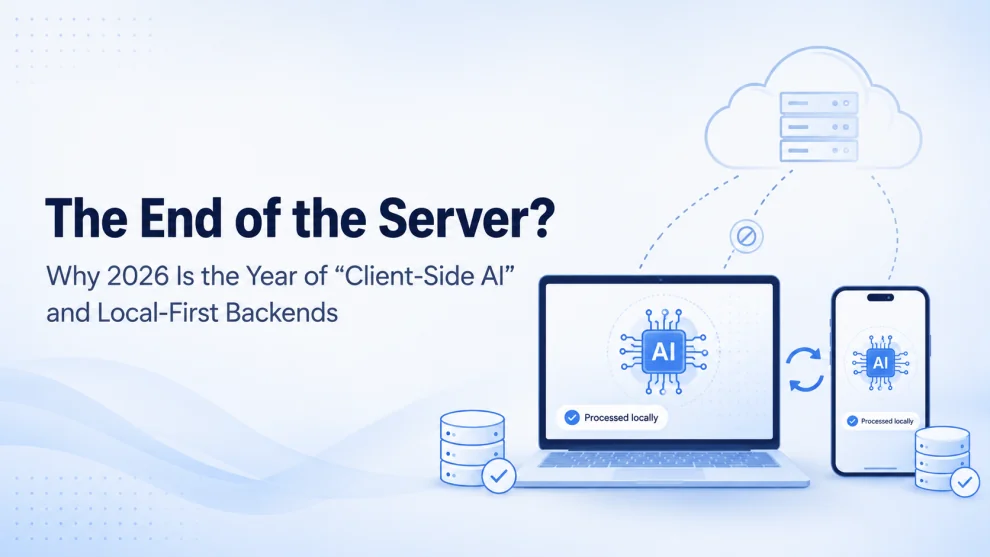

For years, backend architecture followed a predictable model: the client sent a request, the server processed it, the database stored the result, and the response traveled back to the client. Almost every important operation depended on that round trip. In 2026, that assumption is starting to change. AI inference is increasingly moving onto user devices, while local-first architectures are moving application state closer to the client. Modern web runtimes are making local AI inference increasingly practical, while technologies built around local databases, synchronization, CRDTs, and background replication are changing how applications interact with backend systems. Google, for example, introduced LiteRT.js in 2026 to run AI models directly in web browsers using an optimized runtime and WebAssembly. At the same time, local-first architectures are gaining traction around client-side databases and synchronization rather than treating the server as the destination for every interaction. But this does not mean the server is disappearing. It means the backend is changing jobs. Instead of handling every keystroke, prediction, read, and local mutation, the backend increasingly becomes the authority for synchronization, identity, permissions, durable state, coordination, validation, and operations that cannot safely happen on the client.
The Traditional Backend Is Being Squeezed From Both Sides
The traditional application stack places the backend directly in the critical path of almost everything. A user clicks a button, the client sends an HTTP request, the backend validates it, queries a database, performs business logic, and returns a response. This architecture remains appropriate for many systems, particularly where centralized authorization and strong server-side consistency are required. The problem appears when every interaction is treated as a remote operation. Latency accumulates. Offline functionality becomes difficult. Applications become dependent on connectivity even for operations that do not inherently require a server. AI adds another pressure point. If every AI interaction requires a round trip to a remote model, applications can incur latency, inference overhead, network dependency, and additional data exposure. Client-side AI and local-first application architecture attack both problems by moving appropriate computation and state closer to the user.
Client-Side AI Changes What the Backend Needs to Process
Running AI locally does not mean replacing every backend model with an on-device model. The more realistic architecture is hybrid. Small or specialized models can execute locally for tasks such as classification, text transformation, autocomplete, summarization, extraction, recommendations, or contextual assistance. More demanding workloads can still use remote inference. The backend can therefore become an orchestration and governance layer rather than the mandatory execution environment for every AI request. This distinction matters for application architecture. A client-side model can process certain user inputs without sending them to a remote inference service. That can reduce round trips and improve responsiveness while keeping selected workloads available during network interruptions. Browser-based AI runtimes are also making this approach more practical. Google’s LiteRT.js, for example, is designed to bring optimized local inference to web applications through WebAssembly.
Local-First Does Not Mean Serverless
One of the biggest misconceptions around local-first architecture is that the server becomes unnecessary. It does not. Local-first changes the server’s role rather than eliminating it. The client may maintain a local copy of application data and perform reads and writes against that local store first. A synchronization layer then exchanges changes with backend infrastructure. The server remains responsible for authentication, authorization, durable persistence, synchronization, validation, coordination, auditability, and operations that require centralized authority. Recent local-first architecture work highlights this model clearly: client-side databases such as SQLite or IndexedDB can handle local state while synchronization mechanisms connect those replicas to server-side databases such as PostgreSQL.
The New Backend Architecture
A modern local-first application can be thought of as four major layers: client runtime, local database, synchronization layer, and authoritative backend. The client runtime handles UI and potentially local AI inference. The local database provides fast reads and writes without requiring network access. The synchronization layer tracks mutations and exchanges changes between replicas. The backend provides identity, authorization, durable persistence, validation, server-side processing, and coordination. This architecture changes the critical path. Instead of Client → API → Database → API → Client, many interactions become Client → Local State → UI, followed asynchronously by Local State → Sync Layer → Backend. The network becomes part of synchronization rather than a dependency for every interaction.
CRDTs Become a Backend Concern
Once data can be modified locally, synchronization becomes one of the hardest architectural problems. Two devices may change the same data while disconnected. When they reconnect, the system needs a predictable way to reconcile those changes. Conflict-Free Replicated Data Types, or CRDTs, are one approach for deterministic merging of concurrent changes. Tools such as Yjs and Automerge are being used for collaborative and local-first scenarios, while database-oriented synchronization approaches can replicate data between PostgreSQL and client-side SQLite. The important point for backend engineers is that local-first does not remove distributed-systems complexity. It moves that complexity into synchronization, consistency, conflict resolution, authorization, and replication.
Not Every Conflict Is a CRDT Problem
CRDTs can solve structural merge problems, but they cannot automatically understand every business rule. Imagine two employees working offline who both assign the final available inventory item to different customers. The data structure might successfully merge both operations. The application may still have an invalid business state. That is why the backend remains important. Server-side validation must enforce domain invariants that cannot safely be determined by local replicas. A local-first architecture therefore needs to distinguish between mergeable state and authoritative decisions. A client can optimistically record an operation, but the server may still need to validate whether that operation is legitimate.
The Backend Becomes an Authority Layer
This leads to a fundamental architectural shift. The backend may no longer need to be the authority for every UI interaction, but it remains the authority for operations where trust matters. Authentication, authorization, financial transactions, access policies, inventory constraints, compliance rules, resource ownership, and irreversible actions should continue to have strong server-side enforcement. The client can move quickly, but it should not become the final authority over sensitive state. This is particularly important for AI-enabled applications. A local AI model may recommend an action, but the backend should determine whether the action is authorized.
AI and Local-First Architecture Fit Naturally Together
The combination of client-side AI and local-first state creates an interesting architecture. Imagine a field-service application used in locations with unreliable connectivity. The device stores relevant records locally. A small AI model can classify incoming notes, extract structured information, summarize previous activity, or assist with data entry directly on the device. The user continues working even when disconnected. Once connectivity returns, the synchronization layer sends changes to the backend, which validates permissions and business rules before persisting authoritative state. This architecture removes unnecessary network dependencies from the user’s critical workflow while preserving centralized control where it matters.
Privacy Becomes an Architectural Advantage
Client-side inference can also change how applications handle sensitive data. If a task can be completed locally, the application may not need to transmit the raw input to a remote inference service. That does not automatically make the application private or secure, because local storage, device compromise, model extraction, telemetry, and synchronization still introduce risks.
But keeping selected processing on the device can reduce the amount of information that needs to leave it. This becomes especially relevant for applications handling confidential documents, personal information, proprietary content, or sensitive operational data.
The Cost Model Changes Too
Every application interaction does not necessarily need to consume backend compute. Local execution can reduce server-side workload for suitable operations, particularly repetitive transformations and lightweight inference.
But backend engineers should avoid assuming that local-first automatically means lower infrastructure costs. Synchronization, replication, conflict handling, local storage management, model distribution, device compatibility, telemetry, and recovery mechanisms all introduce engineering overhead. The correct architecture is therefore not “move everything to the client.” It is move computation and state to the client when doing so creates a measurable architectural advantage.
Backend APIs Will Become More Intent-Based
Local-first systems also change API design. Traditional REST APIs often revolve around request-response operations such as creating, updating, and retrieving individual records. Synchronization-oriented backends need to understand mutations, versions, cursors, replication state, subscriptions, conflict resolution, and incremental updates.
Instead of asking the server for every screen state, the client may maintain a continuously synchronized subset of the backend dataset. The backend becomes responsible for deciding which data a client is allowed to replicate and which mutations it is allowed to submit. This makes synchronization authorization just as important as API authorization.
Security Gets Harder, Not Easier
Moving data and AI processing to the client creates new attack surfaces. Local databases can be inspected. Client-side code can be modified. Models can potentially be extracted. Synchronization endpoints can receive manipulated mutations. Offline queues can be tampered with. A local-first application therefore cannot assume that the client is trusted simply because it owns a copy of the data. The backend must validate incoming mutations and enforce authorization independently. Client-side AI should also be treated as untrusted computation when its output can influence sensitive backend operations.
Offline Writes Need an Explicit Trust Model
One of the hardest questions is what happens when a user performs an operation offline that the backend would reject if evaluated immediately. A local-first application may optimistically accept the mutation and synchronize it later. The server could then reject the operation because the user’s permission changed, the record was modified by another user, or a business constraint was violated. The application needs a clear strategy for these cases. It might roll back the change, mark it as rejected, request user resolution, or transform the operation into a review workflow. Offline support therefore requires product-level decisions as much as technical ones.
Observability Must Follow the Mutation
Traditional backend observability focuses heavily on server requests. Local-first systems require a wider telemetry model. Engineering teams need visibility into local mutations, synchronization latency, failed uploads, rejected operations, conflict rates, client versions, replication state, and backend validation failures. AI adds another dimension: model version, inference location, tool usage, confidence signals, and fallback behavior may also need to be tracked. Without end-to-end observability, debugging a problem that starts on a device, enters a synchronization queue, reaches the backend, and is rejected by a business rule can become extremely difficult.
What Should Stay on the Server?
The answer should be based on authority, consistency, sensitivity, and computational requirements. Authentication belongs on the server. Authorization belongs on the server. Financial transactions belong on the server. Centralized policy enforcement belongs on the server. Durable system-wide records belong on the server. Large model inference may remain server-side when device hardware is insufficient. Global analytics and coordination may also remain centralized. Meanwhile, local search, lightweight AI inference, drafts, cached records, UI state, offline mutations, and latency-sensitive interactions can often move closer to the client. The architecture becomes a hybrid rather than a battle between client and server.
When Local-First Is the Wrong Choice
Local-first is not automatically superior. Applications that depend heavily on centralized real-time state, highly sensitive authorization decisions, large shared datasets, strict transaction ordering, or complex server-side computation may gain little from moving their primary interaction model to the client. Synchronization can also introduce significant complexity. Recent architecture discussions emphasize that the difficult part is not storing data locally but reliably reconciling changes across replicas. If an application does not have meaningful offline, latency, collaboration, or privacy requirements, a conventional backend architecture may remain the better engineering decision.
What Backend Engineers Should Start Building
Backend teams should begin treating synchronization as a first-class architectural capability. That means designing explicit mutation models, versioning strategies, authorization rules for replicated data, conflict policies, idempotent operations, offline queues, reconciliation workflows, and observability. APIs should be designed with the assumption that requests may arrive late, out of order, duplicated, or generated while the client was disconnected. Server-side validation should remain authoritative even when clients operate optimistically.
For AI applications, teams should also identify which inference workloads genuinely benefit from local execution. A lightweight model does not need to be sent to a remote API simply because the application already has a backend. Conversely, forcing a large model onto a user’s device when the hardware cannot support it is not a meaningful architectural improvement.
Where Engineering Partners Fit
Moving from conventional client-server architecture toward hybrid AI and local-first systems requires changes across backend APIs, data models, synchronization, security, observability, and infrastructure. Engineering teams such as GeekyAnts can help organizations evaluate which application capabilities should remain server-authoritative, which can move to the client, and how to design the synchronization and backend controls required to make that architecture reliable in production.
The goal should not be to eliminate backend infrastructure. It should be to stop using the backend for work that does not need to happen there.
The Server Is Not Dead. Its Job Is Changing.
The provocative idea behind “the end of the server” is useful because it forces backend engineers to reconsider assumptions that have existed for decades. But the server is not disappearing in 2026. Instead, the application boundary is becoming more distributed.
The client can increasingly compute locally. AI can increasingly run on the device. Application state can increasingly exist locally. Synchronization can happen asynchronously. But identity, authorization, durable persistence, global coordination, policy enforcement, and critical business rules still require trusted backend infrastructure.
The future therefore is not client versus server.
It is client plus server, with a smarter boundary between them.
For backend engineers, that is the real architectural shift. The best systems will not send everything to the server or keep everything on the device. They will determine where each operation belongs based on latency, trust, privacy, consistency, cost, and computational requirements.
In 2026, the backend is not disappearing. The always-in-the-middle backend is.
For more, visit our homepage!


Add Comment