







Modern backend systems are becoming too distributed and dynamic for traditional incident response alone. Large applications can span hundreds of services, APIs, databases, containers, queues, and infrastructure components. When one dependency becomes unstable, the resulting failure can propagate across multiple layers before engineering teams have enough context to respond. Self-healing backend systems aim to change that model by combining AI-driven decision-making with low-level runtime visibility from eBPF.
For VP Engineering, Heads of Technology, platform leaders, and digital product executives, the objective is not to eliminate human engineers from production operations. It is to create systems that can detect known failure patterns, understand their impact, execute safe remediation steps, and escalate situations that require human judgment.
Why Traditional Resilience Is Not Enough
Conventional resilience relies heavily on predefined rules such as retries, timeouts, circuit breakers, health checks, autoscaling, and failover. These mechanisms remain essential, but they often operate independently. An application may know that an API is timing out, while infrastructure monitoring detects CPU pressure and application logs show connection failures. Engineers still need to connect these signals to determine the underlying problem.
AI can provide an additional reasoning layer by correlating signals across services and identifying patterns that may not be obvious from a single monitoring system.
Where eBPF Changes Backend Visibility
eBPF provides a way to observe and instrument activity inside the operating system kernel without requiring major application changes. It can provide visibility into network connections, processes, system calls, latency, container activity, and other runtime behavior.
For distributed backend environments, this low-level perspective can complement application-level telemetry. Instead of relying exclusively on logs and application instrumentation, engineering teams can gain additional context about what is actually happening across the runtime.
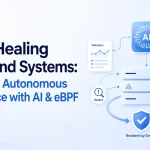
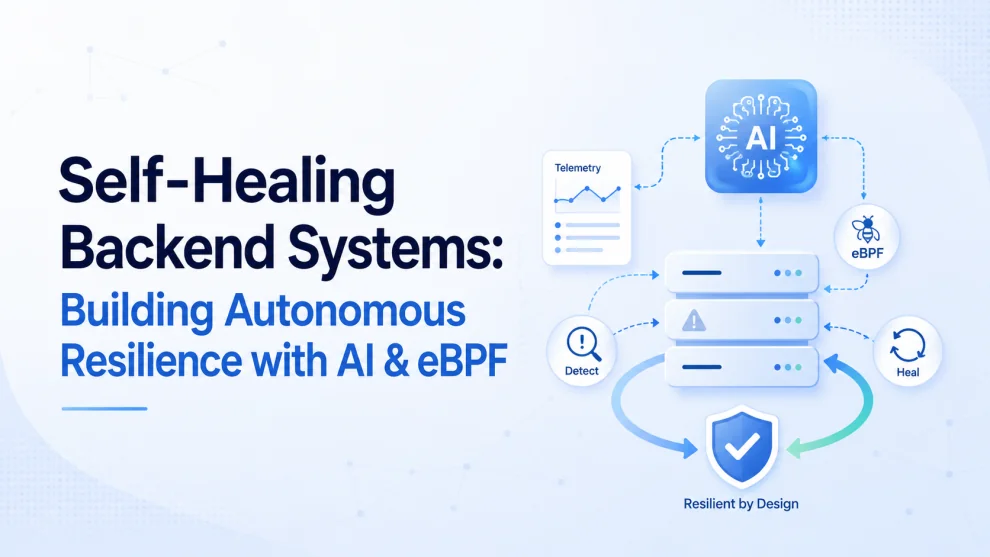
A simplified architecture can look like Application → eBPF Runtime Signals → Telemetry Layer → AI Analysis → Remediation Engine → Backend System.
The AI layer does not replace observability. It uses richer observability to make better decisions.
Combining AI With Runtime Signals
The real opportunity appears when AI can correlate high-level application behavior with low-level infrastructure signals.
Imagine an API begins experiencing increased latency. Application telemetry shows slow requests, while eBPF detects unusual network retransmissions and connection behavior. AI can correlate these signals, compare them with historical patterns, determine the most likely failure scenario, and recommend or execute a predefined remediation.
This creates a feedback loop: Detect → Correlate → Diagnose → Decide → Remediate → Verify.
The verification stage is particularly important. A self-healing system should not simply execute an action and assume the problem is resolved. It should measure the resulting system state and determine whether the remediation actually improved the situation.
What Self-Healing Can Actually Automate
Not every production problem should be handled autonomously. The safest approach is to start with bounded, reversible actions.
Examples include restarting unhealthy workloads, adjusting capacity within predefined limits, clearing specific resource conditions, rerouting traffic, triggering failover, restarting failed workers, or temporarily disabling a problematic dependency.
AI can help determine which predefined action is appropriate based on current signals and historical incidents. For higher-risk actions, the system can generate a recommendation and request human approval rather than executing automatically.
The Importance of Guardrails
Autonomous remediation introduces its own risks. An AI system that misunderstands an incident could make the situation worse by repeatedly restarting healthy services, changing configurations unnecessarily, or creating cascading failures.
Production self-healing therefore requires strict controls around what an AI system is allowed to do. Organizations should define approved actions, execution limits, rollback mechanisms, confidence thresholds, approval requirements, and audit trails. Every autonomous action should also be traceable to the signals and reasoning that triggered it.
The principle should be simple: AI can automate remediation, but engineering teams must define the boundaries of autonomy.
From Alerts to Causal Analysis
A major advantage of combining AI with eBPF is moving beyond alert-based operations.
An alert might say that latency has increased. A self-healing system should attempt to determine why. AI can correlate service dependencies, network behavior, resource consumption, deployment changes, error patterns, and historical incidents to construct a more complete view of the failure.
For example, a deployment may introduce a connection leak that eventually increases resource pressure. Application metrics may show the symptoms, while eBPF provides runtime evidence of the underlying connection behavior. AI can connect those signals and identify the deployment as a likely contributor.
This shifts operations from “something is failing” toward “this specific condition is likely causing the failure.”
Building the Architecture
A production-ready self-healing backend can be structured around several layers. The runtime layer contains applications, containers, services, databases, and infrastructure. The observability layer collects application telemetry, metrics, logs, traces, and eBPF signals. The AI analysis layer correlates events, identifies patterns, evaluates probable causes, and determines confidence. The policy layer defines which actions are permitted. The remediation layer executes approved actions and rollback procedures. Finally, the verification layer confirms whether system health has actually recovered.
This architecture separates intelligence from execution, which is important for controlling risk.
Start With High-Confidence Failure Scenarios
Organizations should not attempt to make every backend component autonomous from day one. A better strategy is to identify recurring incidents where remediation is predictable and reversible.
Good starting points include known workload failures, stuck background workers, predictable capacity conditions, connection exhaustion, recurring service restarts, and specific dependency failures.
Once these scenarios demonstrate reliable detection and remediation, organizations can gradually expand the system’s scope.
Measuring the Value of Self-Healing
Self-healing should be measured using operational outcomes rather than the number of automated actions.
Important metrics include mean time to detection, mean time to recovery, percentage of incidents automatically resolved, remediation success rate, rollback frequency, false-positive rate, escalation rate, and repeated incident frequency.
Engineering leaders should also track whether autonomous remediation reduces operational workload without increasing production risk.
The goal is not maximum automation. The goal is faster and safer recovery.
Where Engineering Partners Add Value
Building autonomous backend resilience requires more than adding an AI model to an existing monitoring stack. It requires application engineering, backend architecture, observability, runtime instrumentation, automation, security controls, and carefully designed operational workflows.
Organizations such as GeekyAnts work across AI engineering, backend development, modern application architecture, and intelligent automation. This combination can support teams looking to move from reactive monitoring toward systems that can detect operational conditions, reason over telemetry, execute controlled remediation, and continuously verify system health.
The Future of Autonomous Resilience
Self-healing backend systems represent a shift in how production reliability can be engineered. Traditional automation handles known conditions through predefined rules. AI can add contextual reasoning, while eBPF can provide deeper visibility into runtime behavior.
Together, they create the foundation for a new operational loop: observe what is happening, understand why it is happening, take a controlled action, and verify the result.
For organizations operating large and complex backend environments, that capability can reduce recovery time, improve system resilience, and allow engineering teams to spend less time responding to repetitive incidents and more time improving the architecture itself.
For more, visit our homepage!


Add Comment