





Artificial intelligence is reshaping how enterprises access, process, and use information. From internal knowledge assistants to customer support platforms and AI-powered search, organizations are investing heavily in large language models (LLMs) to improve productivity and decision-making. However, many early AI deployments have exposed a common limitation: language models are only as reliable as the information they can access.
An AI model trained on public data cannot accurately answer questions about an organization’s latest policies, proprietary documentation, customer contracts, or product updates. This gap often leads to hallucinations, outdated responses, and reduced trust in AI systems.
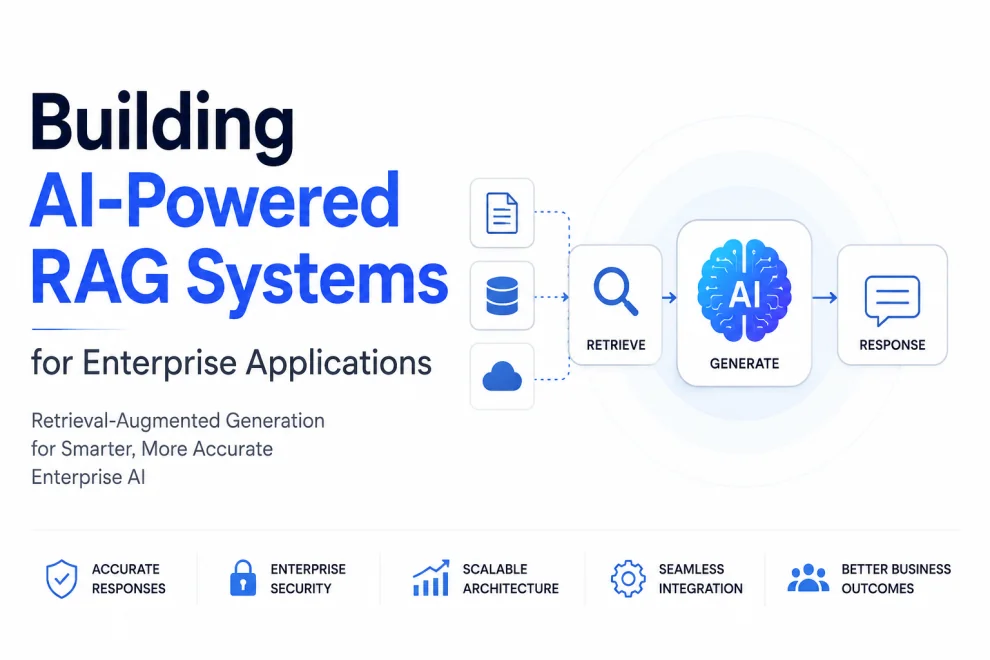
Retrieval-Augmented Generation (RAG) has emerged as the preferred architecture for solving this challenge. Instead of relying solely on an AI model’s training data, RAG retrieves relevant enterprise information in real time and provides it to the model before generating a response. This enables AI applications to produce more accurate, contextual, and trustworthy answers without requiring frequent model retraining.
For enterprise engineering leaders, implementing RAG is no longer simply an AI initiative. It has become a backend engineering challenge that requires scalable architecture, secure infrastructure, efficient data pipelines, and production-ready operations.
Why RAG Has Become Essential for Enterprise AI
Enterprises generate enormous volumes of information every day. Technical documentation, compliance policies, customer records, product specifications, support articles, and operational procedures are constantly evolving. Traditional language models cannot automatically learn these changes after deployment.
RAG bridges this gap by retrieving relevant information directly from enterprise knowledge sources during inference. This ensures AI responses are grounded in current business data rather than static training information.
The result is significantly higher response accuracy, fewer hallucinations, improved explainability, and greater confidence among employees and customers using AI-powered applications.
Building a Strong Backend Foundation
Many organizations assume selecting the right language model is the most important decision when building a RAG application. In reality, backend architecture has a far greater impact on long-term success.
Every enterprise RAG system depends on reliable data ingestion, efficient indexing, scalable APIs, secure authentication, and fast retrieval services. Documents from content management systems, databases, cloud storage, and internal applications must be processed continuously so that newly created information becomes searchable almost immediately.
Without a scalable backend, even the most advanced AI model struggles to deliver reliable enterprise performance.
Data Quality Determines AI Quality
A RAG system is only as effective as the information it retrieves.
Enterprise documents must be cleaned, structured, and divided into meaningful sections before they are converted into vector embeddings. Poor document chunking often causes incomplete or irrelevant retrieval, while inconsistent metadata makes enterprise search significantly less effective.
Organizations that invest in maintaining high-quality knowledge repositories consistently achieve better AI outcomes than those focused solely on model performance.
Choosing the Right Retrieval Strategy
Not every enterprise environment requires the same retrieval approach.
Semantic search works well when users ask natural language questions and need conceptually similar information. However, many enterprise applications benefit from hybrid retrieval that combines keyword search with vector search to improve precision.
Large organizations often enhance retrieval further by using metadata filtering, reranking models, and contextual ranking techniques to ensure users receive the most relevant information available.
Choosing the right retrieval strategy is one of the biggest factors influencing user satisfaction.
Scalability Becomes the Next Challenge
Many proof-of-concept RAG applications perform well with a limited number of users. Enterprise deployments introduce entirely different requirements.
Production systems may need to process millions of documents while supporting thousands of simultaneous AI requests across multiple business units and geographic regions.
Achieving this level of performance requires distributed backend services, scalable vector databases, intelligent caching, asynchronous indexing pipelines, load balancing, and resilient cloud infrastructure.
Organizations that treat RAG as a scalable platform instead of a standalone AI feature are far better prepared for enterprise adoption.
Security Must Extend Across the Entire AI Pipeline
Enterprise AI applications frequently interact with confidential information, making security one of the most critical aspects of RAG architecture.
Every stage of the pipeline should enforce authentication, authorization, encryption, and document-level access controls. A retrieval system should only return information that the requesting user is authorized to access.
Comprehensive audit logging, governance policies, and compliance monitoring are equally important, particularly for organizations operating in regulated industries such as healthcare, financial services, insurance, and government.
Building trust in enterprise AI begins with protecting enterprise data.
Observability Is Critical for Production AI
Unlike traditional backend applications, AI systems introduce entirely new operational challenges.
Monitoring infrastructure alone is no longer sufficient. Engineering teams must also understand how effectively information is being retrieved, whether responses remain accurate, how quickly users receive results, and how often hallucinations occur.
Comprehensive observability enables engineering teams to identify retrieval issues, optimize performance, reduce costs, and continuously improve user experience.
As AI applications become business-critical, observability is rapidly becoming as important as availability.
The Future of Enterprise RAG
Enterprise RAG systems are evolving beyond intelligent search.
Modern architectures increasingly combine RAG with AI agents, Model Context Protocol (MCP), workflow automation, and real-time enterprise data sources. Instead of simply answering questions, these systems can retrieve information, make decisions within defined guardrails, trigger business workflows, and interact with enterprise software platforms.
This shift is transforming RAG from a retrieval solution into the foundation of enterprise AI platforms.
Organizations investing in scalable backend architecture today will be well positioned to support increasingly autonomous AI applications in the future.
Final Thoughts
Building an AI-powered RAG system requires much more than integrating a language model with a vector database. Success depends on backend engineering, cloud infrastructure, security, scalability, governance, and operational excellence.
As enterprises transition from AI experimentation to production deployments, many partner with experienced engineering organizations to accelerate implementation while reducing architectural complexity. Teams such as GeekyAnts help enterprises design AI-ready backend platforms, implement scalable RAG architectures, modernize cloud infrastructure, and build production-grade AI applications capable of supporting long-term business growth.
The future of enterprise AI will not be determined solely by increasingly powerful language models. It will be shaped by the strength of the backend systems that deliver secure, scalable, and reliable AI experiences.
Frequently Asked Questions
What is an AI-powered RAG system?
An AI-powered RAG (Retrieval-Augmented Generation) system combines a large language model with enterprise knowledge retrieval, allowing the AI to generate responses using current business data instead of relying only on pre-trained knowledge.
Why are RAG systems important for enterprises?
RAG systems improve response accuracy, reduce hallucinations, provide access to up-to-date enterprise information, and enable organizations to build trustworthy AI applications without constantly retraining language models.
What technologies are commonly used in enterprise RAG systems?
Enterprise RAG platforms typically use vector databases such as Pinecone, Weaviate, Milvus, Qdrant, or pgvector alongside embedding models, APIs, cloud infrastructure, and large language models.
How do RAG systems reduce AI hallucinations?
By retrieving relevant enterprise documents before generating a response, RAG grounds AI outputs in factual information, significantly reducing inaccurate or fabricated answers.
Can AI-powered RAG systems scale for enterprise workloads?
Yes. With cloud-native backend architecture, distributed indexing, scalable vector databases, caching, and efficient retrieval pipelines, RAG systems can support millions of documents and thousands of concurrent users.
How can organizations secure enterprise RAG applications?
Organizations should implement role-based access control, encryption, document-level permissions, secure authentication, audit logging, and governance policies to ensure only authorized users can access sensitive information.
For more, visit our homepage!

Add Comment